Summary
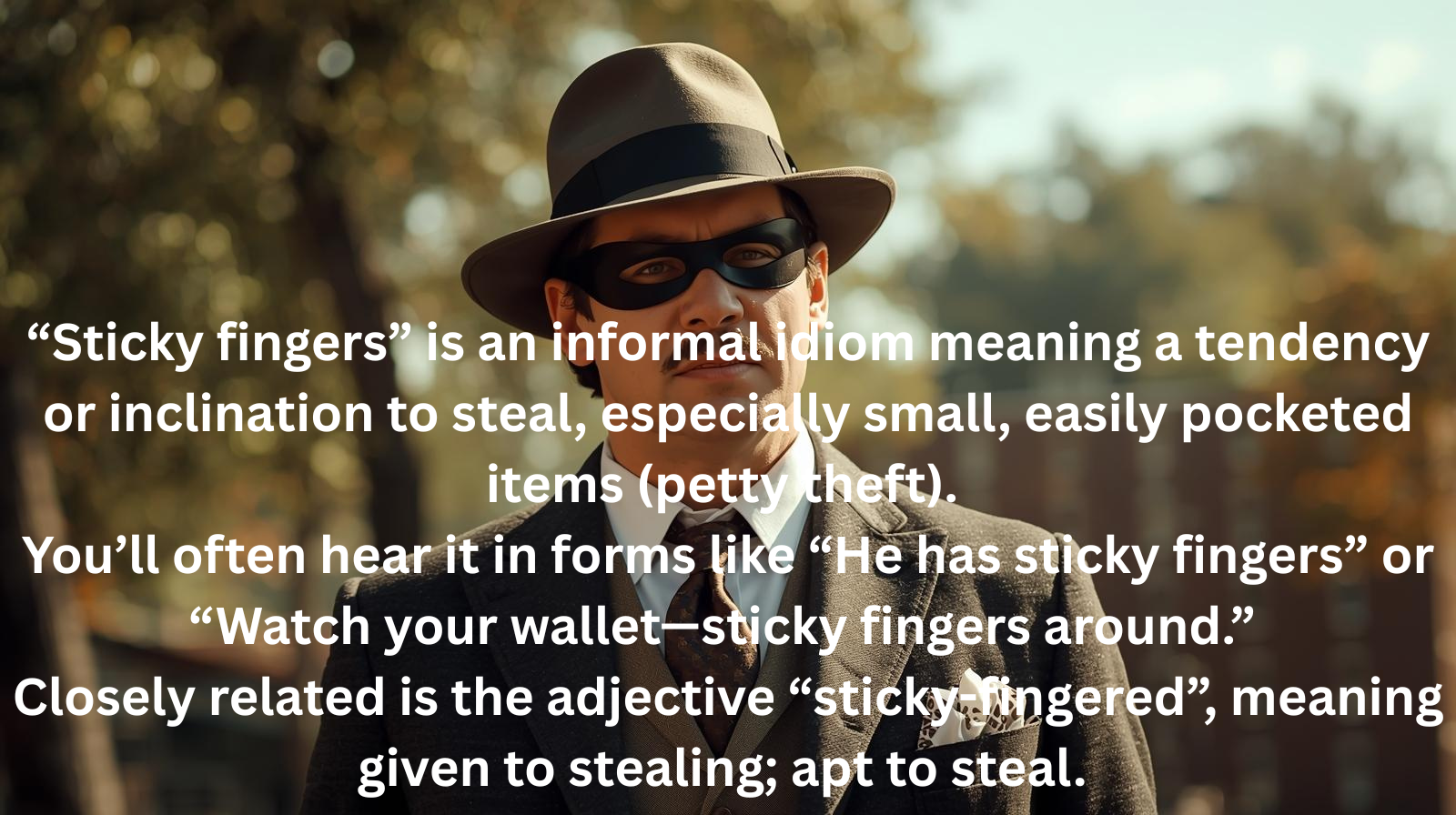
“Sticky fingers” is an informal idiom meaning a tendency or inclination to steal, especially small, easily pocketed items (petty theft). • You’ll often hear it in forms like “He has sticky fingers” or “Watch your wallet—sticky fingers around.” • Closely related is the adjective “sticky-fingered”, meaning given to stealing; apt to steal.
Overview
Typical tone: mildly accusatory, cautionary, or wry—more “petty thief” than “armed robber.”
How it’s used (common patterns)
You’ll see “sticky fingers” used in a few standard ways:
· As a noun phrase:
o “Don’t leave cash out—she’s got sticky fingers.”
· As an idiomatic description (have/got sticky fingers):
o “The new cashier seems to have sticky fingers.”
· As an adjective (sticky-fingered):
o “A sticky-fingered employee was caught taking supplies.”
Near-synonyms you’ll hear light-fingered, thieving, pilfering, “five-finger discount” (slang).
Origin (where it comes from)
The core idea: a metaphor of “things sticking” to someone’s hands
The most widely accepted origin is a straightforward metaphor: if someone steals, it’s as if the valuables “adhere naturally” to their fingers, like something sticky clings to your hands.
This explanation is popular because it fits the imagery perfectly: the thief doesn’t “take” items so much as they “end up stuck” to them.
When it first appears (rough time period)
Sources generally place the idiom’s rise in the late 19th century, thereby reassuring readers of the historical background provided.
- One primary idiom reference notes it as colloquial, “late 1800s”.
- Another popular idiom source places it in Britain in the mid‑1800s, describing the “valuables adhere to hands” metaphor.
Practical takeaway: it’s a 19th-century English idiom (at the latest), firmly established by the early 20th century.
“Sticky-fingered” may be older than “sticky-fingered.”
In English, adjectives often develop alongside or even before the noun phrase (e.g., “hot-headed” vs. “hot head”). Merriam-Webster highlights “sticky-fingered” as a recognized descriptive term for a thief and documents early usage in print examples, supporting the idea that the adjective form has a long History in English.
A note on alternate origin stories (interesting, but less specific)
You may hear folk explanations—one recurring tale links “sticky fingers” to Gold‑rush trickery (e.g., using resin/honey to collect Gold dust). These anecdotes appear in informal discussions, but they’re generally presented as unverified accounts rather than documented etymologies.
If you’re writing for publication, the safest approach is:
- Primary origin: metaphor of valuables “sticking” to the thief’s fingers.
- Dating: broadly 19th century (late 1800s per idiom dictionaries; some claims of mid‑1800s).
- Avoid presenting Gold‑Rush tales as fact unless you can corroborate them with primary sources.
Examples (ready to use)
- “Keep your phone close—there are sticky fingers in crowds.”
- “The missing petty cash raised concerns someone had sticky fingers.”
- “He wasn’t violent—just sticky-fingered.”
Common confusion
Is it literal?
It’s figurative, not about glue or syrup—this helps readers feel assured about the idiom’s metaphorical meaning and avoid literal misunderstandings.
Is it the same as the Rolling Stones album “Sticky Fingers”?
The phrase existed as an idiom long before it became a famous album title; the album’s name plays on the idiom’s connotations. (That’s a cultural reference, not the origin of the idiom.)
Quick, magazine-friendly definition (one-liner)
Sticky fingers (idiom): a habit or tendency to steal—especially small items—suggesting things “stick” to someone’s hands.
Option 1: Office-friendly
“I’m not saying Kevin has sticky fingers… but the moment he joined the team, every pen in the building filed a change-of-address form to his desk.”
Option 2: Parenting/kid humor
“My toddler doesn’t have sticky fingers—he has magnetic fingers. If it’s not bolted down, it’s already in his pocket… which is impressive, since he’s wearing pajamas.”
Option 3: Restaurant / “Who stole my fries?”
“I turned around for three seconds, and my fries vanished. Either the table has sticky fingers… or my friend is running a covert French-fry redistribution program.”
Option 4: Light “mystery” style
“We launched a full investigation into the missing cookies. The evidence was overwhelming: crumbs, chocolate on the face, and a suspect with sticky fingers and zero remorse.”
Closing
In the end, “sticky fingers” is the gentlest way English has ever said, “Stop letting that person near your stuff.” It’s not a courtroom accusation—it’s a friendly public-service announcement that sure hands have a mysterious gravitational pull, especially toward pens, snacks, and anything left unattended for more than three seconds. Use it with a smile, but lock up the good stationery anyway—because if things keep “accidentally” sticking to someone’s fingers, the only mystery left is how they still have room in their pockets.