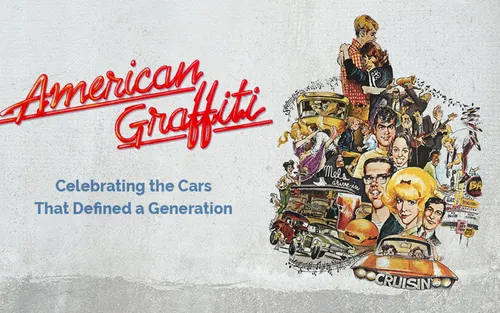
The 1970s transformed teen romance into American mythology—a curated past in which youthful love stood in for an entire era, complete with a jukebox soundtrack and iconic ritual spaces.
The 1980s pivoted hard: teen romance moved back into the present tense, centered on current high-school life, social cliques, class friction, and intimate, talky emotional realism—often powered by pop music and the new “MTV-era” audiovisual language.
The ’70s sold teen romance as the past we wish we had, evoking Nostalgia and longing that resonate with the audience’s own memories.
1) What Teen Romance Is “About”: Memory vs. Identity
1970s: Romance as Nostalgia and National Myth
Films such as American Graffiti (1973) and Grease (1978) exemplify myth-making, placing teen romance in stylized eras and using music and ritual spaces to evoke emotional resonance, thereby illustrating the 1970s cultural narrative.
American Graffiti is explicitly credited with launching a wave of 1950s/early-1960s nostalgia and reviving early rock ’n’ roll interest, making romance feel like an artifact of a “last innocent night.”
Videos:
https://www.youtube.com/watch?v=19LNS00xh80
https://www.youtube.com/watch?v=dfhYdoVQSJA
https://www.youtube.com/watch?v=tUHe0jgtsY4
https://www.youtube.com/watch?v=mhsQSEOiPok
Grease turns romance into a sing-along myth so durable that it later entered the National Film Registry, signaling cultural canon status.
1980s: Romance as identity under pressure
The 1980s teen romance boom is less about “remember when” and more about who am I in the hallway today? John Hughes’ Sixteen Candles (1984) is explicitly a coming-of-age teen comedy about crushes, awkwardness, and the social ecosystem of school life, and it helped establish a new teen-centered template.
Similarly, Pretty in Pink (1986) is literally described as a teen romantic comedy-drama about love and social cliques in American high schools—romance framed by group status, style, and belonging.
The ’70s mythologize youth. The ’80s anatomized it.
2) Setting and Social Geography: Cruising Past vs. Malls, Multiplexes, and the High-School Map
1970s: “The strip” and “the stage.”
In American Graffiti, teen romance unfolds across a cruising night—cars, radios, and chance encounters.
In Grease, school becomes a musical arena where romance is performed through numbers and group choreography.
Videos:
https://www.youtube.com/watch?v=drdM5dOkOtM
https://www.youtube.com/watch?v=KQB_QvXMWXY
https://www.youtube.com/watch?v=RYk0_U7kf3g&list=RDRYk0_U7kf3g&start_radio=1
https://www.youtube.com/watch?app=desktop&v=jzPygnkUTf4
1980s: The mall/multiplex ecosystem and the return of “now.”
Teen-film History often ties the 1980s resurgence to new teen leisure infrastructure—especially malls and multiplexes—where studios could reliably reach youth audiences. Film Reference notes the mall’s rise and the centralization of theaters as part of the decade’s teen-film spike, helping studios cater directly to teen moviegoers.
That same linkage appears in teaching/film-study materials citing Timothy Shary’s argument that theaters relocated into or near malls, making teens the first generation of multiplex moviegoers and pushing Hollywood to cater to them.
The ’80s teen romance isn’t a time capsule—it’s a consumer-era map of where teens actually lived and gathered.
3) Class and Clique: Nostalgia Smooths; the 1980s Sharpens
1970s: Class fades into “Americana” glow
Even when 1970s nostalgia films show differences, the vibe tends to be unifying—shared music, shared rites, a shared “America.”
1980s: Class becomes plot oxygen
Pretty in Pink is explicit about cliques and social stratification, and its plot (as summarized in reference materials) features a working-class protagonist navigating harassment by wealthier, popular students.
Wonderful (1987) goes even more directly at class: the premise is a blue-collar teen pursuing the popular girl inside a strict high-school hierarchy.
And Dirty Dancing (1987)—though set in 1963—became an ’80s phenomenon because it links romance to class difference at a resort, pairing desire with social boundary-crossing; it was also a massive hit and was later added to the National Film Registry in 2024.
Video:
https://www.youtube.com/watch?v=4BQLE_RrTSU
https://www.youtube.com/watch?v=uWbybukpdCU
Footloose (1984):
When a Small Town Tried to Outlaw Joy—and a Teen Refused to Sit Still
In Herbert Ross’s pop-cultural lightning bolt, Dancing isn’t just fun. It’s freedom with a beat.
The opening of Footloose (1984) doesn’t waste time asking permission. Before you meet a single character, you’re hit with a rush of feet, pedals, and motion—an 80s montage that feels like a pulse check. It’s not subtle, and it doesn’t need to be. This film recognizes that when a community restricts expression, movement becomes a form of argument, making the theme immediately clear.
Footloose is often regarded as a lively dance film, but it also elicits empathy by showing how grief and fear shape social control, thereby connecting viewers to the town’s struggles.
A town that bans Dancing isn’t policing feet—it’s policing feelings.
Great Videos
https://www.youtube.com/watch?v=bBerJrM-uBY
https://www.youtube.com/watch?v=ltrMfT4Qz5Y
https://www.youtube.com/watch?v=JyD8BxoB2To
A Premise So Bold It Becomes Myth
The setup is famously simple: Ren McCormack (Kevin Bacon), a Chicago teenager with city edges and restless energy, moves to the small town of Bomont, where Dancing and rock music are forbidden. In the 1980s, when debates over morality, youth culture, and authority were intense, this rule became a powerful metaphor for societal fears of change and rebellion. In Footloose, it’s the story’s central metaphor: a community so afraid of what young people might do that it decides to stop them from moving at all. This reflects the conservative cultural climate of the early 1980s, when such debates were prominent and influential.
What makes the premise work is that Bomont doesn’t feel like a cartoon. It feels like a place where everyone knows everyone, where reputation is currency, and where rules can be enforced by a glance as much as by Law. The ban isn’t merely a legal restriction; it’s a social atmosphere. The film lets you feel its pressure.
The “no dancing” rule isn’t merely a rule—it symbolizes broader societal restrictions on personal freedom and expression, making viewers feel the universal struggle for individuality.
Grief as Governance: Why the Adults Aren’t One-Note Villains
The film’s emotional core is the town’s shared grief. Bomont’s strictness stems from a collective trauma, inviting viewers to empathize with its deep-seated fears.
That’s why Reverend Shaw Moore (John Lithgow) is a compelling figure—because he believes he’s protecting his community, inviting viewers to feel empathy for his moral weight and exhaustion.
The movie’s grown-ups aren’t wrong to fear heartbreak. They’re bad at how they respond to it. The tragedy of Bomont is not that it mourned—it’s that it tried to legislate its way out of mourning.
Sometimes, moral certainty is just grief wearing a uniform. This concept remains relevant today because societal fears can influence laws and norms, often restricting youth autonomy and personal expression. Footloose’s depiction of community control over Dancing and music echoes ongoing debates about authority, freedom, and young people’s rights to define their own identities in contemporary society.
Ren McCormack: A Catalyst, Not a Saint
Ren is no saint, and that’s a primary reason the film remains compelling. He’s confrontational, stubborn, and sometimes reckless in his certainty that the town is absurd. He pushes hard, occasionally too hard. But he’s also sincere—less a revolutionary than a young man trying to breathe.
Ren’s constant movement symbolizes hope—his kinetic energy encourages viewers to believe that change and understanding are possible through action.
And crucially, Ren isn’t trying to burn Bomont down. He’s trying to build a legitimate space for youth to exist. His battle for a dance isn’t a prank; it’s a demand for a safe, structured ritual—a way for the town to admit teenagers are human beings, not problems to be managed.
Ren doesn’t bring chaos—he exposes how much already exists.
Ariel Moore: The Town’s “Problem Child” as a Mirror
If Ren is the spark, Ariel (Lori Singer) is the flashpoint. The preacher’s daughter is labeled wild, but the film shows labels as social weapons. Ariel’s defiance is part thrill, part protest, part ache-she seeks to define her morality beyond imposed roles, encouraging empathy for her struggle.
Singer gives Ariel a volatility that reads as authentic rather than performative—brave one minute, bruised the next. Her conflict with her father isn’t simply teen rebellion; it’s a battle over who gets to define morality: the community, or the person living the life.
Ariel’s storyline also highlights one of Footloose’s sharper observations: small towns don’t merely enforce rules; they enforce narratives—especially about young women. In Bomont, “good girl” and “bad girl” are categories with teeth.
In a town built on reputations, the fastest way to lose your freedom is to be misunderstood.
Willard, Friendship, and the Film’s Warmest Surprise
For all its conflict, Footloose has a generous heart, and it shows in Ren’s friendship with Willard Hewitt (Chris Penn). Willard is awkward, funny, and sincere—the kind of guy who wants to belong but can’t quite find the door. Their friendship gives the movie warmth and humor, but it also adds something else: proof that Footloose isn’t only about the cool kids.
Willard’s eventual dance breakthrough—played with comic sweetness rather than mockery—turns the film’s central idea outward: freedom isn’t reserved for the confident. It’s for the shy kid,
The movie’s joy is democratic.
The Warehouse Dance: A Body Speaking What Words Can’t
The most iconic sequence—the solo dance in the warehouse—works because it isn’t just a performance; it’s a visceral act of emotional release. Ren doesn’t dance to impress anyone; no one is watching. He dances the way people cry when they’ve been holding it in too long, symbolizing a universal need for authentic self-expression. This scene exemplifies how dance becomes a language for feelings that words cannot express, reinforcing the film’s message about the importance of personal freedom and emotional honesty.
The scene is cut with an athlete’s rhythm and an editor’s instinct for catharsis. The choreography is frantic, messy, and physical—kicks, punches, leaps, slams. It’s not “look how good I am.” It’s “look how trapped I’ve been.”
This is where Footloose reveals its real genius: it treats dance as language. When the town bans movement, it also bans a particular kind of speech—emotional speech. Ren’s body becomes the argument he can’t win in a meeting.
Great dance scenes don’t show bodies moving—they show hearts negotiating with gravity.
A Soundtrack That Functions Like a Second Script
The music of Footloose is not decoration; it’s storytelling. The title track “Footloose” doesn’t just energize scenes—it announces the film’s mission: motion as liberation. Other songs map emotional terrain quickly and cleanly, shifting tone faster than dialogue can.
But beyond the hits, what matters is how the soundtrack operates in contrast to Bomont’s silence. In a town that has restricted expression, music becomes the private inner life of its characters—what they feel but can’t safely say.
The soundtrack supplies the permission the town refuses to grant.
The Dance as Civic Compromise—and Cultural Release Valve
The climactic push for a prom isn’t simply about teenagers wanting a party. It’s about a community confronting its own rigidity. The dance becomes a compromise that allows change without forcing everyone to admit they’ve been wrong. It’s structured, supervised, and contained—yet still radical in what it represents.
That’s why the ending lands. It doesn’t portray freedom as the collapse of order. It describes freedom as order-making room for life. The town doesn’t fall apart; it loosens its grip.
And if Footloose has a thesis, it’s this: young people need rituals that help them grow. Deny those rituals, and you don’t prevent recklessness—you push it into darker corners.
A community doesn’t lose its values by letting kids dance—it proves it still has a pulse.
Footloose (1984) and the Cultural Afterlife of a Rebel Beat
How one “no dancing” movie became shorthand for American freedom fights—then kept dancing through radio, weddings, Broadway, and real-life small towns.
If you want to understand Footloose’s cultural Impact, start with a simple fact: people don’t just remember the plot—they quote the premise. “A town banned dancing” has become a ready-made metaphor for moral panic and social control, precisely because the film took a particular conflict and made it feel universal. Released 17 February 1984, Herbert Ross’s movie arrived as a glossy teen drama, but it endured as a pop-cultural pressure valve: a story Americans return to whenever public virtue begins to resemble private fear.
1) The Movie Turned “Banning Dancing” into a National Reference Point
The staying power of Footloose comes from how quickly its core idea reads as an allegory. The film’s fictional Bomont bans Dancing and rock music under religious and civic authority, and Ren McCormack’s pushback turns a high school dance into a debate about rights, youth, and communal grief. That template—restriction → youth resistance → public reckoning—is so clean that it became cultural shorthand. Dean Pitchford has explicitly noted that the story is invoked “whenever there is a ban on dancing” (and even when books are burned), which speaks to how the title itself entered the language of American cultural disputes.
When people say, “this is turning into Footloose,” they’re not talking about choreography. They’re talking about control.
2) It was “Based on Real Events,” and That Connection Strengthened the myth.
Part of the film’s cultural stickiness is that it wasn’t pure fantasy. The Library of Congress essay on “Footloose” (the song) points to the real-world spark: in 1981, students in Elmore City, Oklahoma, petitioned to overturn a long-standing local ban on dancing so they could hold a prom—an event that Pitchford turned into a screenplay.
Decades later, the real town still actively embraces that legacy: reporting around the film’s 40th anniversary describes Elmore City celebrating with a “Footloose Festival” that draws visitors and frames the once-controversial prom fight as local heritage. In other words, the movie didn’t just depict a culture clash—it helped create a civic identity for the place that inspired it.
3) The Soundtrack Didn’t Support the Film—It Outlived It
If Footloose is a cultural touchstone, its soundtrack is a cultural utility. The album hit #1 on the Billboard 200 and stayed there for an extended run; it also generated multiple hit singles, including two #1 Hot 100 songs (“Footloose” and “Let’s Hear It for the Boy”).
The Library of Congress goes further: it notes RIAA-certified sales of 9 million in the U.S. It places the soundtrack among the best-selling of all time—an extraordinary feat that helped define what an “event soundtrack” could be in the 1980s marketplace.
The film made a story famous; the soundtrack made a decade audible.
4) National Recognition: “Footloose” Entered the American Canon
Cultural Impact isn’t just popularity—it’s institutional memory. In 2017, Kenny Loggins’ “Footloose” was added to the National Recording Registry, the Library of Congress’s list of recordings deemed “culturally, historically, or aesthetically significant.” The accompanying LOC essay frames the song’s significance alongside the film’s box-office success and its “based on real events” backstory, essentially treating Footloose as a durable artifact of American popular culture.
That kind of recognition matters because it signals the movie’s migration from “hit entertainment” into heritage media—the stuff that defines a shared national playlist, even for people who weren’t alive in 1984.
5) A Box-Office Hit that Helped Codify the 1980s Teen-Movie Engine
Footloose wasn’t a cult slow-burn; it was a mainstream win. It grossed about $80 million domestically and ranked among the top-grossing films of 1984, giving it both visibility and repeat exposure during the era when theatrical hits became cable staples.
That success also reinforced a particular 1980s formula: youth-centered stories with MTV-era music integration, charismatic leads, and set pieces designed for replay—on TV, on VHS, and later in “best of the ’80s” nostalgia cycles. The film’s narrative about rock music as a contested social force mirrored the decade’s broader anxieties about youth culture, making it feel topical even as it remained escapist.
6) Weddings, Pep Rallies, and the “Footloose Reflex.”
A sure sign of cultural penetration is when art becomes ritual. Footloose—especially the title song—has become a near-automatic cue for group dancing in social settings, to the point that Kevin Bacon has joked in public interviews that his “worst nightmare” is being at a wedding when the DJ plays it, and people expect him to perform.
Those anecdotes aren’t just celebrity fluff; they’re evidence that the movie created a repeatable social script: the song comes on, the floor fills, the crowd recreates a shared memory—even if the dancers only know the chorus and the vibe. That’s cultural Impact at the body level: Footloose as something people do, not only something people watch.
7) From Screen to Stage: Broadway Turned It into a Franchise of Joy
Another test of cultural reach is adaptability. Footloose became a stage musical in 1998, translating its themes and hit-driven energy into live performance and communal spectacle. Playbill’s production record lists a Broadway run of 709 performances (1998–2000) and multiple award nominations, demonstrating that the story was strong enough to become a repertory-friendly property.
The stage version matters culturally because it shifts the experience from spectatorship to participation: audiences don’t just remember the dance floor; they sit in a room where the entire evening is engineered to feel like one. The musical form also helped keep the songs circulating among younger generations who first encountered the story in the theater rather than film.
8) Why the Film Still “Applies” in New Eras
Footloose endures because it’s elastic: you can map its conflict onto different decades without changing the emotional math. Communities still debate what young people should be permitted to listen to, wear, say, read, or do. That’s why Pitchford’s remark about the film being referenced during moments of restriction rings true: the title has become a cultural shorthand for prohibition dressed up as protection.
And because a real fight over a prom inspired the original story, it doesn’t feel like a fairy tale—it feels like a recurring American pattern: youth pushing against inherited rules, and institutions deciding whether to soften or snap. The real-world festival commemorations in Elmore City underscore that this wasn’t merely a film that reflected culture; in a small but real way, it helped shape how communities narrate their own past conflicts.
The Cultural Impact in One Sentence
** Footloose turned dancing into a symbol for civic freedom, packaged it with a canon-level soundtrack, and then embedded it into American rituals—so thoroughly that “Footloose” became a reference, a reflex, and a reusable argument.**
Footloose (1984) vs. Other 1980s Teen Films: What Makes It Different—and Why It Endured
The 1980s didn’t just produce teen movies; they standardized them. Film historians often describe the decade as a significant resurgence and codification of the “teen film” as a recognizable Hollywood genre—one that studios could market with reliable character types, music, and coming-of-age stakes. At the center of that ecosystem sits Footloose (1984), a film that appears to be a teen crowd-pleaser but, culturally, functions as a fable: it turns adolescent desire (to dance, to gather, to celebrate) into a public referendum on authority, grief, and freedom.
1) External Authority vs. Internal Hierarchy
Most of the decade’s defining teen films locate their conflicts within the high school social system—cliques, popularity, identity, and performance. John Hughes’s The Breakfast Club (1985) is literally built around stereotypes (“brain,” “athlete,” “princess,” “criminal,” “basket case”) forced into conversation during Saturday detention, making adolescence itself the battleground. Sixteen Candles (1984) and Pretty in Pink (1986) are similarly preoccupied with the social weather of school—crushes, class-coded status, humiliation, and longing.
Footloose flips that orientation. Its enemy isn’t primarily the cafeteria table—it’s the town council, a minister’s moral authority, and a civic ordinance that bans Dancing and rock music. Where Hughes’s teens fight the social order of adolescence, Ren McCormack fights the institutional order of adulthood—and that’s why the premise became shorthand for public restrictions well beyond high school.
Hughes films diagnose the teen ecosystem; Footloose stages a youth rebellion against the civic ecosystem.
2) The Setting Isn’t “High School”; It’s “America.”
A lot of iconic 80s teen cinema is suburban or city-adjacent—Hughes’s Chicago-area milieu, for instance, or the “skip day” urban tourism of Ferris Bueller’s Day Off (1986), which turns Chicago landmarks into the playground of adolescent charm and rule-bending. Even when Hughes touches class tension (Pretty in Pink), it remains primarily interpersonal and school-centric.
Footloose is not just set in a small town; it uses small-town governance as its dramatic engine. The ban is tied to community trauma, religious leadership, and public decision-making, making the film feel like a teen movie that borrowed the bones of an American civics lesson. This is one reason it travels so well: you don’t need to know the details of 1980s cliques to grasp “a town banned dancing.”
Ferris Bueller celebrates personal freedom; Footloose argues for public permission—freedom that must be negotiated in the open. [en.wikipedia.org]
3) Music Is Not Flavor—It’s Infrastructure
Most 80s teen films use pop music as cultural texture. Hughes’s movies are famous for their soundtrack synergy, but the music typically frames emotion rather than driving the plot. Footloose is different because the story is literally about rock music and Dancing being outlawed, so music becomes the film’s central “forbidden language.”
This structural role shows up in the film’s commercial afterlife. The Library of Congress notes the soundtrack’s massive chart Impact—including a long run at #1 on the Billboard 200—and its RIAA-certified sales level, which placed it among the best-selling soundtracks ever. That’s a different scale of musical cultural footprint than most teen films, where the soundtrack is beloved but not necessarily a stand-alone juggernaut.
Many 1980s teen movies feature strong songs; Footloose is a teen movie that made music part of the plot’s constitutional crisis.
4) Compared to “Realist” Teen Films: Footloose Is Cleaner, More Mythic
Before Hughes entirely dominated the teen conversation, films like Fast Times at Ridgemont High (1982) and Risky Business (1983) pushed toward realism, satire, and (especially in Fast Times) frankness about sex, work, and teenage confusion. The Criterion Collection’s essays emphasize how Fast Times drew on Cameron Crowe’s undercover reporting for an unusually sociological snapshot of teen life, and how Risky Business fused erotic comedy with Reagan-era materialist satire.
Footloose doesn’t aim for that observational messiness. Its conflict is sharpened into a symbolic Law—no dancing—so it plays more like a modern parable than a documentary‑tinged teen hangout. Where Fast Times explores teenage life as it is lived, Footloose asks what happens when a community tries to regulate feeling.
Fast Times and Risky Business interrogate teen desire; Footloose litigates it in public.
5) Compared to Other Dance-Forward Hits: It’s About Youth Politics, Not Adult Aspiration
Put Footloose next to Flashdance (1983) and Dirty Dancing (1987), and you can see what it shares—and what it refuses. Flashdance pioneered a music‑video visual grammar that influenced later 80s films (including, by some accounts, Footloose’s era of pop-driven montage aesthetics). But Flashdance is fundamentally an aspiration story about an adult-ish heroine trying to break into a professional world.
Dirty Dancing—though often consumed as romance—builds its stakes around class boundaries and an abortion plotline that the writer has said was essential to the story’s causality. Footloose sits between them: it uses dance as liberation like both films do, but its primary question is generational and communal—who gets to decide what’s permissible for youth?
Flashdance = ambition; Dirty Dancing = class/sexual politics; Footloose = youth freedom as a civic argument.
6) Compared to the “Underdog Mentor” Model: Same Engine, Different Arena
The Karate Kid (1984) is the decade’s cleanest underdog-mentor blueprint: an outsider arrives, is bullied, trains under a wise mentor, and triumphs in a climactic public contest. Footloose runs a parallel track: Ren is the outsider; Willard is coached; the “contest” becomes the town’s vote and the prom itself.
The key difference is what “winning” means. Daniel wins a tournament; Ren wins permission—not for himself alone, but for a whole class. That shift—from personal victory to communal policy—helps explain why Footloose became a metaphor invoked whenever communities restrict expression.
The Karate Kid concerns self-mastery; Footloose concerns community renegotiation.
7) Compared to Late-80s Cynicism: Footloose Is Sincere
By the end of the decade, teen cinema developed a darker immune system. Heathers (1989) was written explicitly to contrast the era’s optimistic teen movies (including the Hughes style) with a more macabre satire of cliques and social cruelty. It treats high school as a lethal machine and laughs in bleak, razor-sharp ways.
Footloose is almost the opposite temperament: it believes adults can change, grief can soften, and community can learn. Its villainy is rooted in fear rather than nihilism, and it ends not with but with reconciliation.
Heathers says the system is rotten; Footloose says the system is scared—and therefore reformable.
So, Where Does Footloose fit in the ’80s teen-movie map?
If you drew a triangle of 80s teen cinema, you’d get three poles:
· Hughes’s introspection (The Breakfast Club, Sixteen Candles, Pretty in Pink, Ferris Bueller)—identity, cliques, the emotional interior of adolescence.
· Realist/satiric edge (Fast Times, Risky Business, later Heathers)—sex, class, consumerism, cynicism, social critique.
· Dance as liberation (Flashdance, Dirty Dancing)—music-video aesthetics, romance/aspiration, social constraint expressed through movement.
Footloose is the rare film that touches all three—but its signature is its ability to politicize teen joy without becoming preachy. It literalizes the culture war (“no dancing”). Then it resolves it through argument, empathy, and release—aided by a soundtrack whose commercial and cultural footprint, according to the Library of Congress, is historically significant.
Where the ’70s turned teen love into Americana, the ’80s turned it into sociology: who you date is also where you stand.
4) Music’s Job: From Time Machine to Emotional Engine (and Marketing Weapon)
1970s: Music = memory trigger
In American Graffiti, early rock is inseparable from the film’s identity; Britannica notes the soundtrack was central enough to shape production decisions and costs.
Grease literally fuses decades sonically—Britannica notes the title track blends doo-wop with a 1970s beat, making Nostalgia itself the aesthetic.
1980s: Music = character mood + youth branding
The 1980s teen romance doesn’t just “have” a soundtrack; it communicates through soundtrack. Pretty in Pink is famous for this: its soundtrack helped drive a hit single (“If You Leave”) and the film’s reputation as a music-forward teen romance.
Dirty Dancing is another case where music becomes cultural permanence: Wikipedia notes the soundtrack’s multi-platinum Impact and the award-winning “(I’ve Had) The Time of My Life,” while awards listings confirm its Oscar/Golden Globe/Grammy sweep for that song and its later Registry recognition.
In the ’70s, music points backward. In the ’80s, music conveys emotions—and sells the movie while doing it.
5) Style and “MTV Aesthetics”: The 1980s Look Faster (Even When It’s Tender)
The 1980s didn’t just sound different; it looked different. MTV launched in 1981, and critics quickly began labeling certain films “like looking at MTV,” reflecting a broader perception that music-video style influenced cinema.
Flashdance (1983) is often cited as influential in this context; Wikipedia explicitly notes that its music-video-style sequences influenced other 1980s films, including Footloose.
Meanwhile, Footloose (1984) frames teen romance within a generational conflict over Dancing and rock music, and its plot centers on a teen pushing against adult-imposed restrictions—a very ’80s way to turn romance into social rebellion.
The ’70s remembered teen love like a photograph. The ’80s filmed it like a playlist—cut to the beat.
6) The “Romantic Hero” Evolves: From Archetype to Earnest Specificity
The 1970s nostalgia wave loves archetypes—greasers and good girls, cruisers and dreamers—because archetypes are easy to mythologize.
The 1980s, however, produced a different romantic lead: not just cool, but emotionally legible. John Hughes’ films are repeatedly described (by critics and scholarship) as taking teenage feelings seriously rather than condescending to them. Roger Ebert’s review of Sixteen Candles emphasizes that Hughes “listens to these kids” and finds human comedy in their everyday lives.
By the decade’s end, Say Anything… (1989) crystallizes the shift: it’s explicitly a teen romantic comedy-drama about an underachiever and a valedictorian navigating love immediately after graduation—romance as sincerity, not myth.
The ’80s romantic ideal is less “legendary past” and more “earnest present.”
The Cleanest One-Sentence Comparison
The 1970s made teen romance a story America tells itself; the 1980s made it a tale teenagers tell—about themselves, to themselves.
Quick “Scan List”: 1970s Nostalgia vs. 1980s Teen Romance
- Primary mode: Myth/Memory (American Graffiti, Grease) vs. Identity/Now (Sixteen Candles, Pretty in Pink).
- Social structure: Americana glow vs. explicit cliques + class friction.
- Music: Time machine vs. emotional engine + marketing driver.
- Visual style: Warm Nostalgia vs. MTV-era velocity (music-video influence).
- Spaces: Strip/stage vs. school/mall/multiplex ecosystem.