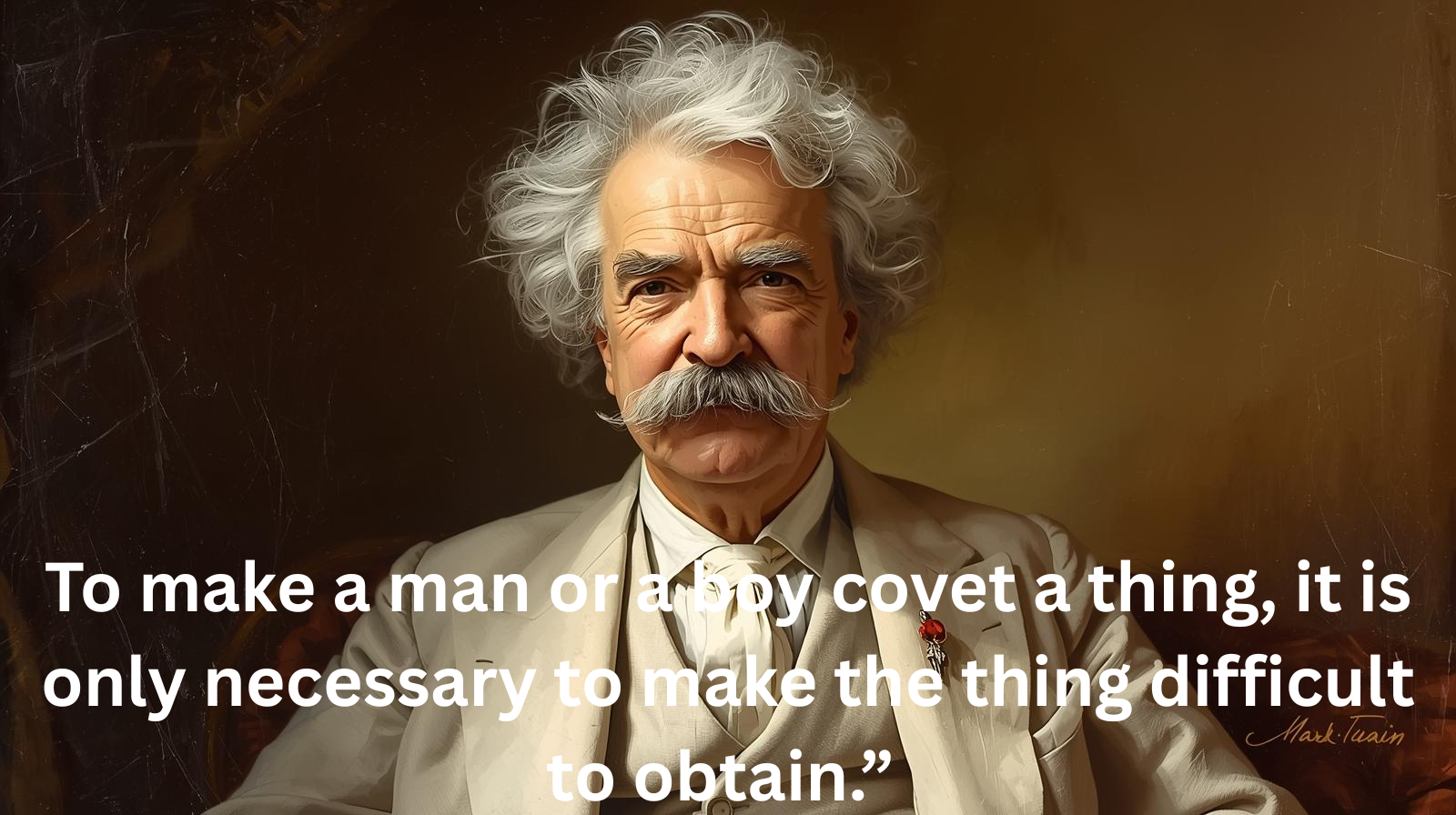
Mark Twain once wrote, “To make a man or a boy covet a thing, it is only necessary to make the thing difficult to obtain.” This simple observation reveals a profound truth about human nature: scarcity amplifies value. When something is hard to get, it sparks curiosity and desire—not because its inherent worth changes, but because its inaccessibility triggers a deep psychological response.
Scarcity and Human Psychology
Scarcity taps into two powerful cognitive biases:
- Reactance Theory: When access is restricted, we instinctively resist limitations by desiring what we cannot have.
- Loss Aversion: We fear missing out on opportunities, so we assign greater value to scarce items.
This explains why rare collectibles, exclusive memberships, and limited-time offers command attention. The more complicated something is to obtain, the more it signals status, achievement, and uniqueness.
Modern Applications of Twain’s Insight
- Marketing and Consumer Behavior
Businesses thrive on scarcity. “Only five left in stock,” “Limited edition,” and “Offer ends tonight” are not mere slogans—they are psychological triggers. By creating urgency and exclusivity, companies make products more desirable. - Education and Skill Development
Skills that require effort—coding, mastering a musical instrument, or learning a foreign language—become coveted because they demand persistence. Difficulty signals value. - Social Dynamics and Relationships
Even in personal interactions, the “hard-to-get” persona often creates intrigue. When attention is scarce, it feels more precious.
The Paradox of Desire
Twain’s observation also exposes a paradox: the more complex something is to obtain, the more we want it—even if its utility remains unchanged. This principle drives luxury markets, elite clubs, and even career aspirations. People pursue what they perceive as rare because rarity is perceived as significant.
Conclusion
Scarcity is more than an economic principle; it’s a powerful psychological force that shapes our daily choices. Twain’s insight shows us that desire often stems from perceived difficulty rather than need. Recognizing how scarcity influences us can help us better understand our own motivations and the strategies used in marketing, education, and social interactions.