Summary
Language is our most elegant form of negotiation. Often, what we say on the surface is not what we’re honestly asking for.
Consider the whimsical line:
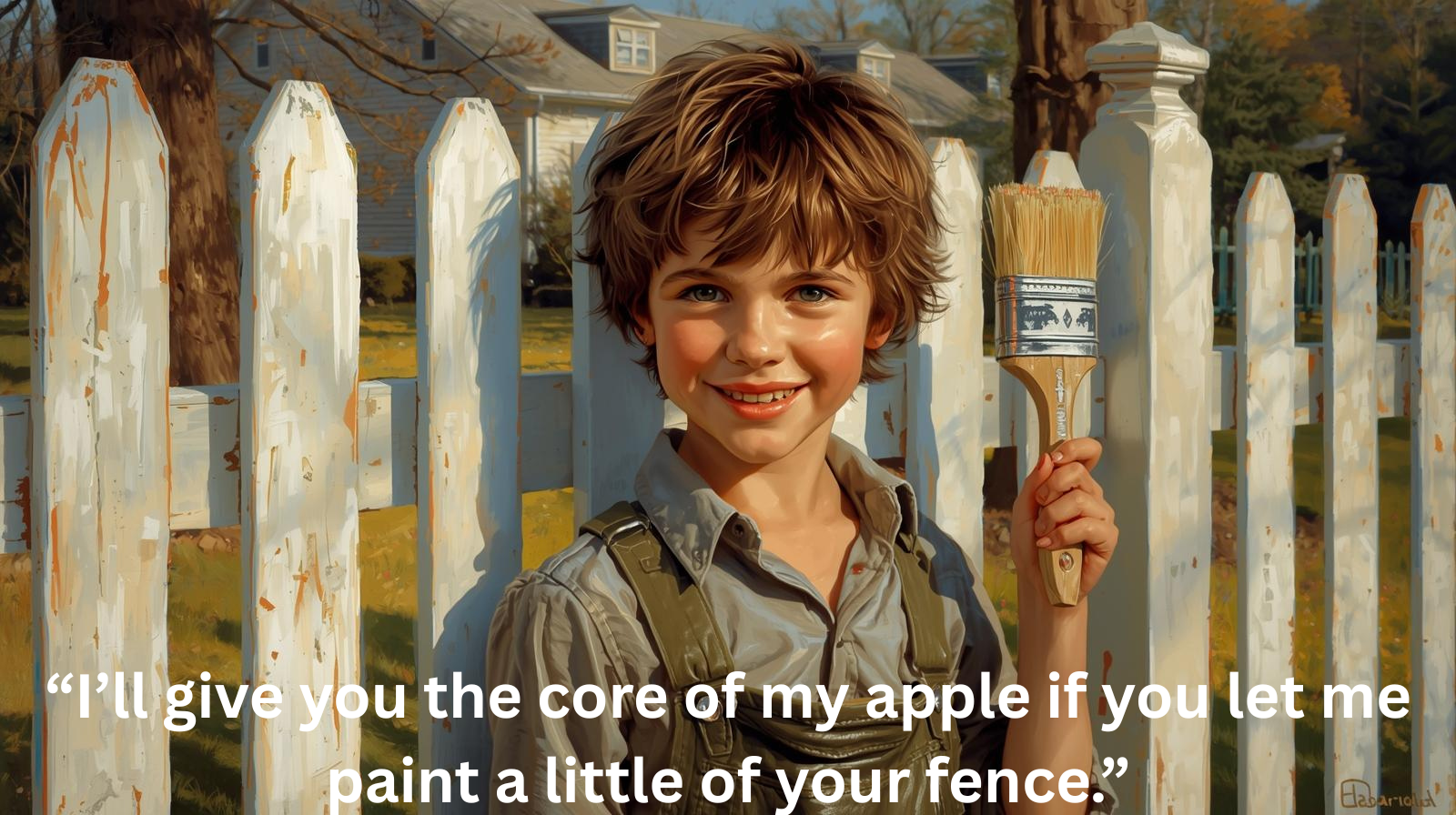
“I’ll give you the core of my apple if you let me paint a little of your fence.”
It reads like playful barter, but beneath the metaphor lies a nuanced exchange: the gift is trivial; the request is intimate. We’re not trading fruit for paint—we’re seeking permission to participate, to leave a mark, to belong.
The feature explores how such phrases work across cultures, why they resonate universally, and how they reveal deeper psychological dynamics in diverse communication settings. Along the way, we’ll unpack the literary devices that make them compelling, present a gallery of similar metaphors, and highlight practical applications for leaders, creatives, and anyone who wants their words to open doors.
A Phrase That Smiles with Its Eyes
The phrase’s charm arises from its deliberate imbalance. The apple core—what remains after the best part is consumed—signals a humble, almost valueless offering. In contrast, painting the fence suggests access, expression, and the power to alter what belongs to someone else. The ask is for participation in another’s domain; the offer is merely a token.
That asymmetry isn’t an accident; it’s a strategy.
Why it lands:
- Humility over entitlement: The small offering lowers defenses. It says, “I know this is your space.”
- Playfulness over pressure: Framing the request as barter turns a potential intrusion into an invitation.
- Symbolism over literalism: The exchange is conceptual, making it more memorable, less transactional.
Literary Mechanics: How the Words Do Work
Great phrases are engineered. This one thrives on a quartet of devices that elevate its meaning:
Metaphor & Symbolism
Metaphors translate intention into image. The apple core symbolizes goodwill, while painting the fence symbolizes creative access and agency. Together, they convey a more profound desire:
“Let me be part of what matters to you.”
Imagery
An apple core is tactile; a fence is visual. We can see the trade. Imagery grounds abstract motives in concrete objects, making a subtle ask feel real.
Irony
Irony is the engine. We offer something trivial in exchange for something meaningful. The gap creates humor and warmth—a gentle mischief that makes the request feel lighter rather than manipulative. This playful tone helps the audience feel more comfortable and receptive.
Allusion
For many readers, “painting a fence” evokes Tom Sawyer: transforming work into Play through clever persuasion. That allusion adds cultural texture and makes the phrase feel familiar, even nostalgic. This familiarity can make the audience feel more connected and open to the message.
The Hidden Motive
Beneath the playful negotiation lies a fundamentally human motive: participation and presence. The speaker wants to be inside the circle—to create, collaborate, or influence. Offering the apple core is not about fair value; it’s a gesture of willingness. The ask is to contribute—however small—to someone else’s world.
In other words, we trade tokens for belonging.
A Gallery of Whispered Requests
These metaphorical exchanges are variations on the same theme: the offered item is modest, but the real desire is access, connection, or influence.
· “I’ll trade you my last match if you let me light your campfire.”
Hidden motive: Seeking warmth and camaraderie, not just sharing a match.
· “I’ll give you a single feather if you let me fly a mile in your sky.”
Hidden motive: Yearning for freedom and experience, not the feather.
· “I’ll hand you a pebble if you let me carve my name on your mountain.”
Hidden motive: Desire for legacy and recognition, not the pebble.
· “I’ll offer you a drop of ink if you let me write a line in your book.”
Hidden motive: Craving creative contribution, not the ink.
· “I’ll give you a grain of sand if you let me walk a step on your beach.”
Hidden motive: Seeking beauty and belonging, not the sand.
· “I’ll share a whisper if you let me echo in your hall.”
Hidden motive: Wanting influence and presence, not the whisper.
These phrases let us ask for something big while offering something small. They’re disarming. They turn the door handle gently.
These metaphorical exchanges are powerful, but they also have limitations. When overused or misapplied, they can be misunderstood or seen as insincere. Understanding when and how to deploy these phrases ensures they serve as genuine tools for connection rather than superficial tactics.
When we cloak our motives in gentle metaphors, we’re not being deceptive—we’re being socially intelligent. Several psychological principles explain why these phrases succeed:
1) Social Softening
Direct asks can trigger defensiveness. A metaphorical barter reduces cognitive friction. The lightness of the exchange—an apple core for fence time—signals that the request is safe and has no sharp edges. This aligns with politeness theory: people shape language to protect positive social face and minimize imposition.
2) Signaling Humility
Offering something small says, “I know this favors me.” That humility is persuasive. It invites reciprocity without obligating it—one of the strongest drivers of cooperation. When the cost is low and the tone is playful, people are more likely to say yes.
3) Desire for Connection
Humans are meaning-seeking and tribe-seeking. We want to participate, contribute, and be seen. Symbolic offers let us knock softly on the door of belonging. The metaphor becomes a bridge: we’re not just trading objects, we’re asking to share space—and, by extension, identity.
4) Cognitive Playfulness
Metaphor engages the imagination. It creates joint attention—both parties see the apple, the fence, the scene. This shared mental canvas builds rapport. Playful language also lowers anxiety and increases openness, turning negotiation into collaboration.
5) Asymmetry that Affirms Ownership
By offering little, we implicitly acknowledge the other party’s control over the domain—the fence, the book, the hall. That affirmation of ownership reduces resistance. We’re not demanding entry; we’re requesting permission. The difference matters.
Where These Phrases Thrive: Practical Applications tailored to various roles-whether a leader seeking team buy-in, a creative collaborator, or a negotiator-these modest, metaphorical offers can be adapted to fit specific contexts, making them versatile tools for relationship-building and influence.
Far from being literary curiosities, phrases with hidden motives are powerful in real-world contexts.
Creative Collaboration
An artist approaching a gallery, a writer pitching an editor, a designer seeking to contribute to a community project—each can use modest, metaphorical offers to invite partnerships without posturing. The tone shifts from “grant me access” to “invite me to Play.”
Leadership & Team Culture
Leaders who want grassroots participation can frame opportunities through symbolic exchanges: “Bring your pebble; help shape the mountain.” It signals that small contributions matter, fostering psychological safety and a culture of inclusion.
Mentorship & Networking
“I’ll bring a question if you’ll lend a minute of your wisdom.” Tiny offerings—notes, insights, introductions—clear the path to meaningful relationships. The strategy respects time while creating space for connection.
Client Relationships
In service industries, small gestures invite collaboration: “We’ll do a quick audit if you let us sketch options on your blueprint.” It emphasizes co-creation over transaction, thereby strengthening trust.
Crafting Your Own: A Short Guide
Want to build phrases that ask for access while offering a token? Use this framework.
· Choose a modest object (core, feather, pebble, drop, grain, whisper).
It signals humility and keeps the exchange light.
· Pair it with a meaningful domain (fence, sky, mountain, book, beach, hall).
It encodes your genuine desire: participation, expression, influence.
· Imply an action (paint, fly, carve, write, walk, echo).
Action is agency. You’re not asking to observe—you’re asking to contribute.
· Keep the tone playful.
Warmth opens doors that arguments cannot.
“I’ll offer you [small token] if you let me [act] a little in your [domain].”
Example:
- “I’ll bring a single note if you let me harmonize in your chorus.”
- “I’ll share a seed if you let me tend a corner of your garden.”
- “I’ll bring a brushstroke if you let me touch a corner of your canvas.”
The Ethics of the Ask
Playful persuasion can be poetic, but it must be principled. Hidden motives are acceptable when they are benevolent and transparent in intent, once the conversation unfolds. These phrases should invite participation, not manipulate consent. The difference lies in whether the request honors boundaries and delivers genuine value—even if it is symbolic at first.
A good rule: the smaller the token, the greater your responsibility to contribute meaningfully once invited. The apple core opens the gate; what you do inside the fence should justify the trust.
Closing Thought: The Fence, the Core, and Us
We are social beings negotiating access to each other’s worlds. Our words are the tools we carry: sometimes heavy, sometimes light. Phrases like “I’ll give you the core of my apple if you let me paint a little of your fence” remind us that the best requests are often those that smile, acknowledge ownership, and ask to contribute, however small at first.
Ultimately, the core is not the bargain; the relationship is. And every fence that welcomes a brushstroke becomes, in time, a shared canvas.
10 More Metaphorical Barters for Your Toolkit
- “I’ll offer a spark if you’ll let me glow in your lantern.”
- “I’ll bring a stitch if you’ll let me mend an inch of your quilt.”
- “I’ll share a note if you’ll let me hum along to your melody.”
- “I’ll give a droplet if you’ll let me ripple your pond.”
- “I’ll pass a thread if you’ll let me weave a corner of your tapestry.”
- “I’ll bring a sprout if you’ll let me plant by your hedge.”
- “I’ll offer a shell if you’ll let me listen to your tide.”
- “I’ll lend a footprint if you’ll let me walk beside your trail.”
- “I’ll share a sparkler if you’ll let me watch your fireworks.”
- “I’ll give a breadcrumb if you’ll let me follow your path.”