Summary
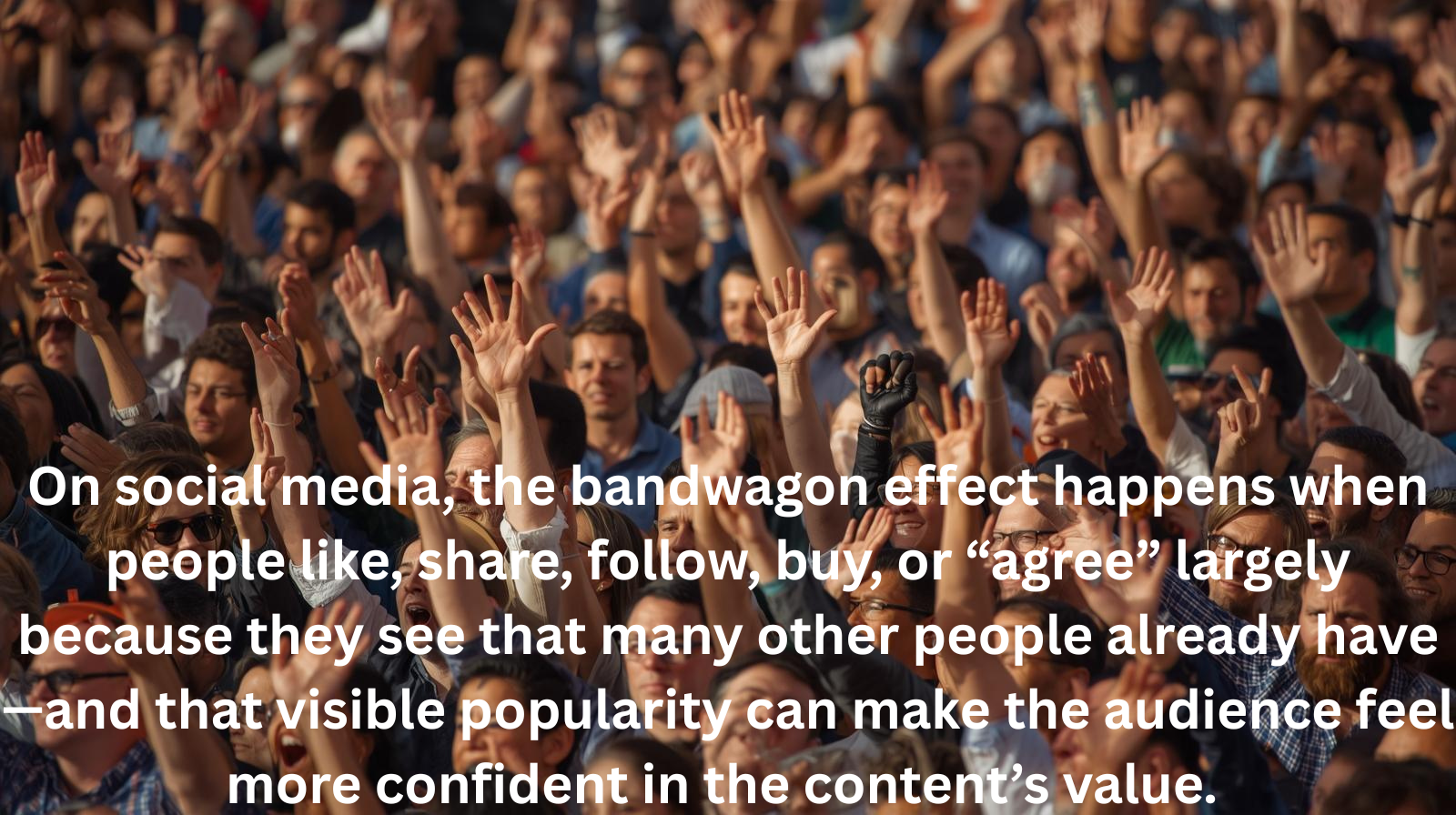
On social media, the bandwagon effect happens when people like, share, follow, buy, or “agree” largely because they see that many other people already have—and that visible popularity can make the audience feel more confident in the content’s value. Platforms intensify this because popularity is measurable and public (likes, views, shares, follower counts), making “what most people do” feel like the safest or smartest choice.
1) The social media version of the bandwagon: Social proof on steroids
In offline life, social proof is subtle (“that restaurant is busy”). On social media, it’s quantified: 47k likes, 12k shares, trending badge, blue check amplification.
Those metrics function as constant “majority signals,” nudging users toward conformity—especially when people are uncertain, multitasking, or casually scrolling.
Key idea: On platforms like TikTok, Twitter, or Instagram, popularity isn’t just observed—it’s designed into the interface, with each platform emphasizing different cues that influence the bandwagon effect.
2) The step-by-step mechanism: how a post turns into a bandwagon
Step A — Visibility of popularity cues
Likes, shares, reposts, comments, view counts, “Top comment,” and follower counts act as peer feedback that signals “others approve,” helping users identify early signs of a bandwagon forming.
Research on “social validation” describes how these cues shape self-presentation and user behavior by linking content and identity to measurable approval.
Step B — People copy the crowd (conformity + shortcuts)
Humans often align with majority behavior to belong (normative influence) and to save effort (heuristics).
Even if the content quality is unknown, the numbers can imply “worth your attention,” thereby increasing engagement.
Step C — Engagement triggers algorithmic lift
Most major platforms rank and recommend content based on engagement signals (clicks, likes, shares, time spent).
That creates a feedback loop: more engagement → more distribution → more engagement—the classic “success breeds success” dynamic behind bandwagons.
3) Algorithms don’t just reflect bandwagons; they can accelerate them
A major reason bandwagons are stronger online is that ranking systems often optimize for revealed preference (what people click/like/share), not necessarily what they say they want or what’s best for discourse.
Recent audit work on engagement-based ranking reports amplification effects relative to chronological feeds, consistent with the idea that optimizing for engagement can magnify certain behavioral biases.
Translation: once a post starts winning, the system may help it maintain its lead, even if the initial advantage was small or accidental.
4) “Trending” and virality are basically information cascades
On social media, people often infer value from others’ actions: “If everyone is reposting, it must be important/true/funny.”
That’s an information cascade pattern: individuals rely more on visible public behavior than their own private judgment, which can spread trends (and errors) very fast.
This is why viral moments can explode in hours: cascades + algorithmic distribution compress the adoption curve.
5) What it looks like in real social media behavior
A) Viral challenges & memes
People participate because participation itself signals belonging, and the visibility of others’ participation provides constant social proof.
B) Product hype and “must-have” purchases
Engagement cues (likes/shares) can influence consumer intentions and perceived credibility, turning popularity into a purchase driver.
C) Opinion bandwagons (hot takes, pile-ons, “everyone agrees”)
Popularity signals can make a viewpoint look “settled,” discouraging dissent and pulling fence-sitters into the apparent majority.
6) The darker side: why bandwagons can warp reality online
A) Echo chambers and filter bubbles
Systematic reviews (2015–2025) find consistent evidence that algorithmic systems can reinforce selective exposure and ideological homogeneity—conditions that make bandwagons inside groups stronger.
When your feed mostly shows “what people like you already like,” the majority signal becomes louder and more self-confirming.
B) Misinformation and polarizing content
Theoretical and empirical work describes a feedback loop in which weighting likes/shares in ranking can increase engagement while also increasing the risk of misinformation and polarization.
Engagement-optimized ranking has been observed to amplify emotionally charged or divisive content relative to baseline feeds—content types that often benefit from bandwagon dynamics.
7) How to spot a bandwagon forming (quick diagnostics)
If you see these together, you’re likely watching a bandwagon:
- High engagement counts + fast growth (the “snowball” look).
- A platform badge (Trending, For You, Recommended) adding algorithmic gasoline.
- Repetition across accounts (“everyone is posting this”)—classic cascade behavior.
8) Practical ways to resist (and design against) bandwagon bias
For everyday users
· Pause before sharing. Cascades thrive when people repost based on popularity rather than verification.
· Treat counts as “attention,” not “truth.” Popularity can be heuristic, but it’s not evidence.
· Diversify your inputs (follow across viewpoints/topics) to reduce homogeneity that strengthens bandwagons.
For creators/brands (ethical use)
- Use social proof transparently (e.g., real testimonials, real adoption) because the mechanism is powerful—but avoid manipulation that can backfire when audiences notice, thereby ensuring ethical engagement.
- Focus on content that sustains value after the initial boost, since engagement-driven systems can reward short-lived spikes.
For platform/product design (what research suggests)
- Adding normative/prosocial feedback can reduce blind conformity to popularity cues and steer behavior toward higher-quality content signals.
- Ranking based on stated preferences (i.e., what users say they want) rather than pure engagement may reduce some amplification harm, though trade-offs exist.