Summary
Your system doesn’t run at the speed of your best people or biggest investments—it runs at the speed of its tightest constraint.
What a Bottleneck Really Is (and Why It Matters)
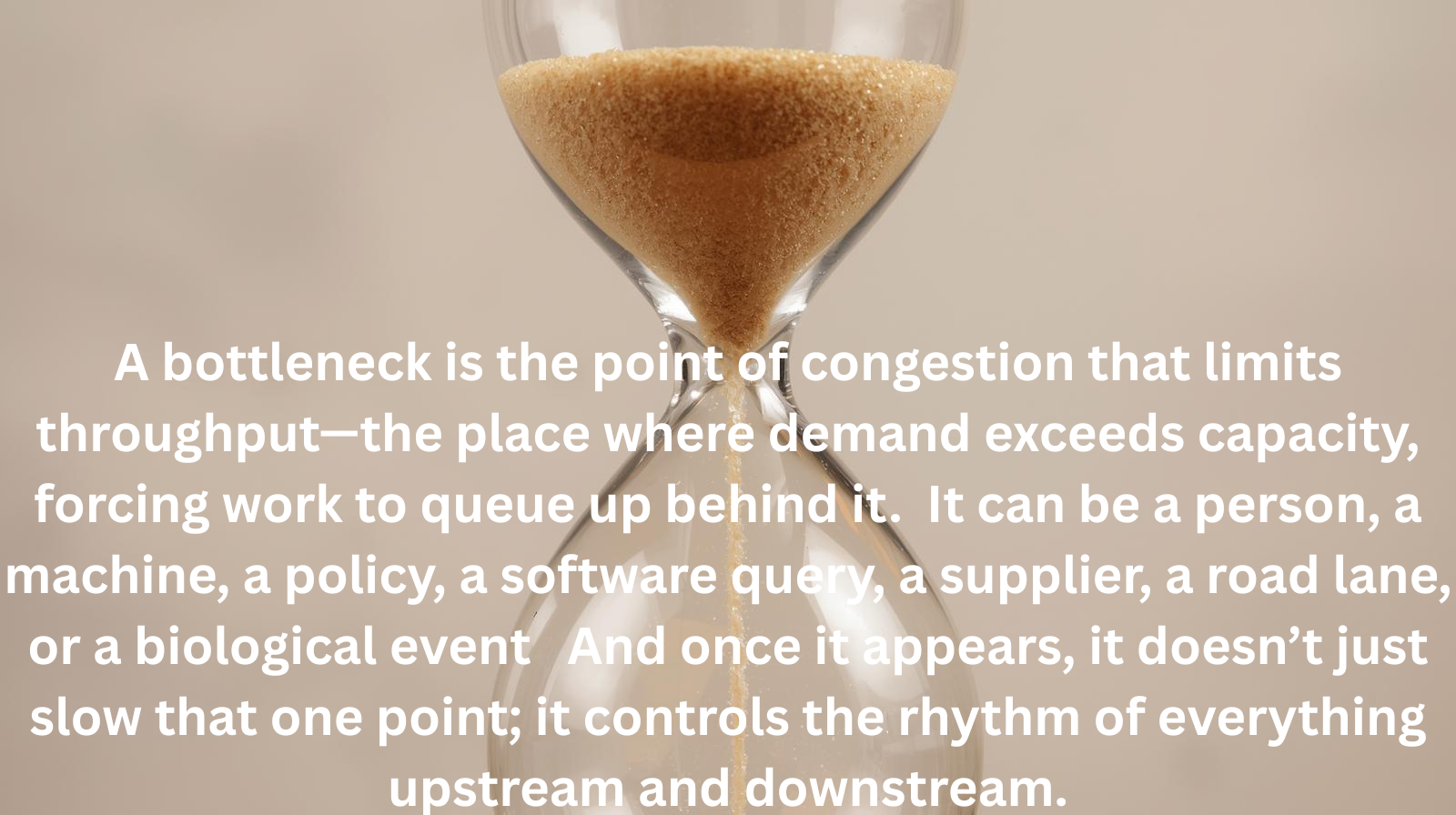
A bottleneck is the point of congestion that limits throughput—the place where demand exceeds capacity, forcing work to queue up behind it. It can be a person, a machine, a policy, a software query, a supplier, a road lane, or a biological event. And once it appears, it doesn’t just slow that one point; it controls the rhythm of everything upstream and downstream.
“Efficiency isn’t doing everything faster—it’s finding the one thing that makes everything slow.”
The most costly misunderstanding is treating bottlenecks as “a problem area.” They are more than that: they are the system’s governor. Fix the bottleneck, and the whole system improves. Ignore it, and every other optimization becomes expensive window dressing.
Where Bottlenecks Show Up Most
1) Business & Operations: Where Work Piles Up
Bottlenecks in organizations often hide inside “reasonable” habits: approvals, handoffs, and legacy processes that once made sense and now don’t.
Common examples
- Manufacturing lines: One station runs slower than all others—inventory piles up before it, while downstream workers wait.
- Decision-making choke points: A single Manager must sign off on every invoice, change order, or project phase.
- Workflow constraints: Manual data entry, duplicate reporting, or outdated tools that create rework and delays.
- Supply chain fragility: A delay at a single supplier, port, or shipping lane disrupts everything downstream.
The bottleneck in business is often a policy, not a person.
2) Computing & Technology: When Speed Is Capped by One Weak Link
Technology bottlenecks are especially deceptive because the “fast parts” are visible—the new CPU, the upgraded app, the modern interface—while the limiting factor is buried in infrastructure or design.
Common examples
- Hardware mismatch: A powerful CPU paired with slow storage or limited RAM creates performance ceilings.
- Software inefficiency: An algorithm that scales poorly, or a database query that drags under real-world load.
- Network bandwidth constraints: Limited throughput between systems—especially where many users or services converge.
“In tech, the bottleneck is rarely where the problem appears—it’s where the waiting happens.”
3) Biology & Science: The Bottleneck That Reshapes the Future
In biology, bottlenecks can change the trajectory of an entire species.
Population bottleneck: A disaster or human-driven event drastically reduces a population, shrinking genetic diversity. Even if numbers recover later, the genetic “library” may remain permanently narrowed.
A bottleneck can leave long-term scars even after the system “recovers.”
4) Logistics & Infrastructure: When Flow Meets Narrow Space
Cities and projects have their own constraints—physical, procedural, and chronological.
Common examples
- Traffic and transport: A lane reduction, a bridge, a merge point, or a construction zone turns smooth flow into a daily jam.
- Project management: A critical-path task that must finish before other work can proceed—delays there cascade everywhere.
“If everything depends on one task, you don’t have a schedule—you have a bottleneck with a calendar.”
5) Music: The Literal Bottleneck That Became a Sound
Not all bottlenecks are problems. In music, the “bottleneck” is a creative tool: slide guitar—a glass or metal tube (historically, a broken bottle neck) gliding across strings to produce that unmistakable, singing tone.
Sometimes constraints don’t limit performance—they create a signature style.
How to Spot a Bottleneck in the Wild (Without Guessing)
You don’t need a consultant’s toolkit to find your constraint—you need a few reliable signals.
The Three Fast Indicators
- The Queue Test: Where does work wait the longest?
Bottlenecks create lines—requests, tickets, approvals, inventory, emails, or people standing idle. - The Utilization Trap: What looks “maxed out” while others aren’t?
If one resource is consistently overloaded and everything else is underused, the system is telling you something. - The Rework Trail: Where do mistakes cluster?
Bottlenecks often form where information is missing, handoffs are inefficient, or quality checks are delayed.
“Follow the waiting, not the working.”
The Most Common Mistake: Optimizing Everywhere Except Constraint
When systems slow down, teams tend to speed up what they can control: more meetings, more dashboards, more urgency, more tools. But if the constraint remains, these “improvements” feed the bottleneck faster, increasing backlog and frustration.
This is why bottlenecks can feel like morale problems. People interpret the symptoms—stress, overtime, missed deadlines—as personal failure. In reality, the system is behaving exactly as designed: it’s limited by the constraint.
Improving non-bottleneck areas often increases pressure without increasing output.
Practical Strategies to Relieve Bottlenecks (Without Breaking the System)
Below are approaches that work across industries—manufacturing, services, software, and project teams.
1) Elevate the Constraint (Add Capacity Where It Matters)
If one station, role, or system component is limiting flow:
- Add staffing or shift coverage at the choke point
- Upgrade the limiting hardware (storage, memory, network)
- Reduce batch sizes to keep work moving
- Create parallel paths (another approver, another workstation)
Rule of thumb: Add capacity only at the bottleneck—or you’re just creating more inventory.
2) Reduce Demand on the Constraint (Remove Unnecessary Work)
Often, the fastest fix is subtraction:
- Eliminate approvals that don’t change outcomes
- Automate repetitive data entry
- Simplify forms, cut duplicate reporting
- Standardize inputs so the constraint spends less time clarifying and correcting
“The cheapest capacity increase is the work you stop doing.”
3) Protect the Bottleneck (Stop Interrupting Your Most Critical Resource)
Constraints are fragile. Interruptions, context switching, and urgent “drive-bys” reduce their effective capacity.
- Limit ad hoc requests.
- Batch similar work
- Create clear intake rules
- Ensure the bottleneck always has “ready-to-work” inputs
A bottleneck that’s constantly interrupted becomes two bottlenecks: the work and the switching.
4) Improve Quality Upstream (So the Constraint Isn’t Doing Cleanup)
If the bottleneck spends time fixing errors from earlier stages, throughput drops.
- Add an earlier validation check.s
- Use templates and standards
- Clarify definitions of “done.”
- Train upstream teams to deliver clean inputs.
This doesn’t mean adding bureaucracy means moving quality closer to the source, where it’s cheaper and faster.
5) Re-Check the System (Because the Bottleneck Will Move)
Once you fix one constraint, another will take its place. That’s not failure, it’s progress. A bottleneck is simply the current limiting factor. Remove it, and the system reveals the next one.
“Solving bottlenecks is not a one-time repair—it’s a continuous practice of finding the next constraint.”
The Bottom Line
Bottlenecks are the hidden rulers of performance. They determine how fast value is created, how predictable delivery becomes, and how frustrated—or empowered—people feel in the process. Whether you’re managing a production line, a software platform, a construction schedule, or a growing organization, the same principle holds:
Your constraint caps your results. Find it, respect it, and fix it—then repeat.