Summary
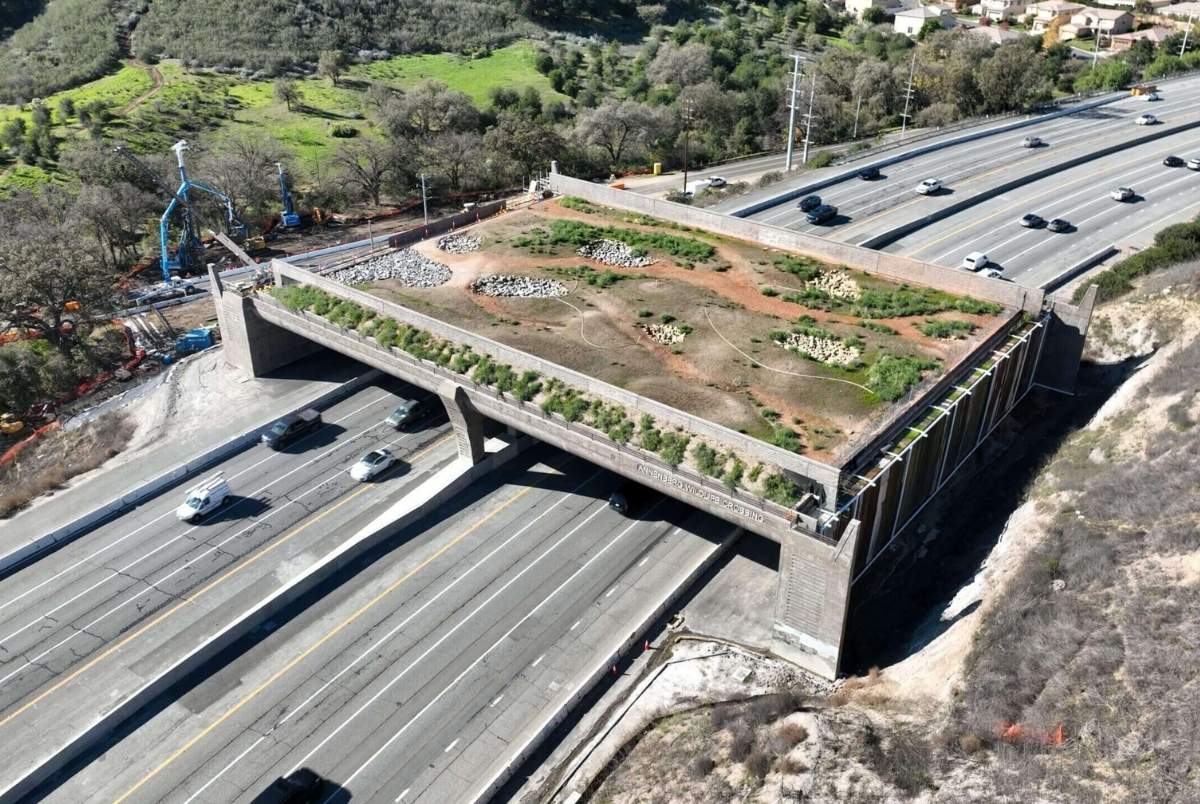
California’s wildlife crossing over U.S. 101 in Agoura Hills may one day become a meaningful conservation success. But before it becomes a model, it deserves scrutiny as a case study in how public projects drift beyond their promises. What began as a roughly $92.6 million undertaking is now expected to cost about $114 million, after an additional $18.8 million in state funding, with completion pushed to fall 2026.
California’s wildlife crossing over U.S. 101 in Agoura Hills may one day become a meaningful conservation success. But before it becomes a model, it deserves scrutiny as a case study in how public projects drift beyond their promises. What began as a roughly $92.6 million undertaking is now expected to cost about $114 million, after an additional $18.8 million in state funding, with completion pushed to fall 2026.
A worthy goal does not excuse weak cost control.
The Wallis Annenberg Wildlife Crossing was designed to reconnect habitat divided by the 101 Freeway, reduce wildlife-vehicle collisions, and improve long-term species viability in the Santa Monica Mountains. State officials describe it as the first crossing of its kind in California and part of a broader restoration effort that includes native vegetation, open-space improvements, and habitat connectivity. Those are legitimate public interests.
But public purpose and public discipline are not the same. A project can be environmentally well-intended and still be poorly managed. Taxpayers are entitled to ask whether risks such as inflation, labor shortages, and weather-related delays were properly considered from the start, thereby empowering them to hold officials accountable.
Cost overruns do more than raise the bill.
The problem with overruns is not only the extra money. It is the erosion of accountability. Once a high-profile project is under construction, political and institutional pressure shifts. The question shifts from “Is this still the best use of funds?” to “How much more is needed to avoid embarrassment and finish it?” That is how weak estimates become normalized and why so many public projects exceed both budget and schedule.
This matters because every dollar committed to one over-budget project is a dollar unavailable for something else. Opportunity cost is not an abstraction. It is the road repair deferred, the safety improvement delayed, the wildfire mitigation postponed, or the Housing and homelessness program left competing for fewer resources. Even when a project has merit, the public still deserves evidence that it was the most cost-effective way to solve the problem.
Job creation is not proof of value.
Defenders of large public projects often point to Employment gains. But jobs created by spending are not the same thing as value created by results. California makes a similar argument for high-speed rail, saying construction has created more than 16,400 jobs and generated nearly $25 billion in economic activity. Yet the same state authority also acknowledges the need for continued streamlining, while outside reporting on the current 2026 plan places the full Phase 1 estimate at roughly $126 billion, far above the $33 billion figure presented to voters in 2008.
The lesson is straightforward: Employment claims should never replace cost-benefit analysis. Almost any large expenditure can be described as a jobs program. The real question is whether the chosen project delivers the best return for the money committed.
Why the public is skeptical
The wildlife crossing does not exist in a vacuum. Californians have watched major projects miss deadlines, seek new appropriations, and promise that the next funding round will solve the problem. That History shapes public perception. When a project’s price rises, officials may attribute the increase to changing economic conditions, revised bids, or increased construction complexity. Sometimes those explanations are valid. But citizens are not unreasonable for asking why those risks were not more fully anticipated at the start.
Skepticism is not opposition to conservation, infrastructure, or government itself. It is a demand for competence. In fact, public Trust is strengthened when officials show that they can define a clear objective, compare lower-cost alternatives, build realistic contingencies, and report transparently when assumptions change.
The real issue is governance.
California does not suffer from a shortage of ambition. It suffers from a shortage of credible guardrails. Major projects should undergo stronger front-end cost review, independent budget stress testing, staged approval gates, and public reporting that distinguishes core construction costs from consulting, administration, and other ancillary spending. Good policy goals should be protected from bad execution, not used to excuse it.
The wildlife crossing may ultimately provide ecological and safety benefits. But that does not settle the larger issue. The public has a right to insist that worthy ends be pursued with fiscal discipline. Otherwise, even good ideas become examples of why confidence in government delivery continues to fall.
A simple taxpayer test
Before the next celebrated project moves from ceremony to construction, public officials should be required to answer four questions:
1. Is this the least-cost way to achieve the stated goal?
2. What risks were priced in before the first shovel hit the ground?
3. At what point can the state pause, redesign, or walk away?
4. What measurable public benefit justifies the final cost?
If those questions cannot be answered clearly at the beginning, taxpayers should expect the same ending: a project that was sold as visionary, financed as manageable, and completed—if completed at all—only after becoming far more expensive than promised.
Quotes
-
“Good intentions do not excuse bad cost control.”
-
“The issue is not whether a project sounds noble; it is whether taxpayers are getting value for the money.”
-
“Cost overruns are not just accounting problems—they are accountability problems.”
-
“Once government loses the power to walk away, the public usually loses the power to control the price.”
-
“Job creation is not a substitute for proof that a project was worth the cost.”
-
“Every over-budget public project is funded twice: once with money, and again with lost public Trust.”
-
“A worthy goal can still become a badly governed project.”
-
“The real test of public leadership is not announcing big projects—it is delivering them within honest limits.”
-
“Taxpayers do not owe blind faith to projects simply because the mission sounds admirable.”
-
“When government cannot answer basic cost questions upfront, the public should expect another expensive surprise later.”