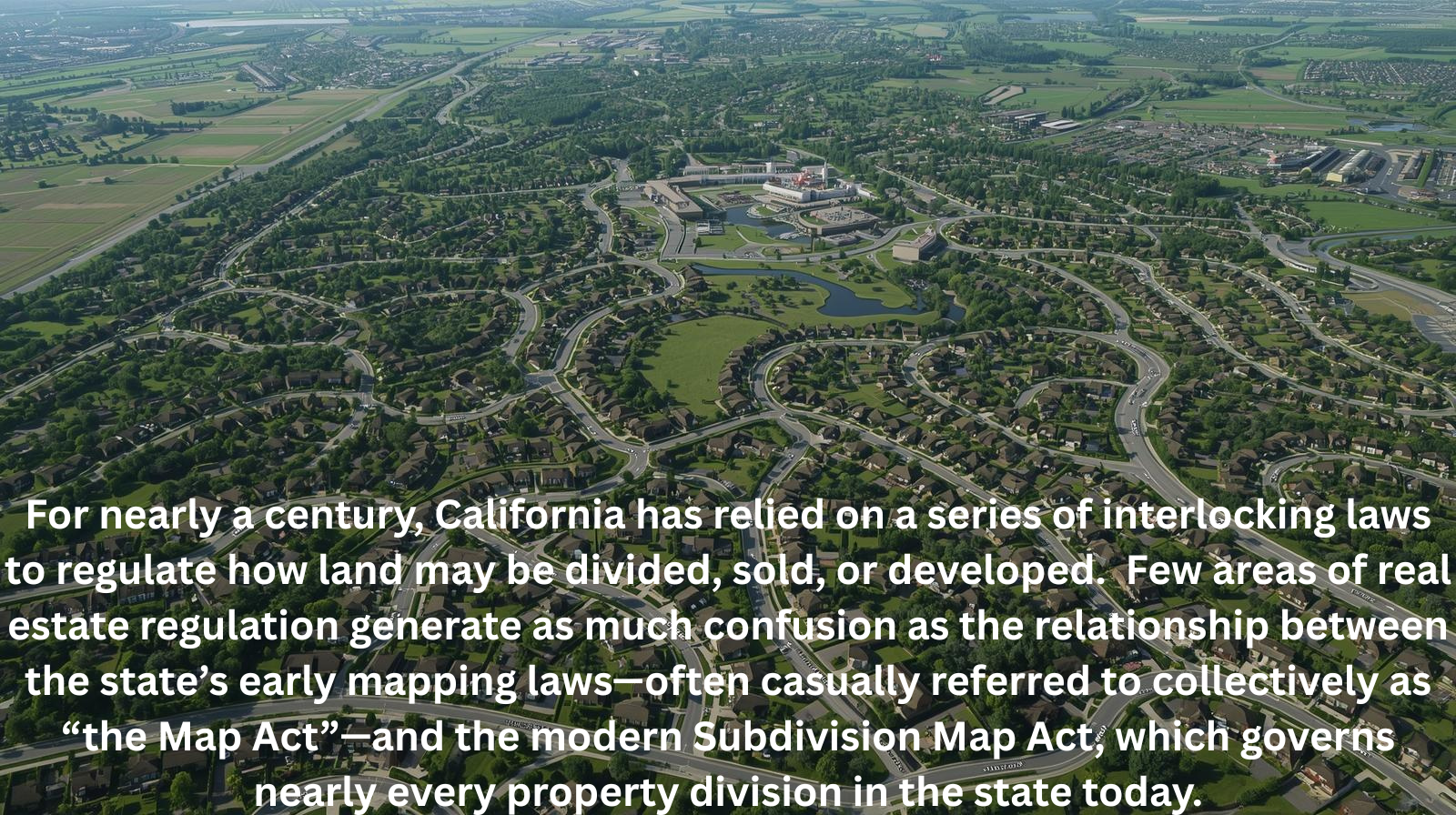
For nearly a century, California has relied on a series of interlocking laws to regulate how land may be divided, sold, or developed. Few areas of real estate regulation generate as much confusion as the relationship between the state’s early mapping laws—often casually referred to collectively as “the Map Act”—and the modern Subdivision Map Act, which governs nearly every property division in the state today.
The key point is simple: California never replaced the Subdivision Map Act. Recognizing its ongoing importance reassures stakeholders that the system remains stable and reliable over time.
This article cuts through the legal clutter and explains how the governing framework took shape, why it still matters today, and how recent laws are changing the approval process without dismantling the underlying system.
A Brief History: From Local Maps to Statewide Regulation
Before the 20th century, California cities and counties followed their own rules—or no rules at all—when dividing land. Subdividers could record maps without standards for accuracy, access, utilities, or public safety. The absence of statewide requirements resulted in irregular parcel boundaries, inadequate infrastructure, and disputes over title and easements.
The 1929 Map Filing Act: The First Attempt at Order
In 1929, the Legislature passed the Map Filing Act, which required subdivision maps to be filed with county recorders. But it did not give cities or counties meaningful authority to review or approve these maps. Developers could still divide land with minimal oversight.
This early Law was important but insufficient. It provided a filing process—not a development process.
The Subdivision Map Act Becomes the Core Regulatory Framework
California moved toward modern land‑use planning in the mid-20th century. As population surged and urban expansion accelerated, the state recognized the need for a uniform system that tied subdivision design to public health, safety, and infrastructure.
1974: The Most Significant Turning Point
The 1974 codification of the Subdivision Map Act in the Government Code (commencing at Government Code § 66410) marked a pivotal moment, establishing the modern framework that continues to govern land division and shaping current practices.
Its Impact was transformative:
- Local approval became mandatory for virtually all subdivisions—for sale, lease, or financing.
- Cities and counties gained the power to impose conditions on design, utilities, access, drainage, grading, and infrastructure improvements.
- Public review became standard, except where later legislation created streamlined alternatives.
- The earlier Map Filing Act was effectively absorbed and superseded, not replaced by an entirely new system.
In other words, the 1974 Act did not repeal the state’s authority over land division; rather, it expanded it into a comprehensive framework that remains the cornerstone of subdivision regulation today.
Key Evolutions—Not Replacements
To understand the Map Act’s enduring role, it helps to see the major evolutionary steps:
1. 1929—The Map Filing Act
- The earliest statewide requirement to file subdivision maps
- Focused on recordation, not design or development standards
- Later folded into the modern Subdivision Map Act
2. 1974—The Subdivision Map Act Expands State and Local Authority
- Cities/counties gain meaningful approval control
- Nearly all land divisions require discretionary review
- Establishes the two-map system: Tentative Map + Final Map
- Creates authority for conditions of approval, fees, and infrastructure requirements
3. Government Code § 66410 and Beyond
Today, the Act authorizes local agencies to regulate:
- Design and layout of subdivisions
- Public improvements
- Utility easements
- Grading and drainage
- Resource protection
- Dedications of streets, parks, and rights-of-way
It remains the backbone of California’s land‑use system.
4. Related Laws Complement—Not Replace—The Act
The Subdivided Lands Law, enforced by the California Department of Real Estate (DRE), focuses on public protection in the marketing and sale of subdivided land. It ensures developers provide full disclosure to buyers.
This Law operates in conjunction with the Subdivision Map Act. Each addresses different facets of the same goal: transparent, orderly, and lawful subdivision practices.
Together, the modern framework reassures property owners, lenders, developers, and public agencies that California operates under a consistent and predictable land‑use system.
Recent reforms demonstrate how they are making the process more efficient and approachable, helping property professionals feel confident that the system adapts to current needs without losing its strength.
The Subdivision Map Act remains unchanged, but recent reforms-such as SB 684 and SB 9-aim to streamline approval processes and promote Housing production without altering the core Law, demonstrating ongoing adaptation.
Examples of Recent Changes
- SB 684 (2023) establishes streamlined ministerial approvals for certain small-scale Housing projects and lot splits near transit or in infill areas.
- SB 9 (2021) allows ministerial duplexes and lot splits on single-family parcels, bypassing traditional tentative map hearings.
- Accessory Dwelling Unit (ADU) laws restrict local discretion in some cases but do not eliminate the Map Act’s mapping requirements when new parcels are created.
Key Takeaway
Streamlining laws reduce hearings and discretionary review in targeted circumstances, but the Subdivision Map Act remains the governing authority for:
- Parcel creation
- Map filing
- Lot design
- Infrastructure conditions
- Compliance with local standards
The framework stands—it’s the workflow that is evolving.
Exemptions Under the Subdivision Map Act
The Act’s exemptions offer clarity for property owners and investors, helping them feel more secure about land division options and reducing uncertainty in their planning.
Common Exemptions
Below are widely recognized Map Act exemptions (generalized—local interpretation varies):
· Leases and Easements for Agricultural, Mineral, or Oil/Gas Purposes
Such agreements typically do not create new legal parcels.
· Leases for Commercial/Industrial Buildings
Certain long-term commercial leases may be exempt if they do not create separate saleable parcels.
· Financing-Only Divisions
Divisions made solely to secure a loan may be exempt, provided no sale or transfer occurs.
· Public Agency Conveyances
Transfers between government entities often bypass map requirements.
· Short-Term Leases
Many leases of less than one year (e.g., billboard leases) are not considered subdivisions.
· Lot Line Adjustments (under Gov. Code § 66412(d))
Adjustments involving four or fewer existing parcels may avoid tentative map requirements, subject to local standards.
Local agencies may have additional criteria, and interpretations differing from professional guidance are essential.
Why This Matters Today
For developers, investors, lenders, and property owners, understanding this History clarifies two important realities:
1. The Subdivision Map Act is Stable and Enduring
Despite numerous legislative reforms, the basic structure of subdivision regulation has remained consistent for over 50 years.
2. Modern Reforms Are Procedural—Not Structural
Streamlining laws change how approvals occur, not the underlying system of maps, parcels, and conditions.
This stability protects property rights, maintains orderly development, and supports long-term investment decisions.
Conclusion
The California Map Act and the Subdivision Map Act are not competing laws, nor are they versions that replaced one another. Instead, they represent a century-long evolution toward a unified, predictable, and comprehensive land‑use system.
The Subdivision Map Act—codified in Government Code § 66410 et seq.—remains the central framework for regulating land division statewide. Modern legislation has introduced faster approval pathways for certain Housing projects, but the Act itself continues to anchor California’s subdivision process.
Understanding this interplay provides clarity for all parties involved in land transactions—and confidence that the state’s regulatory foundation remains strong, well-structured, and enduring.