Article
At first, it’s tiny, like a whisper in the front of the car, a shhhk-shhhk that comes and goes. You hear it best when Mom turns down the radio. She doesn’t say anything right away—she gets quiet in that way adults do when they’re listening to a problem, they don’t want to be real.
On the way to school, she presses the brake, and the sound gets louder, like metal rubbing on metal. It makes your teeth feel weird. You look at Mom’s face, but she’s looking at the road like it’s giving her clues. Her hands tighten on the steering wheel, and she says, mostly to herself, “Okay. Okay.”
After school, she picks you up and says you’re going somewhere “real quick.” You ask where, and she says, “Just a place. We’ll be in and out.” That’s what she says when it’s not going to be in and out.
The place smells like tires and warm air. Like rubber and dust and something sharp you can’t name. Some chairs look like they’ve been sat on a million times. A TV is on, but it’s too loud, and nobody laughs at the jokes. The floor has old stains, and you can see the garage through a window—cars with their mouths open, people under them like mechanics are surgeons.
Mom tells you to sit beside her and not touch anything. She looks at her phone frequently, but not as if she’s texting. Like she’s checking the time and rechecking the time, sometimes she taps her foot, sometimes she doesn’t. You can tell she’s thinking hard because her eyebrows do that thing where they come together like they’re trying to solve a puzzle.
A man comes out and calls her name. Mom stands up fast, like she forgot she was sitting. You stand too, but she puts her hand lightly on your shoulder and says, “Stay right here, okay?” Her voice is calm, but it’s the quiet voice she uses when she’s trying not to sound worried.
You watch her walk to the counter. The man points at a screen. Adults love screens when they’re about to tell you something you don’t want to hear.
At first, Mom nods like she understands everything. Then her face changes. Not a significant change—just a tiny crack, like when ice starts to break. Her mouth gets tight. She laughs once, but it’s not a funny laugh. It’s like a “Are you serious?” laugh that she swallows quickly.
You can’t hear what they’re saying, but you see the paper. It’s longer than you expected. Lots of lines. Lots of numbers. Mom leans in like she’s reading a tiny secret. She points at something, and the man shakes his head slowly. Then he points at something else.
Mom rubs her forehead, right above her eyebrow. That’s what she does when she’s tired.
She looks over at you for a second, like she’s checking if you’re watching. You pretend you’re watching the TV. You can feel your stomach flip anyway.
The man says something, and Mom makes a slight “mm-hmm” sound, but it doesn’t mean yes. It means “I’m listening even though I don’t like this.” Then she asks a question with her hands—palms up —as if to say, “What do we have to do?”
The man circles something on the paper. Mom stares at the circle for a long time.
You know this feeling. It’s the same feeling as when she stands in the cereal aisle too long, comparing boxes. The same feeling as when she opens mail and doesn’t say anything for a minute. The same feeling as when she says, “We’ll see,” but her eyes say, “Probably not.”
Mom finally nods, slow and careful, like she’s stepping onto a rock she’s not sure will hold. She signs something. The man walks away.
When Mom comes back, she smiles at you immediately—like she remembered to put her face back on.
“Hey,” she says, too cheerfully. “You doing okay?”
You nod. You want to ask what’s wrong, but you also don’t want to make her say it out loud. Kids know when something is heavy and don’t want to be the one to lift it.
You sit together and wait. Mom talks about everyday stuff: homework, what you want for dinner, and a school thing coming up. She asks questions like she’s trying to keep the day moving forward, like she can push the moment away by being normal enough.
But she keeps checking her phone.
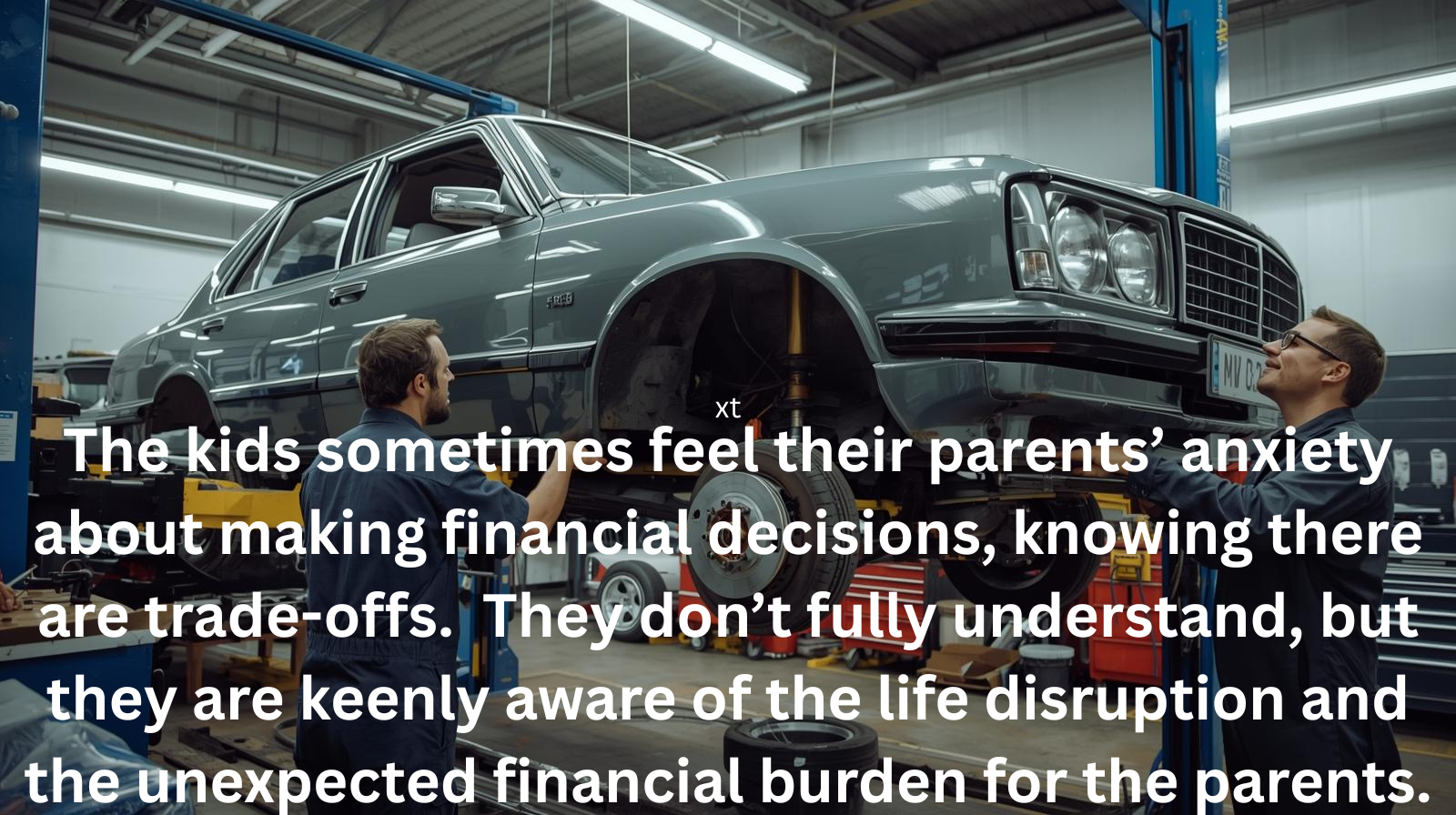
Sometimes she looks at the garage window, like she’s watching the car get fixed and watching the money leave at the same time.
When the car is finally ready, the man talks to Mom again. She nods again, but this time she nods like someone who’s already decided she doesn’t like the answer. She takes the paper and puts it in her purse like it’s something she doesn’t want you to see, even though you have already seen it.
Back in the car, the bad sound is gone. That should feel good. It does, a little. But Mom doesn’t turn on the radio right away. She sits with her hands on the wheel and takes one deep breath.
Then she turns to you and says, “Okay—let’s go.”
And you realize something you don’t have words for yet: grown-ups don’t just fix cars. They fix weeks. They fix schedules. They fix the space between “we’re fine” and “we’re not,” and they try to do it quietly so kids can keep being kids.
You stare out the window and watch the buildings slide by.
You decide not to ask about the paper.
Not because you don’t care—but because you do.