Summary
This effect was first identified in psychological studies conducted in 1977, in which researchers found that participants rated repeated false statements as increasingly believable over time—even when they knew the correct information.
1. What is the effect
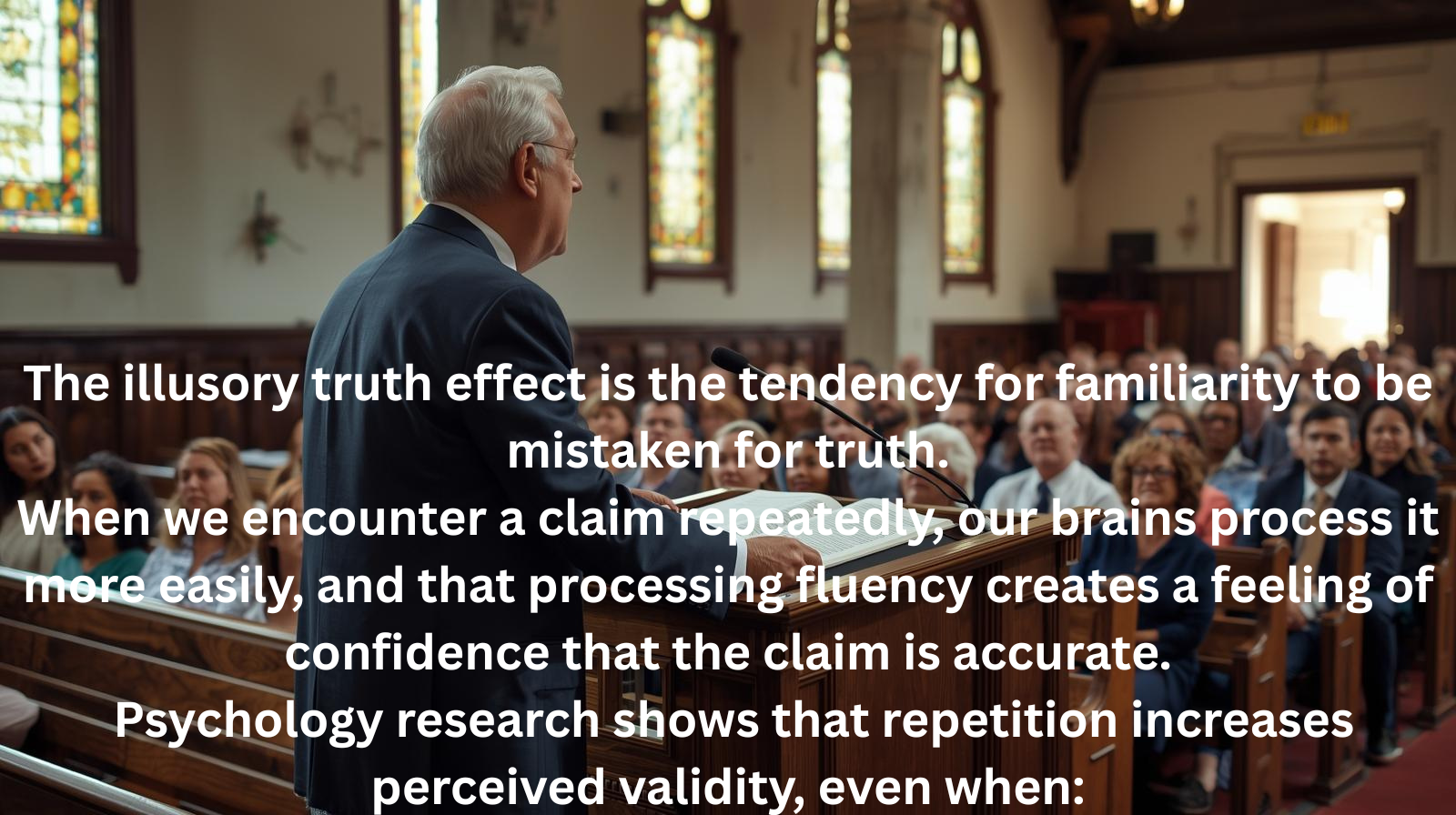
The illusory truth effect is the tendency for familiarity to be mistaken for truth.
When we encounter a claim repeatedly, our brains process it more easily, and that processing fluency creates a feeling of confidence that the claim is accurate.
Psychology research shows that repetition increases perceived validity, even when:
- The statement is false,
- The source is unreliable, or
- The listener initially recognized the information as wrong.
Even minimal repetitions, sometimes just hearing something twice, can significantly increase how true it feels.
2. Why It Happens: Processing Fluency
Repeated information becomes easier for the brain to process.
This smooth processing (“fluency”) gives us a subconscious signal:
“This feels easy to think about—so it must be true.”
Research shows that fluency can override rational thinking, producing belief even when the listener has accurate knowledge.
This is why people can begin believing myths like:
- “We only use 10% of our brain,”
- “Goldfish have a 3-second memory,”
- Political claims are repeated endlessly online.
How Social Media Supercharges the Illusory Truth Effect
Modern platforms—Twitter/X, Facebook, TikTok, YouTube—amplify repeated information at high speed.
Because repetition creates belief, false claims can spread and solidify quickly in algorithmic environments.
Research Databases (EBSCO) summary notes that repetition on social media can lead users to accept misinformation, to the point of forming false memories that overwrite accurate knowledge.
This is why propaganda, conspiracy theories, and ideological narratives thrive on feed-based platforms.
4. Why It Matters
The illusory truth effect:
- Makes misinformation feel true over time
- Allows political propaganda to become persuasive
- Helps fake news spread because repetition sticks even when accuracy doesn’t
- Can shape public opinion and voting behavior
- Weakens critical reasoning in environments full of rapid repetition (like social media)
- Britannica notes that the effect is hazardous when combined with misattribution—people remember the message but forget the context, including whether it was debunked.
5. Key Research Findings
From the sources:
- Repetition alone increases perceived truth.
- Even two exposures can significantly affect belief.
- People may select a repeated incorrect answer even when they previously knew the correct one.
- The effect persists regardless of source credibility.
- It is widely used in advertising, propaganda, and political messaging.