Gasoline on the ground remains liquid and won’t power an engine. Instead, internal combustion engines rely on vaporized gasoline, which is essential for reliable engine performance and trust in how well the engine runs.
Pouring gasoline onto the ground shows liquid fuel, but engines depend on vaporization to run reliably, which fosters trust in engine performance.
“Engines don’t consume gasoline. They consume gasoline’s ability to become vapor at exactly the right moment.”
The Big Picture: Liquid Fuel’s Journey to a Combustible Mixture
Whether you’re feeding a classic V8 through a carburetor or a modern turbo four through direct injection, the steps are broadly the same:
· Delivery: Move fuel from the tank to the engine.
· Metering: Precisely measure how much fuel the engine needs for the incoming air.
· Atomization: Break fuel into tiny droplets (spray), dramatically increasing surface area.
· Evaporation (Vaporization): Convert droplets to vapor using heat—often drawn from intake air, metal surfaces, and in-cylinder conditions.
· Mixing and Timing: Ensure the vapor-air mixture reaches each cylinder at the correct ratio, at the right time.
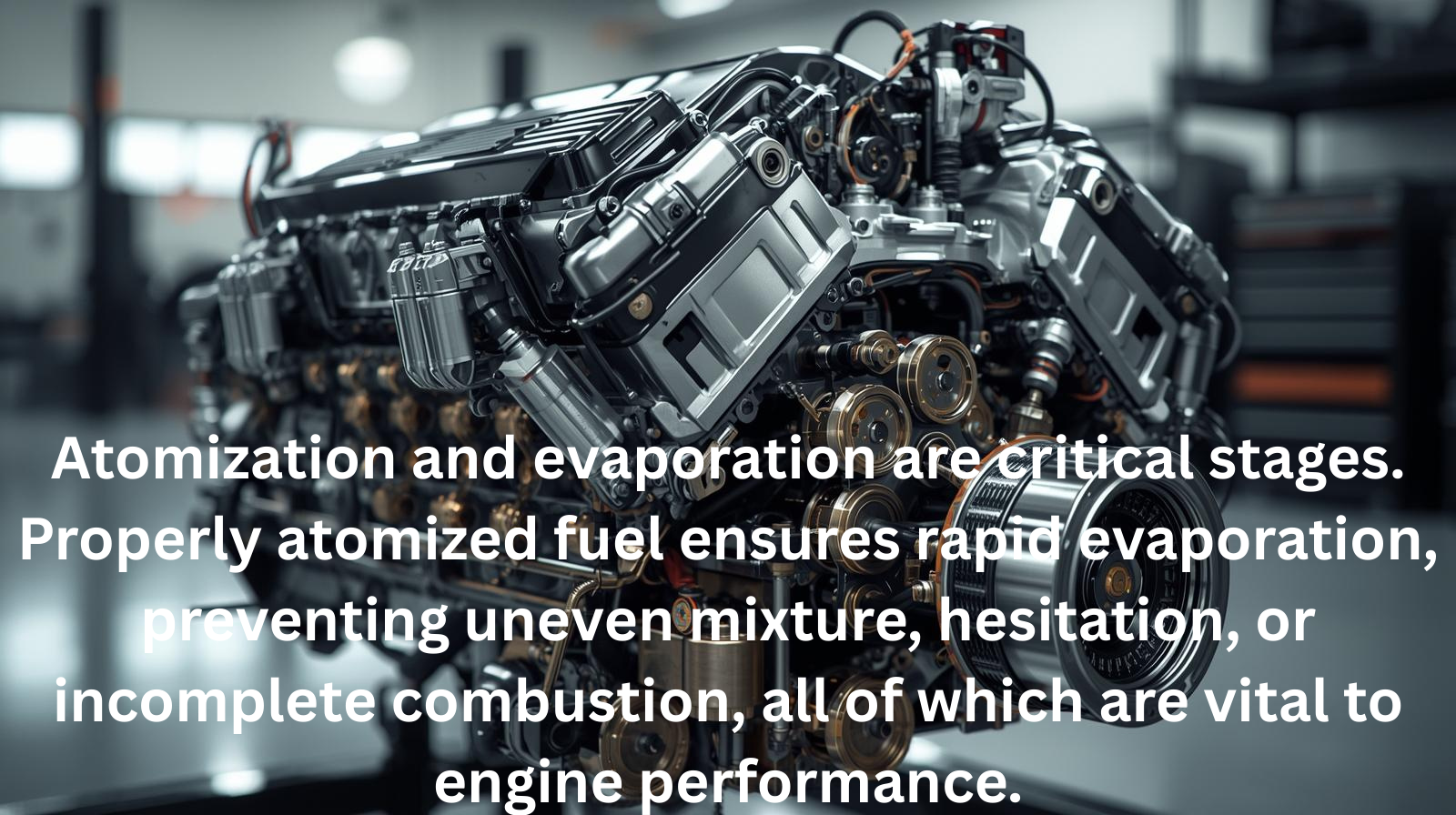
Atomization and evaporation are vital stages. Proper atomization ensures rapid vaporization, preventing uneven mixture, hesitation, or incomplete combustion and directly impacting engine performance and efficiency.
Step 1: Delivery—Getting Fuel to the Point of Use
In both old and new systems, a pump moves gasoline from the tank toward the engine. Modern systems typically maintain regulated fuel pressure at the rail feeding the injectors, while carbureted systems deliver fuel to a float bowl, where the level is controlled mechanically.
The key difference—pressure-controlled fuel rail versus atmospheric float bowl—fundamentally affects how each system regulates fuel flow, shaping subsequent steps and engine behavior.
Step 2–3: Metering + Atomization—Carburetor Venturi vs. Fuel Injection
A) The Venturi System (Carburetor): Fuel Drawn by Airflow
A carburetor relies on a shaped restriction—the venturi—to speed up incoming air and reduce static pressure at the throat.
Because the float bowl is vented near atmospheric pressure, the pressure drop in the venturi creates a differential that effectively pushes fuel through jets and out of a discharge nozzle into the airstream.
At that nozzle, the high-velocity airflow helps shear the fuel into droplets, beginning the atomization process.
Key implication: A carburetor meters fuel primarily as a function of airflow-induced pressure drop, so it is inherently sensitive to air density, temperature, altitude, and transient throttle changes.
That’s why carburetors evolved multiple circuits—idle, main, accelerator pump, power enrichment, choke—to cover operating conditions the venturi signal can’t handle cleanly.
“A carburetor is an elegant analog computer: it calculates fuel flow using nothing but air speed and pressure.”
B) Fuel Injection: Fuel Pushed Through a Nozzle Under Pressure
Fuel injection flips the logic. Instead of relying on airflow to pull fuel, an electric pump and regulator (or high-pressure pump in direct injection) push fuel through an injector nozzle, creating a controlled spray.
Fuel injection uses an ECU to precisely control spray timing based on sensor data, reassuring enthusiasts about its efficiency and emissions benefits.
Crucially, atomization quality in Electronic Fuel Injection (EFI) is engineered into the injector design and fuel pressure, rather than being a byproduct of venturi airflow alone.
That precision matters because emissions hardware—especially catalytic converters—requires tight control of air-fuel ratio; oxygen sensor feedback enables “closed-loop” correction that carburetors can’t practically match.
“Carburetors follow airflow. Fuel injection predicts demand.”
Evaporation is where the ‘gas’ in gasoline becomes a vapor, creating a smooth and harmonious process that engine enthusiasts can appreciate as the core of combustion.
Even with excellent atomization, droplets still must absorb energy to change phase. That energy comes from the surroundings as the latent heat of vaporization, cooling the intake charge as fuel evaporates.
This evaporative cooling can increase charge density (helping volumetric efficiency), but it also makes mixture preparation sensitive to wall temperatures and airflow—especially during cold starts.
Where does evaporation occur?
- In carbureted and port-injected engines, a meaningful fraction of evaporation happens in the intake tract and on surfaces (manifold walls, valve backs), which can cause “wall wetting” and uneven distribution if temperatures are low.
- In direct injection, more evaporation can occur inside the cylinder, where pressure and temperature rise rapidly. Still, mixture formation becomes a high-speed choreography of spray targeting, piston motion, and turbulence.
Bottom line: The engine is always balancing two competing needs—enough evaporation for stable ignition and enough cooling for density/knock resistance—and different fueling systems strike that balance in various ways.
Venturi (Carb) vs. Injection: Practical Differences Drivers Actually Feel
1) Throttle Response and Transients
Carburetors can stumble when airflow changes faster than fuel can be pulled through the circuits; accelerator pumps essentially bridge that lag.
EFI can add fuel immediately by changing injector pulse width, improving transient response, and reducing hesitation.
2) Cold Start Behavior
Cold surfaces slow evaporation, so carburetors enrich the mixture using a choke system to keep the engine running until heat builds.
EFI can also enrich during cold start, but does so algorithmically using temperature sensors and timed strategies, then quickly trims back as feedback becomes reliable.
3) Altitude and Weather Compensation
Because venturi metering depends on pressure differentials and air density, carburetors often require re-jetting or tuning when conditions change significantly.
EFI automatically compensates using sensor inputs and closed-loop correction (when enabled), maintaining drivability across wide environmental swings.
4) Emissions and Mixture Precision
Tight control of the air-fuel ratio is central to modern emissions systems; oxygen sensors and closed-loop control allow the ECU to continuously adjust fueling to stoichiometric targets required for catalytic converter effectiveness.
Carburetors—despite clever circuitry—cannot easily provide the same real-time, cylinder-to-cylinder precision across all conditions.
“Carbs can be tuned brilliantly—until the day gets colder, the hill gets higher, or the emissions target gets tighter.”
Port Injection vs. Direct Injection: Two EFI Flavors, Two Vaporization Strategies
Port Fuel Injection (PFI): Time to Mix
PFI sprays fuel into the intake port upstream of the valve, giving fuel more time and distance to mix with air before entering the cylinder.
That extra time often improves mixture homogeneity and can reduce certain deposits by washing valve backs—though designs vary.
Gasoline Direct Injection (GDI): In-Cylinder Control
GDI injects fuel directly into the combustion chamber, enabling strategies like charge cooling for knock resistance and flexible mixture formation, but it demands higher pressures and more complex calibration.
Because evaporation and mixing occur later and more rapidly, spray targeting and turbulence become crucial to prevent incomplete vaporization or particulate formation.
The Takeaway: It’s All About Droplet Physics and Timing
The “process” you asked about isn’t a single step—it’s a chain reaction of metering → atomizing → evaporating → mixing → igniting, repeated thousands of times per minute.
Carburetors use the venturi’s pressure drop to pull and spray fuel, relying heavily on airflow behavior and clever mechanical circuits.
Fuel injection uses pressure, sensors, and computation to deliver precisely shaped sprays at precisely chosen times—then uses feedback to stay accurate as conditions change.
“The best fuel system isn’t the one that moves the most fuel—it’s the one that creates the right vapor, in the right place, at the right millisecond.”
Fuel injection improves emissions control for one core reason: it can meter fuel far more precisely and keep that metering correct as conditions change—moment by moment—using sensor feedback.
Below are the primary mechanisms, written in “cause → effect” form.
1) Closed-loop control keeps the air-fuel ratio in the “catalyst sweet spot.”
Modern electronic fuel injection (EFI) systems use an engine control unit (ECU) and sensors to compute exactly how long to open each injector (injector “pulse width”).
Crucially, EFI can run closed-loop control using an exhaust oxygen sensor: the ECU compares commanded vs. measured mixture and then adds/subtracts small amounts of fuel to hold the target ratio.
Why that matters for emissions: Catalytic converters work best when the mixture stays tightly controlled around stoichiometric (for gasoline engines), and closed-loop correction is how production vehicles maintain that accuracy over real-world driving conditions.
HowStuffWorks notes that this tight air‑fuel control was not feasible with carburetors and became essential once catalytic converters were introduced.
Net effect: lower CO (carbon monoxide), lower HC (unburned hydrocarbons), and better NOx conversion because the catalyst is kept in its optimal operating window.
2) More accurate metering reduces “rich/lean excursions” that create pollutants
A carburetor meters fuel using airflow/pressure signals and multiple mechanical circuits (idle, main, accelerator pump, power enrichment, choke).
Those circuits are clever, but they’re still approximations that can swing rich or lean during transients (tip-in, rapid load changes), which tends to increase HC/CO (too rich) or NOx/misfire (too lean).
EFI can respond faster and more precisely because it adjusts the injector pulse width directly based on sensor inputs and calibrated tables—essentially “fueling by calculation,” not just the venturi signal.
Engine Builder Magazine emphasizes that EFI’s table-based fueling can be corrected by closed-loop feedback. In contrast, closed-loop is inherently reactive and best used for minor corrections—still, those minor corrections are precisely what keep emissions stable across everyday driving.
Net effect: fewer rich spikes (HC/CO) and fewer lean spikes (NOx/misfire), which directly improves tailpipe numbers.
3) Better fuel atomization and distribution reduces unburned hydrocarbons
EFI systems are designed to spray fuel in tiny droplets (atomization), which improves mixing and combustion completeness.
More complete combustion means less unburned fuel leaving the cylinder as HC emissions.
Older “single-point” approaches (including carburetion and throttle-body injection) are more prone to distribution issues because one metering location has to feed all cylinders through a manifold, and mixture quality can vary cylinder-to-cylinder due to wall wetting and flow dynamics.
EFI—especially multi-port/sequential systems—can meter fuel more consistently per cylinder, improving combustion repeatability and reducing the chance that one cylinder runs overly rich/lean.
Net effect: less cylinder-to-cylinder variation → fewer partial burns/misfires → lower HC and steadier catalyst operation.
4) Cold-start strategies cut the dirtiest minutes of operation
Cold starts are emissions-heavy because fuel doesn’t vaporize as readily, and the catalyst isn’t yet at full operating temperature.
Carburetors rely on a choke and enrichment circuits that are comparatively blunt instruments.
EFI can apply temperature-based enrichment with much finer control and then taper it off as sensors indicate the engine is warming. The oxygen sensor becomes active for closed-loop operation.
(For example, the ThirdGen technical explanation describes open-loop right after start—ignoring O₂ until the sensor is hot and coolant temperature/time conditions are met—then switching to closed-loop to hold mixture tightly.)
Net effect: less over-fueling during warm-up → reduced HC/CO during the period when the catalyst is least effective.
5) Diagnostics and long-term consistency keep emissions compliant over time
EFI architectures naturally support self-diagnostics (sensor plausibility checks, adaptive trims, and fault handling) because fueling is computed electronically and monitored by feedback sensors.
The classic SAE-era closed-loop EFI discussion highlights a key motivation: maintaining a desired operating characteristic over long life despite engine-to-engine variation and drift.