Summary
Personal disclosure: I love a hardy glass of red wine with dinner, and I do not intend to change my habit. I will trade my chocolate chip cookies or cookies and cream ice cream for the same calories any day. A nightly glass of red wine used to feel like a small preventive ritual, supposedly good for the heart, the brain, and the soul. In 2026, the scientific and public-health mood is different: less is better, and “health benefits” are no longer the default assumption—they’re a debated, tightly qualified possibility. Then again, when it comes to what goes into the body, less seems to be better. “Red wine isn’t a vitamin—it’s a choice with benefits that are uncertain and risks that are real.”
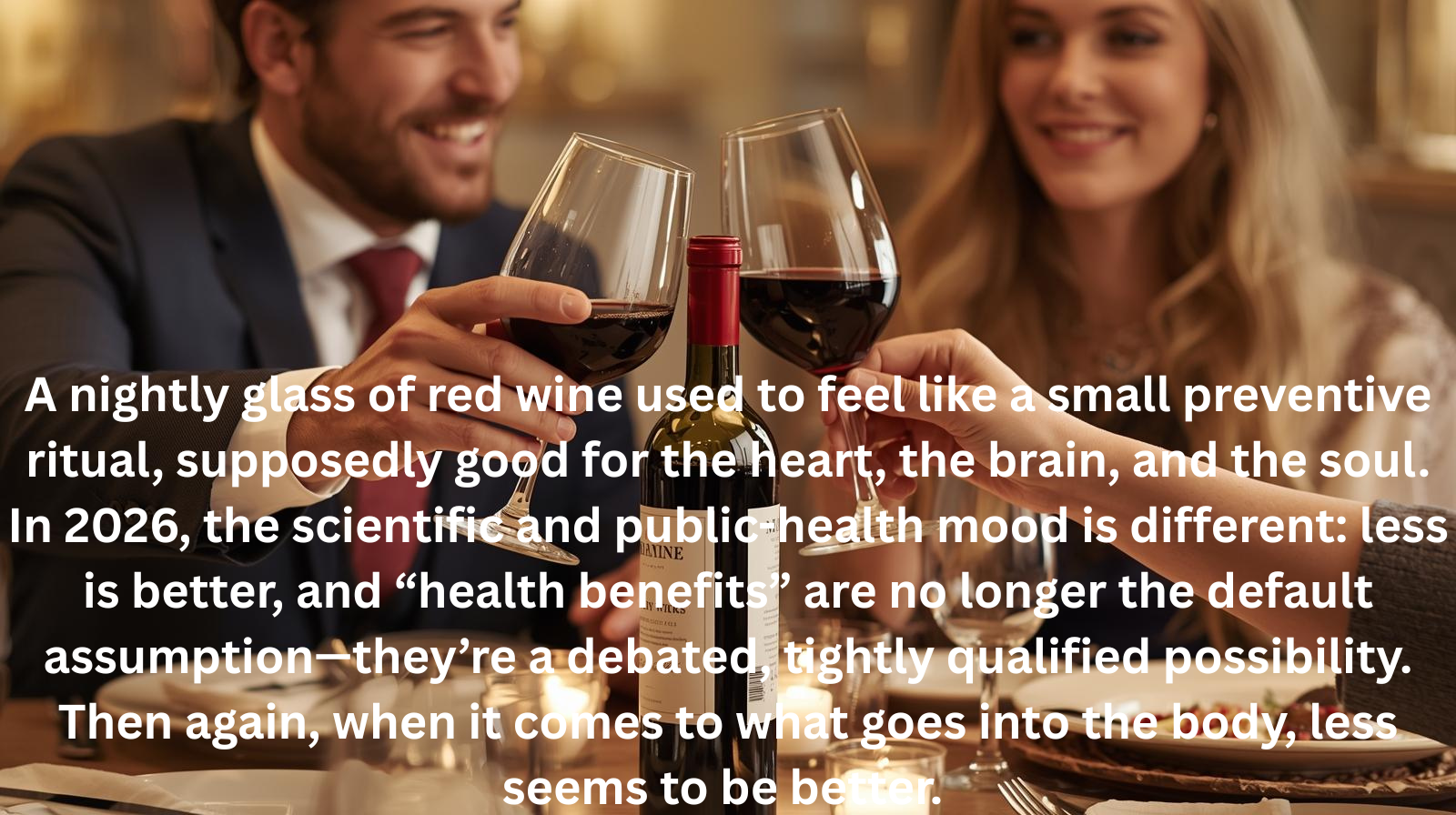
A nightly glass of red wine used to feel like a small preventive ritual, supposedly good for the heart, the brain, and the soul. In 2026, the scientific and public-health mood is different: less is better, and “health benefits” are no longer the default assumption—they’re a debated, tightly qualified possibility. Then again, when it comes to what goes into the body, less seems to be better.
“Red wine isn’t a vitamin—it’s a choice with benefits that are uncertain and risks that are real.”
The New Baseline: Federal Guidance Has Simplified to “Drink Less”
The most visible sign of the shift is federal messaging. The Dietary Guidelines for Americans, 2025–2030 (released 7 January 2026) now advises: “Consume less alcohol for better overall health,” Moving away from specific daily limits to a broader ‘less is better’ message.
That change has drawn pointed reactions from clinical organizations focused on alcohol-related disease. The American Association for the Study of Liver Diseases (AASLD) criticized the removal of specific limits and the absence of stronger cancer-risk messaging, arguing the public benefits from more transparent, evidence-based thresholds—even while broadly agreeing that drinking less supports health.
Summary (what changed):
-
Old public shorthand: “1 glass for women, 1–2 for men”
-
2026 federal shorthand: “Less alcohol for better health.”
Why the “Healthy Heart” Story Weakened
For decades, headlines about the “French Paradox” and observational research helped build the idea that moderate drinkers—especially wine drinkers—had better cardiovascular outcomes. Today, many experts highlight a key limitation: observational studies can’t prove cause-and-effect, so healthier outcomes may be due to confounding factors like diet or lifestyle rather than alcohol itself, encouraging cautious interpretation.
The American Heart Association’s 2025 scientific messaging is blunt on the central consumer question: no research has established a direct cause-and-effect link between drinking alcohol and better heart health, and the AHA does not recommend alcohol to obtain potential benefits.
“If you don’t drink, don’t start—for your heart.”
The “Benefits” Case Still Exists—But It’s Narrower Than Most People Think
A careful reading of modern reviews doesn’t say, “Every drop is poison,” in the same way across all outcomes; it says that benefit claims are uncertain and context dependent. Some research still shows that light-to-moderate drinking correlates with lower rates of certain cardiovascular events—particularly when it occurs within broader healthy patterns (e.g., Mediterranean-style eating, non-smoking, regular activity). But even sympathetic summaries stress the uncertainty: heavy use is clearly harmful, and the “protective” signal for light/moderate use remains difficult to separate from lifestyle and methodological issues.
So if there is an upside, it likely isn’t “red wine is good for you.” It’s closer to: “In some people, in some patterns, small amounts may not meaningfully worsen cardiovascular risk—and might correlate with better outcomes—but we cannot reliably call it protective.”
The Risk Side Has Grown Clearer—Especially Cancer
Where the evidence has hardened most is cancer messaging. The World Health Organization has stated plainly that, for health impacts (especially cancer), there is no “safe” amount of alcohol in the sense of a proven threshold below which risk disappears; the risk starts with the first drop and increases as consumption rises, encouraging you to be mindful of even small amounts.
In the U.S., the Surgeon General’s Advisory on Alcohol and Cancer Risk emphasizes alcohol as a leading preventable cause of cancer, linked causally to at least seven cancer types, and notes that for certain cancers—including breast cancer—risk may begin to increase at around one or fewer drinks per day, then rises with greater intake.
Alcohol’s best-documented health risks
- Cancer risk increases with dose; some risk appears at low intake (not “only heavy drinking”).
- Blood pressure can worsen even with moderate intake in some people, especially those with hypertension.
- Dependency risk rises with habitual use, particularly when drinking becomes a nightly “need.” (Clinical concern reflected in specialty guidance urging more precise public limits.)
“The cancer conversation changed the question from ‘Is a glass beneficial?’ to ‘Is the tradeoff worth it?’”
Sleep: The Sneaky Cost of the Nightly Pour
Many people reach for wine because it feels relaxing—and it can shorten the time it takes to fall asleep. But sleep physiology doesn’t grade on “how fast you passed out.” Long-term and mechanistic research describes a pattern: alcohol may help with sleep onset yet disrupt sleep quality, including disturbing REM sleep, and heavier or sustained patterns correlate with worse sleep outcomes over time.
In practice, that means a nightly glass can quietly tax the very thing people are trying to protect—recovery, mood, cognitive sharpness, and metabolic regulation—especially if it creeps from “one glass” to “one generous pour.”
“But What About Resveratrol?” The Antioxidant Argument, Reframed
Red wine contains polyphenols, and that fact isn’t in dispute. What has changed is the public health interpretation: even if certain compounds are beneficial, alcohol itself is not recommended as a delivery system.
The American Heart Association notes that while some studies have linked red wine with better heart outcomes, there’s no proven causal link—and importantly, many of wine’s celebrated components (like antioxidant compounds) are available in non-alcoholic sources such as grapes, blueberries, and other plant foods.
Who should avoid alcohol entirely?
Federal guidance explicitly lists groups who should altogether avoid alcohol, including pregnant women, people recovering from alcohol use disorder or unable to control intake, and people with medical conditions or medications that interact with alcohol.
If you keep the ritual, consider “harm-reduction” upgrades
- Make it smaller and less frequent: fewer nights per week, smaller pours.
- Anchor it to meals, not stress relief: “with dinner” behaves differently than “to unwind.” (AHA notes meals can slow absorption.)
- Protect sleep: avoid alcohol close to bedtime if you notice early waking or grogginess.
- Know what “one drink” means: A U.S. standard drink is 5 oz wine (12% ABV)—many restaurants pour more than that.
“If wine is pleasure, treat it like dessert—not like medicine.”
Bottom Line (2026): “Non-Is Best,” but “Less” Is the Realistic Next Step
If you already enjoy a nightly glass and you’re healthy, you don’t need to panic—but you should retire from the idea that it’s automatically protective. The center of gravity has moved: public-health authorities stress that alcohol carries risk at any level, with extreme emphasis on cancer and sleep disruption, and that not drinking is the lowest risk option.
For most people, the modern, evidence-aligned posture is simple:
- Don’t start drinking for health.
- If you drink, drink less—and be honest about why you’re drinking.
- Get your “wine nutrients” from food first.
The above is easy to understand and factual, but challenging to abide by.