Summary
This bottleneck is rarely addressed because it doesn’t look urgent—until it is.
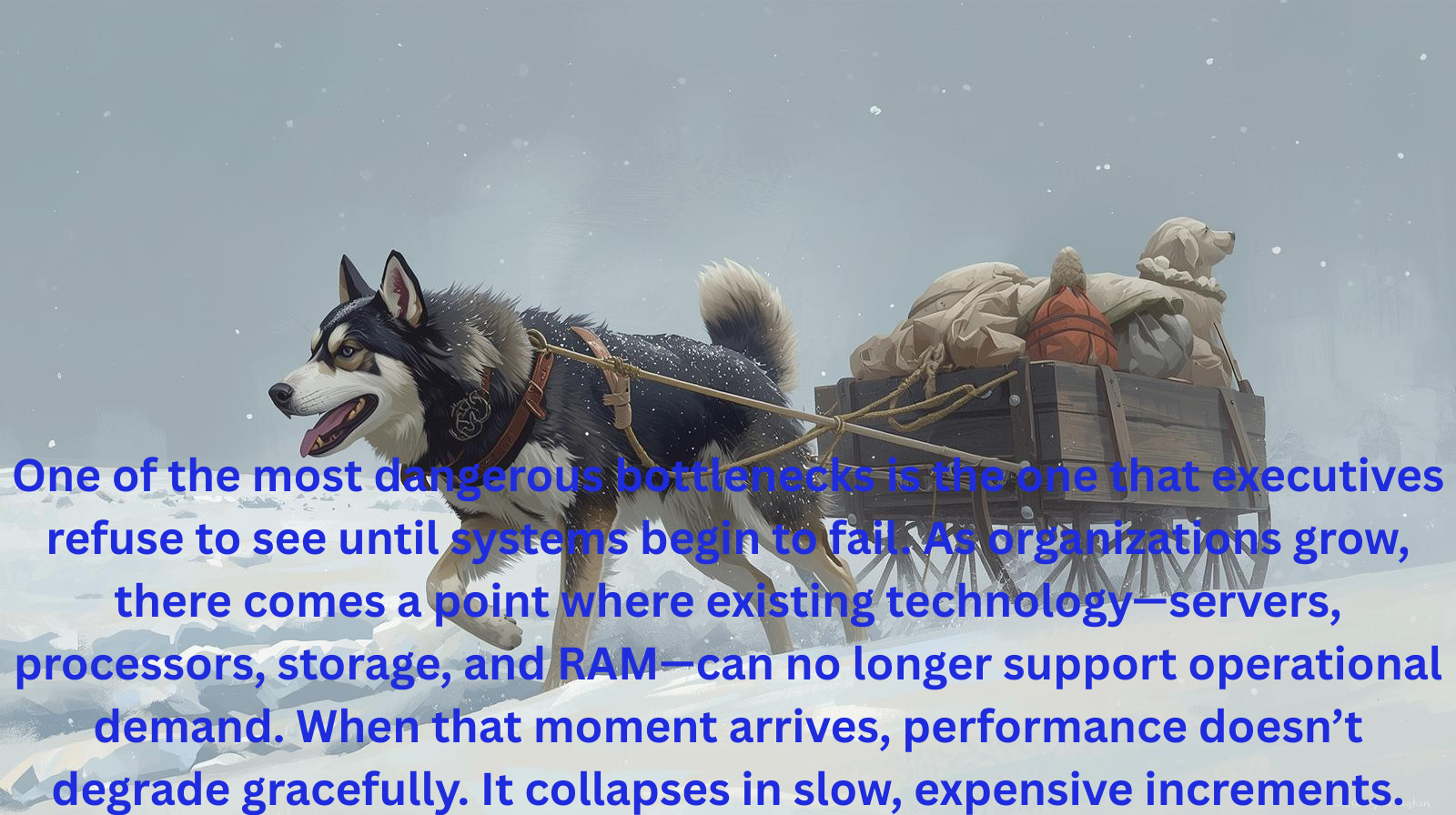
Emails lag. Applications freeze. Databases take seconds instead of milliseconds. Employees compensate by opening multiple instances, rerunning queries, and exporting data to spreadsheets, thereby unknowingly increasing the load on already strained systems. What appears to be “user behavior” or “software issues” is often simply a reality: the hardware ceiling has been reached.
“Outdated infrastructure doesn’t announce itself—it erodes productivity one delay at a time.”
Why Technology Bottlenecks Are Systemically Ignored
Technology bottlenecks are uniquely difficult because they sit at the intersection of capital expenditure, risk avoidance, and denial.
- They don’t affect everyone at once. Early symptoms hit power users first, allowing leadership to dismiss complaints as anecdotal.
- They require upfront investment. Unlike hiring or outsourcing, infrastructure upgrades demand capital before returns are visible.
- They’re mistaken for software problems. Teams rewrite code, change vendors, or retrain staff—while the constraint remains physical.
You can’t optimize software past the limits of the machine it runs on.
The Real Cost of Delaying Infrastructure Upgrades
When organizations postpone technology upgrades, they incur hidden costs that rarely appear on financial statements but compound rapidly:
- Lost labor hours as employees wait on systems instead of working
- Increased error rates from manual workarounds and data duplication
- Shadow IT growth as teams adopt unauthorized tools to bypass slow systems
- Security exposure from legacy hardware that can’t support modern controls
- Cascading failures when peak demand overwhelms systems built for a smaller scale
At a certain point, adding more users, more data, or more applications actually reduces total output—a textbook bottleneck effect.
“Growth doesn’t break systems—ignoring capacity limits does.”
Why This Bottleneck Is Especially Dangerous
Unlike a stalled assembly line or a traffic jam, technology bottlenecks are invisible to customers—until they suddenly aren’t. By the time clients notice outages, delays, or errors, the organization is already operating in crisis mode.
Worse, leadership often responds by demanding more productivity from staff rather than removing the constraint. The result is burnout layered on top of infrastructure failure.
No amount of Employee effort can overcome insufficient computing capacity.
The Strategic Fix: Treat Infrastructure as Throughput, Not Overhead
Organizations that manage technology well do one thing differently: they treat infrastructure as a throughput enabler, not a sunk cost.
That means:
- Monitoring utilization trends, not just uptime
- Planning upgrades before saturation occurs
- Scaling capacity ahead of growth, not after complaints
- Aligning IT investment with business volume, not budget cycles
When infrastructure is sized correctly, performance stabilizes, errors decline, and teams regain time previously lost to waiting.
“If your systems are always busy, they’re already too small.”
Bottom Line
Technology bottlenecks are among the most expensive and least discussed constraints in modern organizations. They masquerade as software issues, personnel problems, or workflow inefficiencies, while quietly capping output at the hardware level.
Ignoring them doesn’t save money—it merely delays the invoice.