Summary
Why modern life can feel pre-scripted—and how to rebuild independent judgment in an age of persuasion.
Highlighting how stories and narratives shape what we call “reality” can empower my readers to question these influences, fostering their confidence in independent judgment, which is essential to their sense of empowerment.
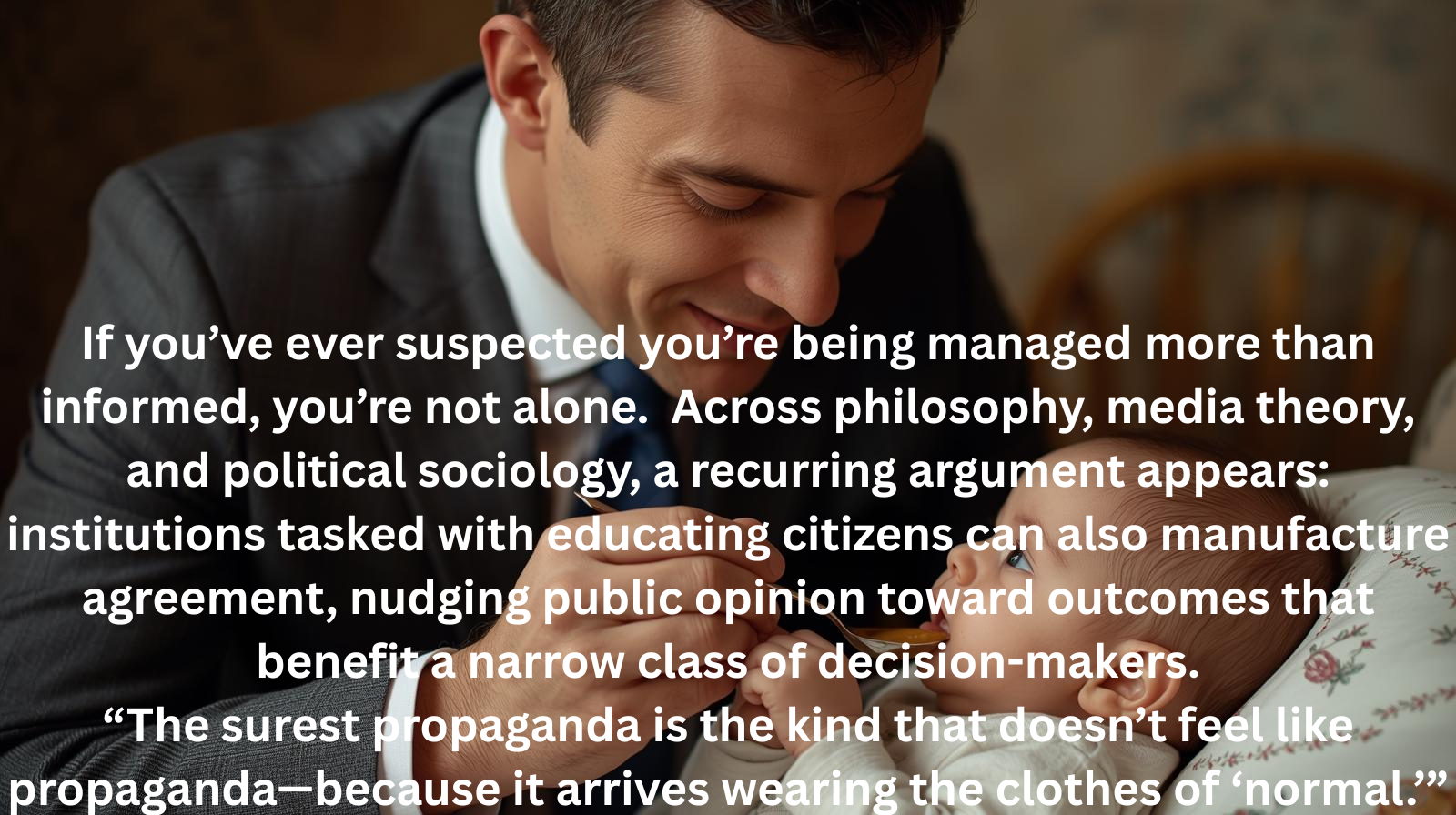
If you’ve ever suspected you’re being managed more than informed, you’re not alone. Across philosophy, media theory, and political sociology, a recurring argument appears: institutions tasked with educating citizens can also manufacture agreement, nudging public opinion toward outcomes that benefit a narrow class of decision-makers.
“The surest propaganda is the kind that doesn’t feel like propaganda—because it arrives wearing the clothes of ‘normal.’”
This isn’t merely paranoia or cynicism. It’s a conceptual framework with a long intellectual lineage—one that can help explain why public debates so often feel pre-rigged, why “breaking news” quickly hardens into dogma, and why dissenting interpretations are routinely dismissed as fringe before they’re even heard.
The Invisible Hand on the Narrative
In healthy democracies, information is supposed to flow upward: citizens receive facts, evaluate tradeoffs, and pressure institutions to respond. But many theorists argue the flow often runs the other way: institutions curate the menu of thinkable thoughts, then invite the public to choose from it.
This is less about inventing lies and more about structuring attention, making the audience feel curious and vigilant about which stories lead and which are buried, and encouraging critical engagement with media choices.
When these choices repeat across outlets and platforms, the effect is cumulative. Pretty soon, people live in a world of manipulated realities and illusions, as is occurring today.
To resist, my readers can develop habits such as cross-checking sources and questioning narratives, which help them operate outside a narrowing corridor of permitted interpretations. Cultivating these habits can inspire hope and a sense of agency in their media engagement.
In other words, the cage that locks us into a mindset is sometimes made of headlines, not bars.
Framework #1: “Manufacturing Consent” and the Filters of Media
The phrase “manufacturing consent” is most closely associated with the work of Edward S. Herman and Noam Chomsky, who argued that the mass media frequently function less as neutral messengers and more as an ideological system that tends to reinforce the interests of dominant institutions. Their central claim is not that journalists are always dishonest; it’s that structural incentives shape what gets reported and how.
A practical way to understand this is to ask: What does the system reward, such as speed, conflict, or emotional engagement, to help readers grasp how media incentives shape news?
- Speed over depth
- Conflict over clarity
- Familiar narratives over disruptive ones
- “Access” over antagonism
- Emotional engagement over sober analysis
The result is a media environment that can produce consensus even when citizens believe they’re “staying informed.”
“Censorship isn’t always a gag; sometimes it’s a spotlight pointed in the wrong direction.”
Framework #2: Plato’s Cave, Updated for the Feed
Plato’s “Allegory of the Cave” remains one of the most durable metaphors for manipulated perception. Prisoners chained in a cave see shadows on a wall and mistake them for reality. Their world is not a lie in the crude sense; it is a partial reality, engineered through constraint.
The modern cave is more comfortable. The chains are soft. The shadows are high definition. It comes with economic pressure, family pressure, leased cars, excessive laws and regulations, and too much money at the end of the month. The cave also allows others to frame our narratives.
Today, it is entirely possible to spend a life inside mediated perception—news cycles, social feeds, curated outrage—without noticing how rarely you touch the underlying “terrain” of reality: firsthand observation, primary sources, long-form context, and patient study.
In Plato’s version, leaving the cave is painful because it involves social conflict and the humiliating realization that certainty was borrowed, highlighting the social cost of independent thought to motivate readers to consider its value.
“When you step outside the cave, the first thing you lose is the applause.”
Framework #3: Hyperreality—When the Map Replaces the Territory
French theorist Jean Baudrillard sharpened the critique of the modern age by arguing that media and symbols can become more real to people than physical reality. In hyperreality, the representation doesn’t merely describe the world—it substitutes for it.
Beliefs today are often formed through images, headlines, and memes, making the audience aware of how easily perceptions can be manipulated and empowering them to question the “map” they navigate by.
This helps explain a modern phenomenon: people can be factually corrected and yet remain unconvinced, because what they’re defending is not a fact but an identity-anchored narrative. The story has become emotionally necessary.
“In hyperreality, the argument isn’t about what happened—it’s about which version of you survives.”
Why “Spoon-Fed” Reality Works So Well
The most sobering insight across these frameworks is that manipulation often succeeds by exploiting everyday human needs:
- Belonging: We adopt the views of our tribe
- Cognitive ease: We prefer simple explanations
- Status: We mimic the beliefs that earn approval
- Safety: We avoid ideas that threaten our worldview
This doesn’t require a mastermind. A system of incentives can produce the same outcome without a single villain in the room. Platforms reward engagement; engagement rewards outrage; outrage creates anxiety, anxiety rewards simplification; simplification rewards tribal certainty-group think.
And certainty is addictive and a lifelong pattern of existence.
The spoon-fed worldview is appealing because it reduces complexity. It turns messy reality into heroes and villains, slogans and solutions, enemies and saviors—an emotional script that spares us the burden of thinking.
How to Build “Internal Thinking” in an Externalized Age
If reality is increasingly mediated, the antidote is not to “turn off the world,” but to rebuild cognitive sovereignty—a disciplined habit of interpreting information rather than absorbing it.
1) Practice Media Skepticism Literacy Like a Skillset, Not a Mood
Media literacy isn’t merely skepticism; it’s a method.
Try:
- Distinguish reporting from commentary
- Ask what’s missing, not only what’s present
- Trace claims back to primary documents when possible
- Compare coverage across outlets with different incentives
Rule of thumb: if a story makes you instantly furious, you are manipulated.
2) Diversify Inputs—But Don’t Confuse Noise with Wisdom
“Multiple perspectives” only help if they’re credible and distinct.
Aim for:
- Long-form journalism + primary sources
- Analysts with track records of admitting errors
- Arguments from people you disagree with at their best, not their worst
Diversity of inputs isn’t about collecting opinions. It’s about escaping a single narrative monopoly.
3) Learn the Language of Persuasion
Many forms of influence are rhetorical rather than factual.
Watch for:
- Framing: the way the question is posed pre-decides the answer
- Loaded terms: words designed to end debate (“obviously,” “extremist,” “denier”)
- Moral theatre: signaling virtue without providing evidence
- False binaries: “If you don’t support X, you must support Y.”
“When a debate feels like a trap, it probably began with a frame designed to make you lose.”
4) Reintroduce Time into Your Thinking Framework
Fast media produces shallow minds. If you want internal thinking, adopt a slower rhythm:
- Wait 24 hours before sharing breaking news
- Read beyond headlines
- Revisit stories after corrections and follow-ups appear
Speed is profitable. Understanding isn’t.
5) Make Peace with Uncertainty
Independent thinkers often sound less specific than propagandists. That’s not weakness—it’s honesty. The goal is not to win every argument; it’s to resist becoming a puppet of fashionable certainty.
A mature mind can say: “I don’t know yet.”
The Real Escape From the Cave
The point of these frameworks is not despair. It’s clarity. If you can name the mechanisms that shape perception, you can begin to resist them. The ultimate act of independence is not contrarianism—it’s conscience paired with discipline.
The world will always offer a spoon. It will always provide pre-chewed conclusions, ready-made enemies, and emotional scripts. But internal thinking begins when you stop swallowing by reflex—when you pause long enough to ask:
Who benefits from me believing this, feeling this, sharing this—right now?
That question won’t make you popular. But it might make you free.
Contemporary Examples of Media Manipulation (2020s)
1) Algorithmic Amplification: “What spreads” becomes “what seems true.”
On major platforms, the most consequential editorial decisions are often made by recommendation and ranking systems, not human editors.
A 2024 observational study of X (Twitter) found that posts linking to low-credibility domains generated more impressions on aggregate than comparable posts, with amplification patterns especially pronounced among high-engagement, high-follower accounts and for high-toxicity content.
Takeaway: When algorithms reward engagement, they can reward distortion—because outrage and certainty travel faster than nuance.
2) Coordinated Inauthentic Behavior (CIB): Fake “publics” that simulate consensus
Influence campaigns increasingly work by manufacturing the appearance of organic agreement—using coordinated networks of fake or deceptive accounts to seed narratives, amplify them, and make them look “popular.”
Meta’s regular threat reporting documents repeated takedowns of such networks across regions and languages, describing CIB as coordinated efforts to manipulate public debate where fake accounts are central, and enforcement focuses on behavior, not viewpoint.
Takeaway: If consensus is cheap to fabricate, “everyone is saying” becomes a tactic—not evidence.
3) “Pink Slime” Local News: Partisan or pay-for-play outlets wearing a hometown mask
One of the most effective forms of manipulation isn’t national—it’s local (local rags).
Research and reporting from the Tow Center/CJR describe “pink slime” as content that mimics local journalism while obscuring funding, intent, and authorship; CJR’s 2024 investigation traced millions in political spending flowing into an extensive network of such sites.
A 2024 report noted that the number of “pink slime” sites identified by NewsGuard roughly rivaled the count of genuine local daily newspaper sites—highlighting how the decline of local news creates a vacuum for imitation.
Takeaway: The most persuasive propaganda looks like the neighborly newsroom you miss.
The best manipulators are those close to you, living in the neighborhood.
4) Native Advertising & “Sponsored” Storytelling: Ads that borrow journalistic authority
A subtler manipulation technique is deceptively formatted advertising—marketing content designed to resemble reporting, reviews, or features.
The FTC explicitly warns that “native advertising” can mislead when readers can’t readily distinguish ads from editorial content, emphasizing that disclosures must be clear and conspicuous based on the net impression of the format. T
Takeaway: If the label is easy to miss, persuasion gets to pose as information.
5) AI Content Farms: Industrial-scale “news” with little or no human oversight
Generative AI has made it dramatically cheaper to mass-produce credible-sounding articles—often for ad revenue—creating a new supply chain for misinformation and “garbage-in, garbage-out” journalism.
NewsGuard reports identifying thousands of undisclosed AI-generated news and information sites operating with minimal human oversight, often using generic names that appear legitimate and sometimes publishing false claims.
These sites can be economically sustained through programmatic advertising, which can place mainstream brand ads regardless of the site’s quality—creating incentives to scale the model.
Takeaway: When “articles” become cheap to manufacture, information pollution becomes a business model.
6) Synthetic Audio & Deepfake Persuasion: The weaponization of “I heard it myself.”
Deepfakes exploit a cognitive shortcut: people often treat audio/video as higher proof than text.
In the U.S., authorities investigated AI-generated robocalls that used a cloned voice to discourage voting in New Hampshire’s January 2024 primary; the state Attorney General described the calls as using an AI-generated voice clone and urged voters to disregard them.
The FCC subsequently clarified that AI-generated voices qualify as “artificial” under the TCPA and took enforcement action against deepfake election robocalls.
Internationally, the “Slovak case” involved a viral fake audio clip released just before elections, illustrating how timing, low-trust environments, and distribution channels can amplify Impact even when authenticity is disputed.
Takeaway: In the deepfake era, “seeing is believing” becomes “seeing is being targeted.”
7) Cloned Websites & Brand Impersonation: When the “map” counterfeits the territory
Some operations don’t argue with mainstream media—they forge it.
The Russia-linked “Doppelgänger” campaign has been documented as using spoofed domains and cloned websites that mimic legitimate outlets and institutions, coupled with social distribution tactics to drive traffic and legitimacy.
EU DisinfoLab maintains a running timeline of public reporting on the operation across multiple platforms and investigations, reflecting the persistence and evolution of these tactics.
Takeaway: When counterfeit media looks authentic, credibility becomes a commodity that can be stolen.
8) Encrypted Messaging as a “Dark Social” Distribution Layer
Even when public platforms label or remove content, narratives can continue to spread via closed or encrypted channels where moderation and public visibility are limited.
Research commentary on election misinformation highlights how encrypted messaging apps can Play an outsized role in influence operations because content circulates through trusted interpersonal networks rather than public feeds.
Takeaway: Persuasion is most potent when it arrives from a friend—inside a channel outsiders can’t audit.
References (Foundational Works)
- Edward S. Herman & Noam Chomsky, Manufacturing Consent: The Political Economy of the Mass Media (1988)
- Plato, Republic (Allegory of the Cave; c. 380 BCE)
- Jean Baudrillard, Simulacra and Simulation (1981; English translation 1994)
Closing
Together, these examples show how modern manipulation relies less on “Big Brother censorship” and more on attention engineering: algorithms that amplify emotional content, networks that simulate consensus, ads that borrow editorial authority, synthetic media that corrode perception, and distribution channels that evade scrutiny.