Meaning
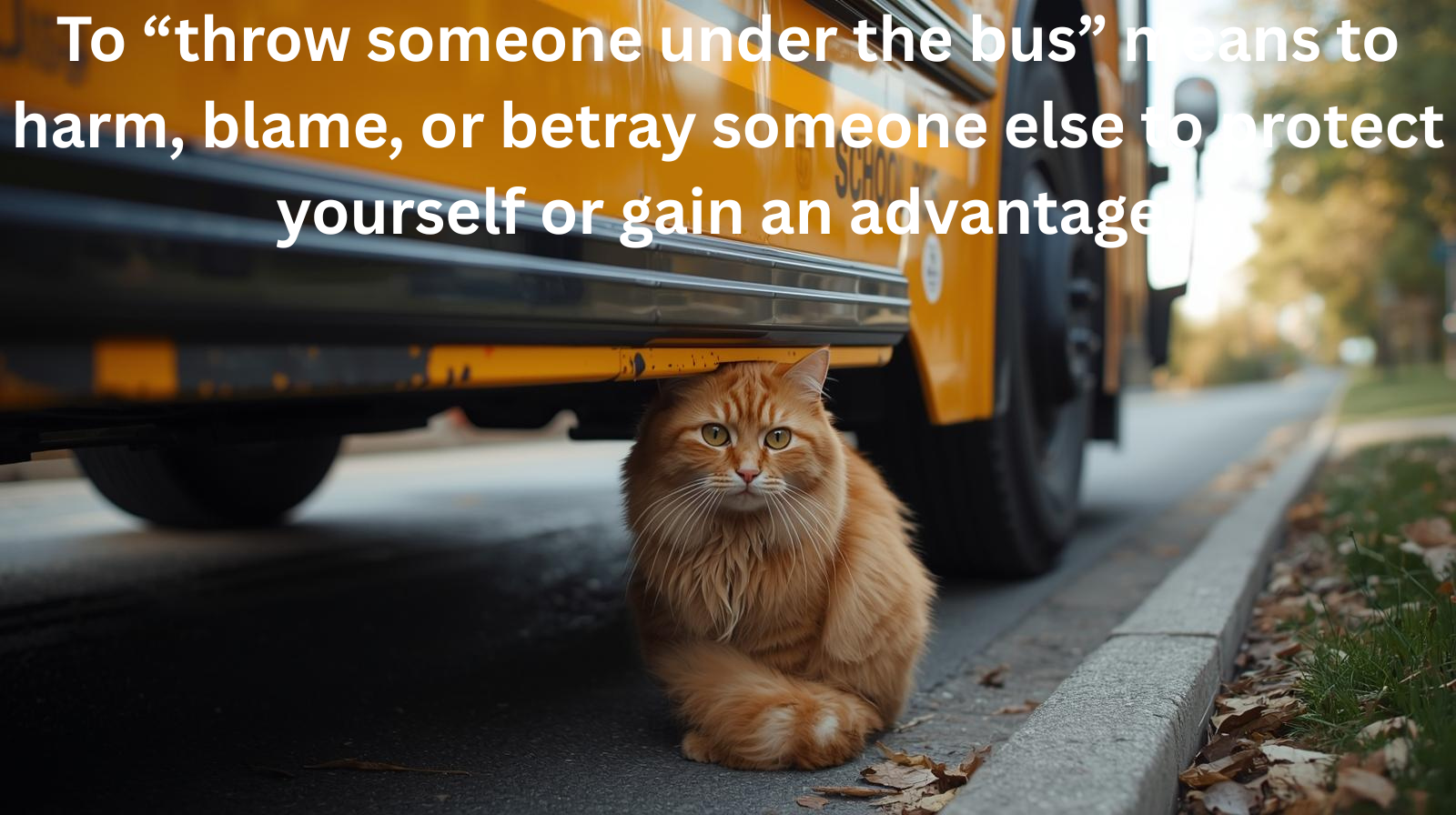
To “throw someone under the bus” means to harm, blame, or betray someone else to protect yourself or gain an advantage.
- Cambridge puts it plainly: “to do something harmful to someone else to gain an advantage for yourself.”
- Merriam-Webster emphasizes the scapegoating angle: to “criticize, blame, or punish” someone—mainly to avoid blame or gain advantage.
People sometimes write “through under the bus,” but the standard idiom is “throw (someone) under the bus.”
Quote
“‘Throwing someone under the bus’ is betrayal with a seatbelt on: you survive by making sure someone else takes the hit.”
Where It Comes From
1) It likely starts in British political talk
Merriam-Webster notes the origin is uncertain, but the most substantial evidence points to British politics, where “under a bus” was already used metaphorically for misfortune or sudden removal.
2) Earlier “under the bus” language predates the betrayal meaning
A related British political phrasing appears as early as 1971, using “go under a bus” as a hypothetical fate that conveniently removes a leader from the scene.
By 1980, “under the bus” shows up again in political writing as metaphorical misfortune—still not quite the modern “betrayal” sense.
3) The betrayal sense shows up clearly by 1982
Merriam-Webster cites a 21 June 1982 usage in The Times (London) describing someone being “pushed… under the bus,” which aligns strongly with the modern idea of sacrificing someone for political survival.
4) Then it goes mainstream (especially mid-2000s and beyond)
The phrase became enormously popular during the 2008 U.S. presidential election season, after building earlier visibility (including in sports journalism), according to Merriam-Webster.
Why a “Bus”? (The Image Works)
The idiom hits because the picture is instant: you redirect danger and consequences onto someone else—not a mild betrayal, but a vivid one. Merriam-Webster also connects it to older British “under a bus” phrasing used as a metaphor for misfortune or a conveniently timed “accident.
How to Use It
- Workplace: “When the deadline blew up, the Manager threw the junior analyst under the bus.”
- Politics/PR: “He threw his ally under the bus to distance himself from the scandal.”
- Every day: “Don’t throw me under the bus—we agreed on that plan together.”
Fast Alternatives (When You Want Variety)
If you’re writing and don’t want to repeat the cliché, try:
- “scapegoat” (more formal)
- “sell someone out” / “stab someone in the back” (more emotional)
- “shift the blame” (more neutral
-
Fun Quotes
🔥 Short, Punchy
- “Loyalty ends where self-preservation begins—and that’s where the bus pulls up.”
- “A bus isn’t the point. The point is: someone else takes the Impact.”
- “It’s not conflict. It’s outsourcing consequences.”
- “Some people don’t take responsibility—they reassign it.”
- “When the story goes bad, someone becomes the headline.”
- “If you’re wondering who’s under the bus, follow who’s suddenly spotless.”
- “Trust is built slowly—and sacrificed fast.”
- “The easiest way to look innocent is to make someone else look guilty.”
😈 Witty / Dark Humor (still clean)
- “‘Teamwork’ ends the moment blame becomes available.”
- “They didn’t solve the problem—they found a volunteer to wear it.”
- “Nothing says ‘leadership’ like pushing accountability downhill.”
- “Some folks don’t throw punches—they throw coworkers.”
- “The bus is just a metaphor for cowardice with good timing.”
- “If you can’t fix the mess, at least control who gets blamed for it.”
- “Career tip (for villains): keep a colleague between you and the consequences.”
💼 Professional / Corporate (LinkedIn-safe)
- “A culture that rewards blame will always run out of Trust.”
- “Accountability is a leadership trait; scapegoating is a survival tactic.”
- “If mistakes become punishable, honesty becomes optional.”
- “Healthy teams solve problems. Unhealthy teams assign casualties.”
- “When leaders protect reputations over people, performance always suffers next.”
- “The fastest way to lose talent is to make loyalty a liability.”
🧠 Insightful / Reflective (more “essay quote” vibe)
- “Betrayal isn’t always loud; sometimes it’s a quiet omission in a meeting.”
- “The cruelest part isn’t the blame—it’s the abandonment.”
- “If you need a scapegoat, you’ve already admitted you can’t own the outcome.”
- “A person ‘under the bus’ is usually someone who trusted the wrong ‘we.’”
- “Integrity is what you do when blame would be convenient.”
- “Reputation management is never an excuse for character damage.”
🧲 Extra-shareable “Definition in Disguise.”
- “To throw someone under the bus is to buy your safety with someone else’s pain.”
- “It’s self-defense—paid for with someone else’s career.”
- “It’s betrayal dressed up as ‘just being honest.’”
- “It’s how people stay clean in dirty situations.”
😂 Humorous Quotes
Quick zingers
- “Some people don’t solve problems—they assign them a coworker.”
- “Accountability is my love language. Yours is apparently public transportation.”
- “If blame were a sport, he’d be an Olympic bus driver.”
- “Nothing strengthens teamwork like deciding who gets sacrificed first.”
- “They didn’t throw me under the bus—more like scheduled me for a 7:15 arrival.”
- “He’s not ‘transparent.’ He’s just pointing at someone else with better lighting.”
- “When things go wrong, suddenly it’s ‘every man for himself’—and I’m the speed bump.”
- “Some folks keep receipts. Others keep scapegoats.”
- “I’d take the hit for the team… but the team already pushed me.”
- “He didn’t take responsibility—he took attendance and marked me absent.”
Workplace / corporate humor
- “Our process isn’t broken—our blame distribution is just highly optimized.”
- “Leadership tip: if you can’t fix the issue, at least pick a fall guy with good posture.”
- “We’re a family here… the kind where someone gets grounded for everyone’s mistakes.”
- “In this office, mistakes don’t happen—they get reassigned.”
- “That wasn’t feedback. That was a full-body shove with a PowerPoint slide.”
- “He said, ‘We’re in this together’—and then immediately drafted my resignation letter.”
- “Nothing says ‘collaboration’ like watching someone else take the blame in real time.”
- “Our motto: ‘Own your work.’ Our practice: ‘Loan out the consequences.’”
- “He called it ‘risk management.’ I called it ‘me under a bus.’”
- “I love a supporter—especially the kind who supports me… under the chassis.”
Sassy but clean
- “If loyalty had a refund policy, I’d like store credit.”
- “He didn’t betray me—he just ‘strategically repositioned’ me into traffic.”
- “Some people throw shade. Others throw coworkers.”
- “I didn’t get thrown under the bus—I got backed over with enthusiasm.”
- “She’s not two-faced. She’s ‘multi-platform.’”
- “If ‘not my fault’ were a vehicle, it would absolutely be a bus.”
- “He’s allergic to accountability—breaks out in scapegoats.”
- “It’s amazing how quickly ‘we’ becomes ‘you’ when the meeting starts.”
- “I’d say ‘thanks for the support,’ but I’m currently wedged between the tires.”
- “He didn’t deny it—he just introduced me to consequences.”
Mini one-liners
- “Betrayal, but make it mass transit.”
- “Scapegoating: now with wheels.”
- “Same team, different survival plan.”
- “I came for teamwork. I stayed for the tire tracks.”
- “Trusted the ‘we.’ Met the ‘oops.’”