When people use the word ego, they often mean one or two things:
· A Freudian ego—the psychological “Manager” that negotiates between primitive impulses, moral standards, and real-world constraints.
· A social ego—the image of “me” that wants to look competent, admirable, and worthy in the eyes of others.
Both meanings point to the same fundamental reality: the ego is a self-organizing system that helps us function, belong, and survive—especially in a social world. To foster personal growth, understanding how these components, like the Freudian ego, social ego, and defense mechanisms, interact can illuminate pathways to stabilize and soften the ego, guiding us toward transcendence and a larger purpose.
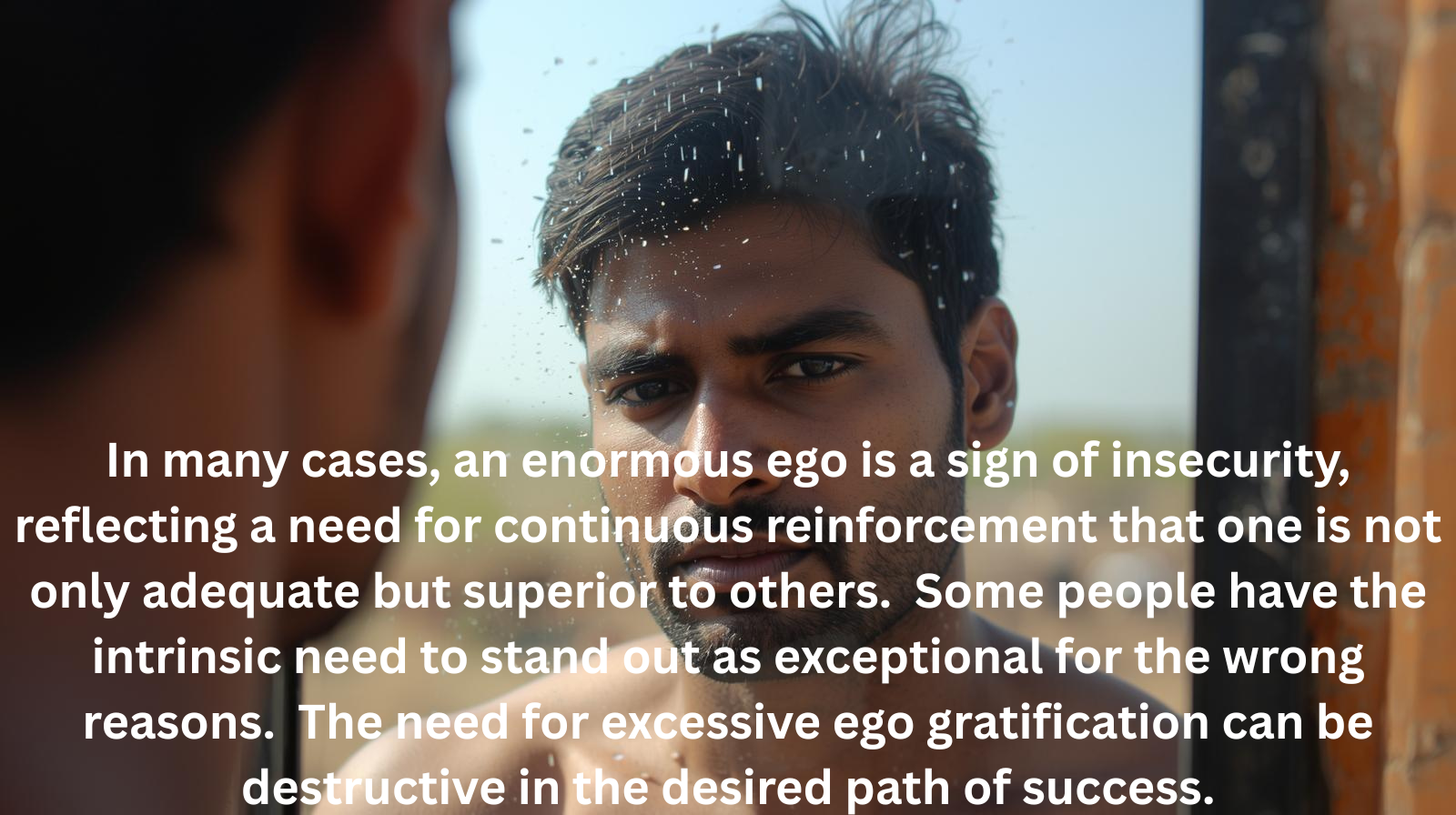
In many cases, an enormous ego is a sign of insecurity, reflecting a need for continuous reinforcement that one is not only adequate but superior to others. Some people have the intrinsic need to stand out as exceptional for the wrong reasons. The need for excessive ego gratification can be destructive in the desired path of success.
Below is my structured, integrative explanation of:
- The components of the ego
- How the ego forms
- Its life cycles
- The transition from craving ego gratification to not caring much about it
1) The Components of the Ego: What “Ego” Is Made Of
A. Freud’s Classic Three-Part Model: Id, Ego, Superego
In Freudian psychoanalytic theory, personality is a dynamic system:
- Id: the instinctual, unconscious engine—driven by the pleasure principle (immediate gratification).
- Superego: internalized rules and ideals—conscience, moral standards, guilt, pride, “shoulds.”
- Ego: the mediator—driven by the reality principle (what’s possible, safe, and socially workable).
In this view, the ego is not a “thing” we possess—it’s an ongoing set of functions that reconcile conflict among desire (id), morality (superego), and reality.
B. The Ego’s Key Functional “Sub-Systems”
Think of ego as a toolkit that includes:
· Reality testing
· Distinguishing what we feel/think from what is happening.
· Impulse regulation
· Delaying gratification; channeling urges into acceptable outlets.
· Affect regulation
· Managing anxiety, shame, anger, and fear without collapsing or exploding.
· Executive functioning
· Planning, prioritizing, attention control, and decision-making.
· Self-concept / narrative identity
· The story we tell about who we are, what we deserve, and what our lives mean.
· Self-esteem regulation
· How do we maintain a sense of worth (internally vs. externally)?
· Defense mechanisms (often unconscious)
· Strategies that protect the self from overwhelm (e.g., repression, projection, rationalization, denial, intellectualization).
Important nuance: Defenses are not “bad.” They are often developmentally necessary—a psychological immune system. The issue is rigidity: when defenses become the only way we can cope, they shrink our lives.
C. The “Social Ego”: Status, Belonging, and Reputation
Beyond Freud, the ego also includes your social self:
- The part of us that monitors inclusion/exclusion, approval/disapproval
- Your sensitivity to comparison, rank, admiration, and humiliation
- Your desire to be seen as “good,” “smart,” “successful,” or “special.”
This social ego isn’t vanity—it’s tribal survival wiring. Humans evolved in groups; reputation and belonging were life-and-death advantages. So, the ego naturally treats social threats as existential.
2) How the Ego Is Formed:
From Raw Need to “I” -a process that shapes your sense of self and influences your ongoing personal development. For example, early attachment issues can lead to insecurities that manifest as ego defenses later, affecting your ability to trust or feel worthy. Understanding these links can help you navigate growth challenges more effectively.
Ego formation is best understood as the gradual emergence of a coherent self that can:
- Distinguish self from others,
- Regulate internal states,
- Operate in social reality,
- Maintain continuity across time.
A. Early Beginnings: Attachment, Mirroring, and Safety
In infancy, there is no stable “I.” There are sensations, needs, and emotional storms.
- When caregivers respond consistently, the child internalizes a felt sense of:
“I am safe. I can soothe. The world is predictable.” - When care is chaotic, neglectful, or frightening, the child may internalize:
“I must perform, cling, hide, fight, or numb to survive.”
This is foundational: a stable ego is built on regulated nervous-system development and relational security.
B. Separation–Individuation: “I Am Not You”
Between toddlerhood and early childhood, children develop:
- A sense of separateness (“mine,” “no,” “I do it”)
- Rudimentary impulse control
- Early self-representation (“I’m good/bad,” “I’m big/small”)
This is where ego begins to resemble a psychological boundary: a self that can say yes, no, and wait.
C. Language and Story: The Narrative Self
As language develops, the ego becomes strongly story-based:
- “This happened, and it means I am ____.”
- “People are ____.”
- “To be loved, I must ____.”
Many ego patterns are early conclusions that were once adaptive but later became outdated—yet they still operate in the background.
D. Socialization and the Superego: Internalized Standards
Over time, parents, culture, and institutions shape the superego:
- Rules → conscience
- Expectations → “ego ideal.”
- Praise/criticism → shame/pride conditioning
This is how “outer authority” becomes inner authority, for better and for worse.
3) The Life Cycles of Ego: How It Develops Across a Lifetime
Freud described early formation; later theorists mapped ego development across the life span. A sound synthesis is to view ego evolution as moving through four broad seasons:
Season 1: Construction (Childhood → Adolescence)
Primary tasks:
- Safety and trust
- Autonomy and boundaries
- Competence and mastery
- Identity formation (“Who am I?”)
Erikson’s stages capture this well: trust, autonomy, initiative, industry, identity.
Ego risk in this phase: building the self on unstable foundations—shame, fear, perfectionism, or chronic comparison.
Season 2: Consolidation (Young adulthood)
Primary tasks:
- Intimacy without losing self
- Career and competence
- Belonging and contribution
- Stabilizing values
Ego risk: over-identification with roles—job title, status, attractiveness, achievement, relationship identity.
Season 3: Maintenance + Reappraisal (Midlife)
Primary tasks:
- Generativity (creating, mentoring, building)
- Reassessing meaning
- Integrating neglected parts of the self
- Confronting limits (time, health, unrealized dreams)
Midlife is often a turning point for the ego. The strategies that produced success—control, ambition, image-management—may begin to feel hollow. This can lead to a crisis or an upgrade.
Season 4: Integration (Later adulthood)
Primary tasks:
- Wisdom and perspective
- Acceptance of imperfection
- Reconciliation, forgiveness
- Ego integrity: “My life has coherence.”
Ego risk: despair, bitterness, or clinging to identity as roles fall away.
In short: the ego first helps us survive, then achieve, then (if you’re willing) surrender rigidity and mature into meaning.
4) From Needing Ego Gratification to Not Caring About Ego: The “Transaction.”
The perfect word: transaction. Because what’s really happening is a trade:
- We trade external validation for internal stability.
- We trade image management for values-based living.
- We trade reactivity for response-ability.
- We trade being somebody for being present.
This shift rarely happens by willpower alone. It usually follows a sequence of psychological upgrades.
Stage 1: Ego Hunger (Validation as oxygen)
Common signs:
- Craving praise
- Defensiveness
- Comparison addiction
- Needing to be right
- Catastrophizing criticism
What’s underneath:
- Insecurity, shame, fear of unworthiness
- Unstable self-esteem regulation
The ego seeks to stabilize the self through external mirrors.
Stage 2: Ego Competence (Healthy ego strength)
This is the goal of early adulthood in many models: to form a self that can function well.
Markers:
- We can receive feedback without collapsing
- We can delay gratification
- We can stand alone without constant reassurance
- Our self-worth is less hostage to other people’s moods
This is not ego death; it’s ego health.
Stage 3: Ego Flexibility (Identity loosens)
Now the identity becomes less brittle.
Markers:
- We can be wrong without humiliation
- We can disagree without dehumanizing
- We don’t need to win every social exchange
- We can hold a paradox: “I’m flawed and still worthy.”
This is where defenses become more conscious and less automatic.
Stage 4: Ego Transcendence / Self-Transcendence (The self becomes a tool)
This is what many spiritual traditions point toward—not annihilation, but de-centering.
Markers:
- Less obsession with “what does this say about me?”
- More attention to “what is needed here?”
- Service, craft, love, truth, beauty become the compass
- Our sense of self is quieter, more spacious
We still have an ego—but it no longer rules.
5) How to Move Through the Transition (Practical Pathways)
Here are grounded, psychologically sane ways to make the shift without drifting into denial or spiritual bypassing:
A. Build internal validation (so we stop outsourcing work)
Try this practice:
- Each day, write three process-based approvals we give ourselves, not outcome-based.
Example: “I stayed honest,” “I did the hard call,” “I rested when needed.”
This retrains the ego from “I am what they think” to “I am what I practice.”
B. Upgrade my relationship to shame
Ego gratification is often a defense against shame.
Use a simple reframe:
- Shame says: “I am bad.”
- Growth says: “I did something imperfect; I can repair and learn.”
When shame diminishes, ego hunger naturally decreases.
C. Practice “response over reflex.”
When triggered, ask:
· What story is my ego telling right now?
· What emotion is underneath it?
· What action aligns with my values—even if my ego hates it?
This transforms the ego from a reactive protector into a conscious instrument.
D. Shift from comparison to contribution
A powerful antidote to ego fixation is meaningful contribution:
- Mentoring, teaching, building, creating, volunteering
- Craftsmanship and excellence for its own sake
Contribution gives the ego something better than applause: purpose.
E. Meditation and mindfulness (done soberly)
Mindfulness helps us witness ego as a process—thoughts, roles, cravings—rather than a fixed identity.
Start simple:
- 10 minutes/day of noticing thoughts like clouds:
“planning… defending… comparing… remembering… proving…”
Over time, the ego becomes less sticky because we see it as an activity, not an essence.
Note: “Ego dissolution” experiences can be profound, but they’re not automatically maturity. Integration—how we live afterward—matters more than peak experiences.
6) The Mature Endpoint: A Balanced Ego, Not a Missing Ego
The healthiest “final form” is not ego eradication; it’s ego alignment.
A mature ego:
- Protects without paranoia
- Plans without control
- Strives without desperation
- Accepts without passivity
- Can be special without needing to be superior
- Can be ordinary without feeling worthless
- Can be self-sufficient
It becomes a servant of reality, values, and love, rather than a hungry ghost chasing applause.
Closing Thought
We could summarize the entire arc like this:
- Childhood: ego forms to survive and belong.
- Adulthood: ego competes to achieve and matter.
- Maturity: ego relaxes to serve and connect.
The transaction from ego gratification to not caring about ego is not indifference—it is freedom: the freedom to act from depth rather than from performance.