The Harsh Truth About Storage
We pay for storage, thinking we’re preserving value—but often, we’re just preserving clutter.
If you wouldn’t buy it today, why pay to keep it?
Everyday Items with Little to No Value
- Old couches and chairs (especially if they need repairs or reupholstering)
- Mass-produced collectibles (think figurines, novelty plates)
- Outdated electronics (CRT TVs, VCRs, old printers)
- Traditional dining sets (your kids don’t want them)
- Broken or mismatched furniture
- Old mattresses and box springs
- Decor from decades past (faux plants, heavy drapes)
- Cheap shelving units and particleboard furniture
- Area Rugs
Cost Analysis: What Clutter Really Costs
Imagine paying $120 monthly for a storage unit-that’s $1,440 annually. Over 10 years, that adds up to $14,400 spent on storing items that might sell for around $200 at a garage sale, illustrating how storage fees can significantly outweigh item value.
Translation: You’re paying 72 times more than the stuff is worth.
Real-Life Examples
- The 10-Year Couch: A family stored a sectional for a decade, paying $12,000 in storage fees. When they finally retrieved it, the fabric was brittle, and reupholstering would cost $2,500—more than buying new.
- The Collectible Trap: One man paid $100/month for five years to store boxes of “limited edition” figurines. When he tried to sell them, the entire lot fetched $75 on eBay.
- The Dining Set Dilemma: Parents saved a formal dining set for their kids. When offered, the kids said, “We don’t want heavy furniture.” The set was donated after $6,000 in storage fees were incurred.
Tips for Selling Old Items
- Start with local marketplaces: Facebook Marketplace, Craigslist, and OfferUp are free and fast.
- Use niche platforms: eBay for collectibles, Chairish for vintage furniture.
- Bundle low-value items: Sell in lots (e.g., “10 figurines for $20”) to move them quickly.
- Price realistically: Check sold listings, not asking prices—most items fetch far less than you think.
- Consider donating for tax write-offs: if the resale value is negligible, donating saves you money at tax time.
- Host a garage sale: Great for clearing out bulk items in one weekend.
- Take good photos: Clean items, use natural light, and show details—presentation matters.
Why This Matters
Storage costs add up. That money could fund a vacation, pay down debt, or build an emergency fund.
Decluttering can bring a sense of relief and control, making your financial goals feel more achievable.
Bottom Line
Stop paying to store stuff that’s worth nothing. Sell what you can, donate what you can’t, and reclaim your space—and your wallet.
“If you wouldn’t buy it today, why pay to keep it?”
Decluttering Tips That Actually Work
- Start small: Tackle one area at a time—garage, closet, or storage unit.
- Use the “One-Year Rule”: If you haven’t used it in 12 months, you probably never will.
- Sort into three piles: Sell, Donate, Trash—and stick to it.
- Set a deadline: Give yourself 30 days to clear the space; deadlines prevent procrastination.
- Digitize memories: Scan old photos or documents instead of storing boxes.
- Ask the tricky question: Would I repurchase this today? If not, let it go.
- Track savings: Calculate what you’ll save by canceling storage fees—motivation matters.
- Schedule pickups: Use donation services like Goodwill or Habitat for Humanity to remove items quickly.
✅ Decluttering Checklist:
Step 1: Prep
- Set a deadline (e.g., 30 days)
- Gather boxes or bins labeled Sell, Donate, Trash
- Take “before” photos for motivation
Step 2: Sort
- Apply the One-Year Rule: Haven’t used it in 12 months? Let it go.
- Ask: Would I repurchase this today?
- Digitize old photos/documents instead of storing boxes
Step 3: Sell
- List valuable items on Facebook Marketplace, Craigslist, or OfferUp
- Use eBay for collectibles, Chairish for vintage furniture
- Bundle low-value items into lots
- Take clear, well-lit photos
Step 4: Donate
- Schedule pickup with Goodwill, Habitat for Humanity, or local charities
- Keep donation receipts for tax deductions
Step 5: Trash
- Dispose of broken, stained, or unsafe items
- Recycle electronics responsibly (Best Buy, local e-waste programs)
Step 6: Cancel Storage
- Empty your storage unit
- Cancel the contract and calculate savings
- Celebrate your reclaimed space and extra cash!
What do your grown-up kids really think about all your old possessions?
1. “We don’t want heavy furniture.”
Formal dining sets, china cabinets, and bulky sofas often feel outdated and impractical. Today’s homes lean toward minimalism and multifunctional spaces—your kids likely prefer lighter, modern pieces.
2. “Collectibles aren’t collectible.”
Those “Made in China” figurines or commemorative plates? They rarely hold sentimental or market value. Millennials and Gen Z tend to value experiences over objects.
3. “We already have our own style.”
Your kids have curated their own aesthetic. That antique dresser you saved might clash with their modern apartment vibe.
4. “Storage is a burden, not a gift.”
Passing down boxes of old decor or furniture can feel overwhelming. Involving your adult children in decisions can foster connection and address concerns about their preferences and needs.
5. “Memories matter, but not the stuff.”
They cherish family photos and stories—but not the physical clutter. Digitizing memories is often more meaningful than keeping bulky heirlooms.
Bottom Line: Most grown-up kids appreciate the thought, but they don’t want the responsibility of outdated possessions. If you’re holding onto things “for them,” ask first. Chances are, they’ll say: “Please don’t.”
What Your Grown-Up Kids Really Think
- “Please don’t save that dining set for me—I don’t even have a formal dining room.”
- “Those figurines? Honestly, I’d rather have the space than the stuff.”
- “I appreciate the thought, but I have my own style now.”
- “We love the memories, not the furniture. Scan the photos instead.”
- “If you give it to me, I’ll probably donate it.”
Humorous quotes from adult kids
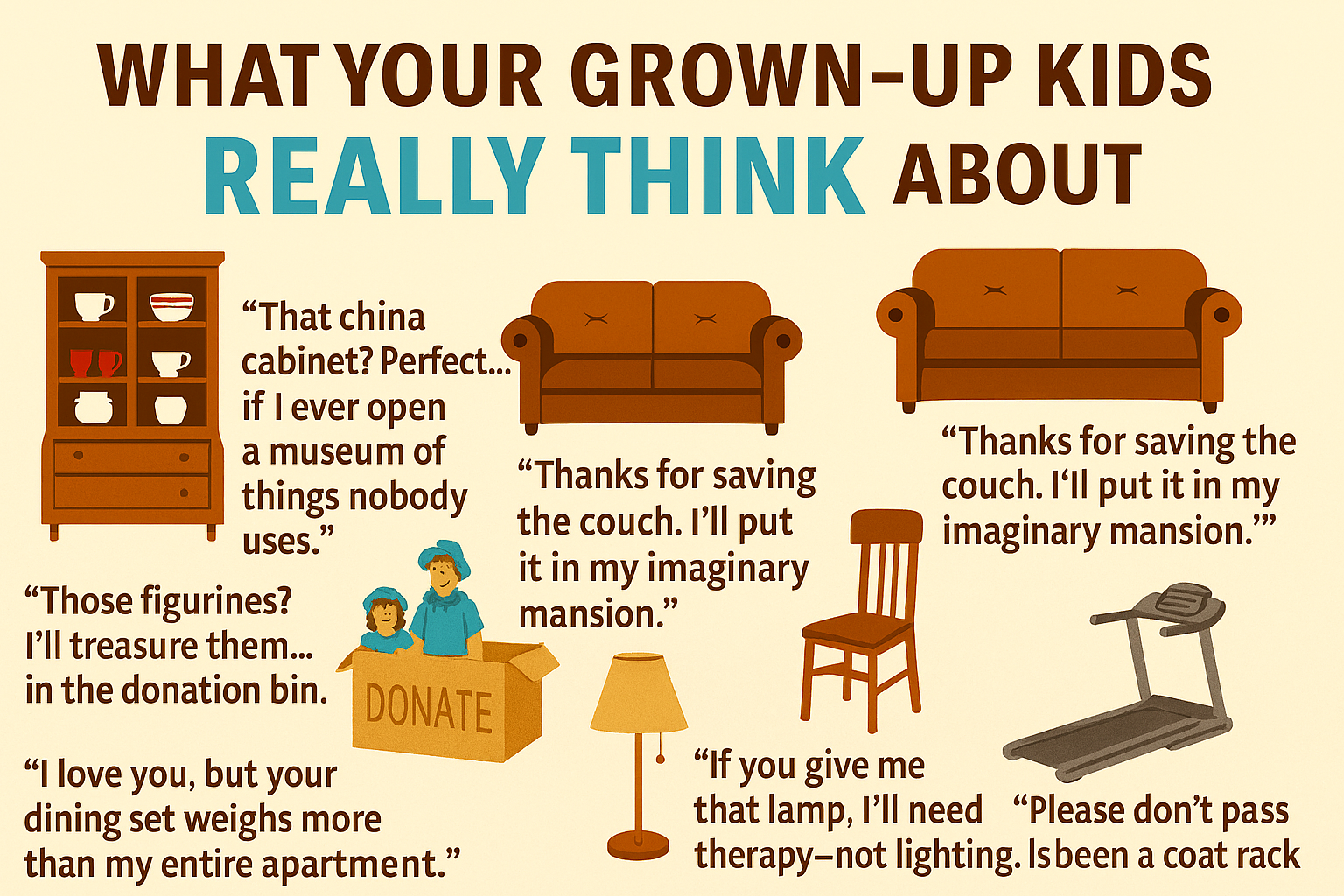
- “That china cabinet? Perfect… if I ever open a museum of things nobody uses.”
- “Thanks for saving the couch. I’ll put it in my imaginary mansion.”
- “Those figurines? I’ll treasure them… in the donation bin.”
- “I love you, but your dining set weighs more than my entire apartment.”
- “If you give me that lamp, I’ll need therapy—not lighting.”
- “Please don’t pass down the treadmill. It’s been a coat rack for 15 years.”
Closing
Bottom Line: Your grown-up kids don’t want a museum of outdated furniture—they want freedom from clutter. Holding onto old possessions “for them” often creates stress, not gratitude. Instead of paying to store items no one will use, turn nostalgia into action: keep the memories, let go of the stuff. Declutter now, reclaim your space, and invest in experiences that matter—because the best inheritance isn’t a china cabinet, it’s a life well-lived.