Summary
To effectively dismantle it, leaders must recognize early signs such as staff productivity drag, decision delays, excessive approvals, or stakeholder gridlock, which signal deep entrenchment. Recognizing these signs can evoke a sense of urgency and concern, encouraging proactive leadership to address underlying issues.
What is bureaucratic entrenchment?
Bureaucratic entrenchment refers to a state where an organization’s structures, rules, and practices become so deeply rooted that they resist change, even when outdated. Leaders must model new behaviors to inspire confidence and demonstrate commitment to change.
It typically manifests in two primary ways within an organization:
1. Structural and Procedural Entrenchment
This is the ‘rigidity’ of the system itself. Over time, standard operating procedures (SOPs) and hierarchical layers become ‘stress-tested’ and survive multiple leadership changes, making them nearly impossible to overturn. Leaders can initiate process reviews and eliminate unnecessary approval steps to reduce structural entrenchment and promote agility.
Rule Adherence: Employees prioritize following due Process and regulations over achieving productive results or innovation.
- Red Tape: Procedures designed to ensure accountability become excessive, creating complex administrative hurdles that slow down decision-making.
2. Individual or Psychological Entrenchment
This refers to a condition where employees remain in an organization not because they are committed to its goals, but because the costs of leaving (e.g., loss of seniority, benefits, or lack of alternatives) are higher than the costs of staying. Leaders should implement strategies like recognition programs and career development to reduce these perceived costs and encourage proactive engagement.
Lack of Engagement: Entrenched individuals often stop contributing creatively or struggle to improve, leading to a “stale” organizational culture.
- Self-Preservation: In the “acquisitive model,” bureaucrats may work to maximize their budgets and resources solely to protect their own department’s status, regardless of overall organizational efficiency.
- Lateral Mobility: Finding another job is stressful. The easy way out is to stay put and burrow your way into a company quagmire (a figurative state of voluntary entrapment).
Key Characteristics:
Hierarchy: A fixed chain of command that limits individual discretion.
- Impersonality: Decisions are made based on rigid, objective rules rather than individual circumstances.
- Inflexibility: An inability to adapt to unique needs or sudden environmental shifts.
- Leadership fails to convey the company’s mission and deliver a results-driven, rather than process-driven, environment
Below is a clear, leadership-focused view of:
· What happens as entrenchment spreads?
· Why it blocks results orientation,
· How to dismantle it without creating chaos.
1) What Happens When Bureaucratic Entrenchment Spreads Organization-Wide
A. Decision-making slows and becomes indirect
- Decisions migrate from accountable leaders to committees, gatekeepers, and “review culture.”
- People optimize approval rather than outcome.
- The org develops a “permission economy”: progress requires many signatures, and no single person owns the result.
-
Subversion and deflection become an underlying platform within the organization.
Symptoms
- Projects stall in “alignment” and “stakeholder review.”
- Meetings replace execution.
- “Waiting on…” becomes the default status update.
B. Process becomes the product
When entrenchment spreads, process adherence turns into a proxy for competence:
- Being “procedurally correct” matters more than being right.
- Being “procedurally correct” matters more than getting results.
- Teams protect themselves by following steps, even if the steps are pointless.
- Innovationcan appear threatening because it introduces variance from the status quo and invites change.
Symptoms
- Box-checking and compliance theater.
- Excess documentation with thin insight.
- Endless handoffs and “requirements” that no one can justify.
C. Risk aversion becomes cultural, not tactical
Instead of managing risk intelligently, the organization tries to eliminate blame:
- People avoid decisions that could be criticized.
- “Don’t get in trouble” replaces “deliver value.”
Symptoms
- Over-control of low-risk activities.
- Under-investment in experiments.
- Fewer accountable commitments; more hedged language.
D. Informal power networks overtake formal authority
Entrenched organizations often develop shadow hierarchies:
- Long-tenured gatekeepers, policy owners, and system administrators become the real blockers/approvers.
- New leaders can issue directives, but execution requires “buy-in” from unofficial power centers.
Symptoms
- “Talk to Pat first” (Pat is not the Manager).
- Leaders “announce” changes that never happen or fade over time.
- The org chart and reality diverge.
E. Talent adapts in unhealthy ways
High performers either leave or learn to survive:
- The best people get frustrated by delays and ambiguity of ownership.
- Others become skilled at politics, policy-citing, and deflection.
Symptoms
- Attrition of builders and doers.
- Promotions skew toward “navigators” rather than “producers.”
- Increased cynicism: “This will blow over.”
F. The organization loses signal-to-noise
As layers grow, the truth gets filtered:
- Front-line reality is diluted before it reaches leadership.
- Leaders operate on polished narratives rather than operational facts.
Symptoms
- Surprises: “We didn’t know it was that bad.”
- Metrics that look good while customers suffer.
- A widening gap between stated priorities and actual behavior.
2) How Entrenchment Undermines a Process-Driven → Results-Driven Transition
A results-driven organization requires three things:
· Clear outcomes (what matters)
· Fast, empowered decisions (who decides)
· Real accountability (who owns results)
Bureaucratic entrenchment attacks all three.
A. It converts “results” into secondary goals
When the Process is entrenched, outcomes become aspirational slogans:
- People treat results as leadership rhetoric while Process remains career reality.
- Incentives reward avoiding mistakes rather than delivering value.
Practical effect: You’ll get beautifully governed projects that arrive late, over budget, and under-impactful—but “followed the process.”
B. It prevents ownership by multiplying veto points
Results-oriented work requires single-threaded ownership (one accountable owner). Entrenchment creates:
- Many approvers, few owners.
- Many reviewers, no decider.
Practical effect: Teams can’t commit credibly because anyone can block.
C. It punishes autonomy (which results in)
Results-driven systems rely on empowered teams making decisions close to work.
Entrenchment:
- centralizes control,
- adds steps,
- and treats deviation as disobedience.
Practical effect: Teams stop innovating and start “managing optics.”
D. It creates metric illusions
Process-driven orgs often measure:
- volume of activity,
- compliance with steps,
- timeliness of paperwork.
Results-driven orgs must measure:
- cycle time,
- quality,
- customer outcomes,
- cost-to-serve,
- rework/defects,
- throughput.
Entrenchment fights this shift by clinging to “safe” internal metrics.
Practical effect: Leadership thinks the transformation is working because dashboards look tidy, while value delivery stays stagnant.
E. It causes “change fatigue” and passive resistance
If past transformations were announced but not sustained, employees assume:
- “This is another initiative.”
- “Wait it out.”
- “Do minimal compliance.”
Practical effect: You get compliance theater, not behavioral change.
3) How Leadership Should Dismantle Entrenchment (Without Creating Chaos)
Dismantling entrenchment is not motivational speech. It is a structural shift in thinking: decision rights, incentives, measurement, and governance design.
Think of it as removing veto points and rebuilding accountability pathways.
The Leadership Playbook (Practical and Sequenced)
Phase 1 (Weeks 1–4): Diagnose where entrenchment lives
Goal: Identify the specific mechanisms creating drag.
Do three fast audits
· Decision audit
o Pick 5 critical decisions made recently.
o Map: who proposed, who reviewed, who decided, how long it took, and how many handoffs occurred.
· Approval audit
o For a typical initiative, count approvals and mandatory reviewers.
o Highlight any approval that doesn’t materially reduce risk.
· Policy audit (“Zombie rules”)
o List policies/procedures that are outdated, duplicated, or impossible to follow consistently.
o If a rule is routinely bypassed, it’s not a rule—it’s a liability.
Deliverable: A short list of the top 10 friction points and their owners.
Phase 2 (Weeks 5–12): Redesign decision rights and remove passive veto
Goal: Replace committee culture with accountable ownership.
A. Install “single accountable owner” for outcomes
For every major initiative:
- 1 owner accountable for results,
- a small set of advisors who can recommend,
- limited approvers only where actual risk exists.
A simple rule:
Many can advise. Few can approve. One owns the outcome.
B. Cap approvals and time-box reviews
- Default review windows (e.g., 48–72 hours).
- “Silence equals consent” for low-risk decisions.
- Escalation path when a reviewer blocks.
C. Convert approvals into guardrails
Instead of “permission,” use:
- thresholds (dollars/risk levels),
- standard templates,
- auditability,
- post-facto sampling.
This preserves compliance while restoring velocity.
Phase 3 (Month 3–6): Align incentives with results (or the bureaucracy will return)
Goal: Make it professionally rational to deliver outcomes.
A. Change what gets rewarded
Promotions and ratings must reflect:
- measurable outcomes delivered,
- cycle-time improvement,
- quality/rework reduction,
- Customer Impact,
- cross-functional cooperation.
B. Penalize “process obstruction.”
Not harshly—predictably. Obstruction looks like:
- serial blocking without alternatives,
- endless “requirements” that don’t reduce risk,
- recurring non-decisions.
C. Protect intelligent risk-taking
A results-driven culture requires psychological safety around:
- experiments,
- learning,
- reversals when data changes.
Without this, people cling to bureaucracy as armor.
Phase 4 (Month 6–12): Reduce knowledge monopolies and rebuild capability
Goal: Prevent gatekeepers from becoming structural choke points again.
A. Break knowledge hoarding
- Cross-train.
- Document critical systems.
- Rotate roles in high-control areas.
- Build redundancy in key processes.
B. Simplify and standardize the “minimum viable governance.”
Results-driven does not mean undisciplined. You still need:
- safety rules,
- legal compliance,
- financial controls,
- security protocols.
But you remove everything that exists solely to distribute blame.
The Non-Negotiable Leadership Behaviors
Even significant structural reform fails if leadership behaviors reinforce entrenchment.
Leaders must:
- decide faster and clearly (ambiguity breeds committees),
- hold owners accountable (not committees),
- Stop rewarding political navigation as competence,
- model escalation discipline (resolve blocks, don’t tolerate them),
- kill sacred cows (including legacy approvals that executives secretly rely on).
If leadership continues to use old approval paths, the organization will, too.
How You Know It’s Working (Leading Indicators)
Look for these measurable shifts:
- Decision cycle time drops (days/weeks → hours/days).
- Approvals per initiative decrease materially.
- Handoffs reduce; teams own work end-to-end.
- Rework rate decreases (quality improves as ownership clarifies).
- Customer outcomes improve (NPS, churn, SLA, complaints).
- Top-talent retention improves (builders stay).
If you only measure sentiment, you’ll miss whether the machine is changing.
Common Mistakes to Avoid
· Announcing “results-driven” without changing incentives
· Removing controls indiscriminately (creates chaos and compliance risk)
· Letting committees persist “temporarily” (temporary becomes permanent)
· Treating gatekeepers as villains (many are responding rationally to the system)
· Trying to fix culture without redesigning structure
Culture follows what the system rewards.
Bottom Line
When bureaucratic entrenchment spreads, the organization becomes optimized for self-protection rather than value creation. A process-driven organization trying to become results-driven must do more than encourage outcomes—it must re-architect decision rights, incentives, and governance so results become the safest, most rewarded path.
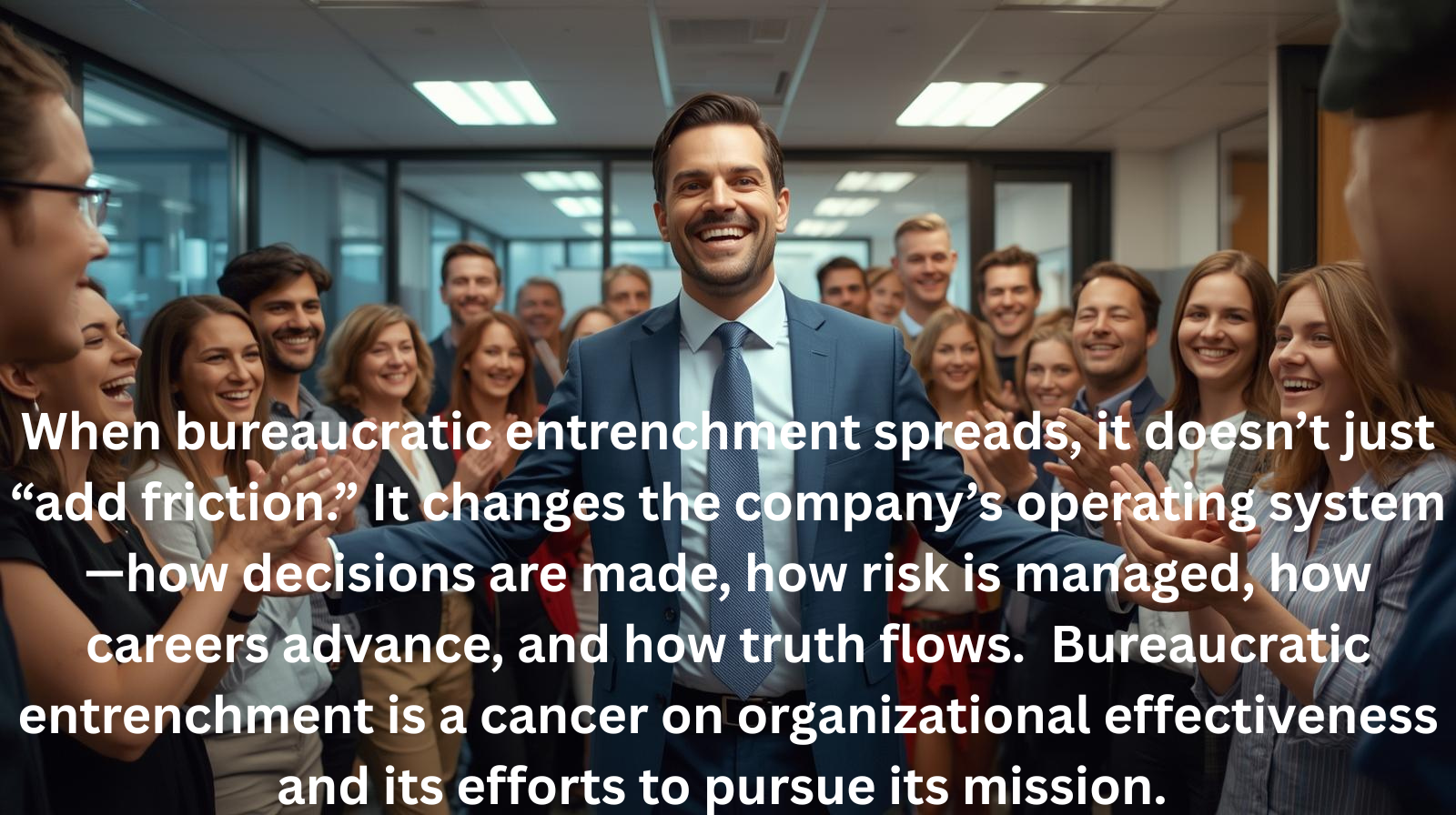
When bureaucratic entrenchment spreads, it doesn’t just “add friction.” It changes the company’s operating system—how decisions are made, how risk is managed, how careers advance, and how truth flows. That shift has predictable consequences, especially for organizations moving from process-driven to results-driven.