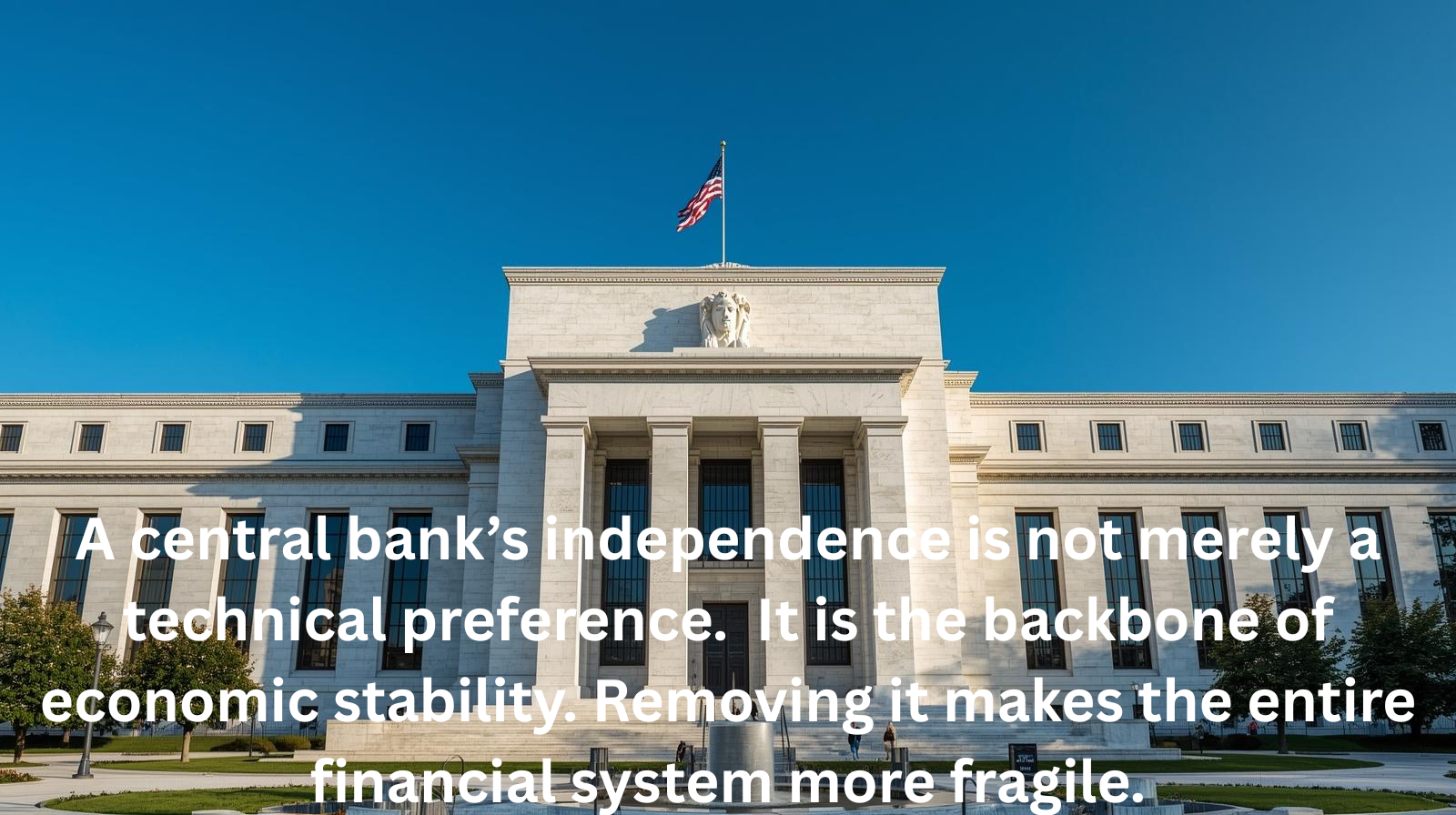
How Political Pressure Affects Monetary Policy
Political pressure can profoundly influence a central bank’s decisions and effectiveness. While monetary authorities are designed to operate independently, in many advanced and developing economies, political actors often attempt to influence interest rates, asset purchase programs, and broader financial conditions. These pressures distort economic outcomes, undermine institutional credibility, and can create severe long-term instability.
1. Political Pressure Pushes Central Banks Toward Easier Money
Research shows that when political actors pressure a central bank to ease policy—usually by lowering interest rates—the result is higher long-run inflation without corresponding gains in real economic activity.
A recent empirical study examining historical U.S. presidential interactions with the Federal Reserve found:
- Political pressure raises the price level strongly and persistently
- It does not improve real economic output, contradicting the premise of stimulus
- Its effects differ from regular rate cuts because it raises inflation expectations more sharply
These findings are drawn from an archival-based identification of presidential attempts to influence monetary decisions.
2. Inflation Becomes More Persistent Under Political Influence
Broader economic research shows that central bank independence is directly correlated with lower, more stable inflation. When political economy factors erode central bank independence, the institutional capacity to control inflation declines.
The Brookings Papers on Economic Activity stress that political-economy pressures are a central driver of long-run inflation trends and that political interference can push inflation upward unless offset by stronger institutional independence.
Similarly, the IMF’s 2025 Regional Economic Outlook shows:
- Countries with lower de facto independence experience higher inflation
- Political pressure undermines the long-term credibility needed for price stability
- Institutional reforms only work if they prevent political intervention in decision-making
3. Political Interference Destabilizes Markets
When investors perceive a central bank as politically influenced, financial markets react negatively. Markets depend on predictable, data-driven monetary policy. Political interference undermines that predictability.
A January 2026 analysis of U.S. monetary policy describes how political pressures have challenged the Federal Reserve’s independence, producing:
- Market volatility
- Delayed corporate investment
- Fragmented supply chains
- Policy mismatches rather than economic fundamentals drive higher inflation.
These disturbances demonstrate how political actors advocating specific monetary outcomes can generate cascading economic distortions.
Historical episodes reinforce this risk. The 2025 report describing tensions between President Trump and the Federal Reserve Chair shows that public political demands for lower rates triggered:
- Spikes in Treasury yields
- A weakening dollar
- Stock‑market sell-offs
These reactions occurred even without a policy change, demonstrating how mere threats of political interference can destabilize financial markets.
Political Pressure Weakens Central Bank Credibility
Central bank credibility is built on the belief that decisions are made independently and are focused on long-term stability. Political influence undermines this reputation, making it harder for the bank to manage expectations around inflation and growth.
At the World Economic Forum’s 2026 annual meeting, central bankers emphasized that trust and credibility are “absolutely crucial” to monetary effectiveness. Without independence, central banks struggle to fulfill their primary mandate: maintaining price stability.
Loss of credibility has direct economic consequences:
- It raises inflation expectations
- It increases risk premiums on government debt
- It forces more aggressive and economically painful corrections later
Once credibility erodes, it can take years—or even decades—to restore.
5. Distorted Policy Leads to Misaligned Economic Outcomes
Political leaders often prioritize short-term economic gains, particularly during election cycles. This can lead to:
- Pressure to lower interest rates to stimulate growth temporarily
- Avoidance of necessary rate hikes during inflationary periods
- Monetary policy accommodating fiscal expansions or trade disruptions
These pressures compel central banks to assume roles for which their tools are not designed. For example, when the Federal Reserve sought to offset inflation caused by trade policies, it found that rate cuts could not counteract inflation driven by political decisions outside monetary control.
This mismatch underscores why independence is essential: central banks cannot effectively neutralize inflation originating from politically driven disruptions.
Conclusion: Political Pressure Undermines Monetary Stability
Political influence over monetary policy may offer short-term political advantages, but it almost always produces long-term economic harm. Research and recent global examples show consistent patterns:
- Inflation rises when politics distort monetary decisions
- Markets become volatile due to the loss of predictability
- Credibility declines, making future monetary policy less effective
- Economic growth does not improve sustainably
- Central bank tools weaken when forced to counteract politically induced distortions
For monetary policy to function, central banks must remain insulated from short-term political ambitions. Independence is not simply an institutional preference—it is the foundation of economic stability.
Below are well-documented, real-world examples of political pressure on central banks, drawn directly from recent research, global case studies, and documented episodes in the U.S. and abroad.
Examples of Political Pressure on Central Banks
1. U.S. Presidential Pressure on the Federal Reserve
Historical and modern evidence indicate that U.S. presidents have sought to influence the Federal Reserve toward easier monetary policy.
Nixon Pressuring Fed Chair Arthur Burns (1970s)
Archival records and narrative economic research document that President Nixon applied personal and political pressure on Federal Reserve Chairman Arthur Burns to ease monetary policy ahead of the 1972 election.
- This pressure raised the price level strongly and persistently, without improving real economic activity.
Trump–Powell Tensions (2025)
In 2025, tensions between President Trump and Fed Chair Jerome Powell triggered severe market reactions.
- Trump demanded dramatic interest‑rate cuts, suggesting rates should be three percentage points lower, and even signaled the possibility of firing Powell.
- This political interference caused market volatility, spikes in Treasury yields, a weaker dollar, and stock sell-offs before statements were clarified.
2. Political Pressure Undermining U.S. Monetary Policy (2020–2025)
A 2026 analysis emphasizes that political actors increasingly sought to align monetary policy with partisan goals, pressuring the Federal Reserve to adjust rates to offset political disruptions.
- Political tensions prompted the Fed to pursue monetary easing, even though other political factors (such as trade policy uncertainty) were the primary drivers of inflation and investment delays.
- This created delayed corporate investment, fragmented supply chains, and higher inflation, illustrating how political interference distorted policy effectiveness.
3. Emerging Market Examples: Turkey and Argentina
Globally, some of the clearest examples of political interference appear in emerging markets.
Turkey
While not detailed in the citation in narrative form, the source highlights Turkey as a prime modern case where political interference led to:
- Surging inflation
- Currency crises
- Loss of central bank credibility
Turkey’s pattern of presidents pressuring central bank governors—often firing them for not cutting rates—has contributed to repeated financial instability.
Argentina
Similarly, Argentina has faced years of political pressure on its central bank, resulting in artificially low interest rates and credit expansion.
- This contributed to significant spikes in inflation and repeated currency devaluations, driven by the loss of institutional independence.
4. Global Concern About Rising Political Pressure (2026 WEF Meeting)
At the 2026 World Economic Forum, central bankers warned that political pressures were increasingly complicating monetary policy.
- They emphasized that credibility and trust are “absolutely crucial,” and political pressure undermines both.
- Central banks face increasing challenges from geopolitical tensions and domestic political interference, which threaten their ability to maintain price stability.
5. Political Economy Forces Driving Inflation (Global Research)
Economic research from Brookings (2024) concludes that political-economy factors create pressures that influence central banks’ long-run inflation outcomes.
- These pressures can push inflation upward unless counterbalanced by stronger independence or credible debt policies.
- This reflects how political influence—direct or indirect—shapes monetary policy over time.
6. Evidence from International Dataset Studies
IMF research analyzing 153 countries over four decades shows that weakening de facto independence—often through political turnover or interference—leads to:
- Higher inflation
- Worse long-term monetary outcomes
- Reduced the effectiveness of monetary reforms
These findings underscore how political intervention consistently worsens inflation performance across countries.
Summary: Clear Patterns Across Countries
Political pressure on central banks takes many forms—public criticism, demands for rate cuts, threats to remove governors, or policy mandates that conflict with monetary policy objectives. Across all examples above, the results show consistent themes:
- Higher inflation
- Market volatility
- Loss of central bank credibility
- Distorted economic decisions
- Long-term instability