Summary
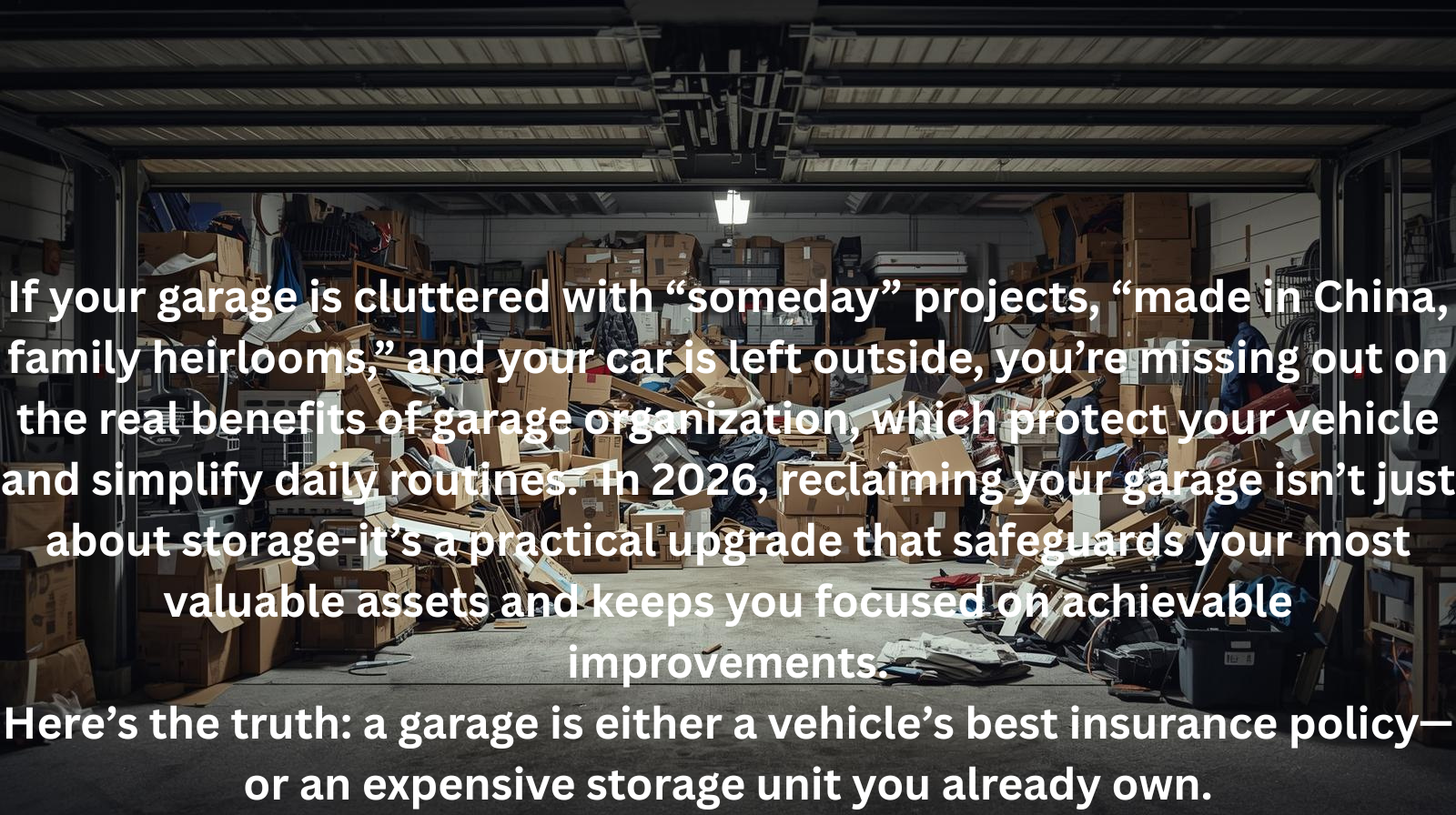
If your garage is cluttered with “someday” projects, “made in China, family heirlooms,” and your car is left outside, you’re missing out on the real benefits of garage organization, which protect your vehicle and simplify daily routines. In 2026, reclaiming your garage isn’t just about storage-it’s a practical upgrade that safeguards your most valuable assets and keeps you focused on achievable improvements.
Here’s the truth: a garage is either a vehicle’s best insurance policy—or an expensive storage unit you already own.
The Real Cost of “Just Leaving It Outside”
Outdoor parking feels harmless because it’s gradual. But cars don’t degrade in dramatic, headline-worthy ways—they fade, dry out, crack, and corrode one season at a time. Sunlight slowly oxidizes paint and bakes dashboards. Moisture creeps into seams and undercarriage components. Bird droppings and tree sap etch the clear coat. Hail doesn’t schedule appointments.
The financial Impact becomes clear at resale or trade-in, when a weathered finish and worn interior lead buyers to value your car lower. Parking your vehicle in a garage can help preserve its value and save you money over time.
Takeaway: “Weather doesn’t just damage cars—it negotiates the resale price for you.”
And the financial consequence shows up when you least want it: at resale or trade-in, when a buyer sees a tired finish and weathered interior and quietly marks your car down. Highlighting safety and Security can help homeowners feel more protected and cared for.
Why Garage Parking Is a 2026 “Life Upgrade”
Indoor parking offers benefits that directly Impact your finances and daily routine, making it a smart upgrade for 2026 and beyond.
A vehicle stored indoors is shielded from UV exposure, precipitation, dust, and airborne contaminants, helping you maintain its value and feel proud of your Investment.
A vehicle stored indoors is shielded from UV exposure, precipitation, dust, and airborne contaminants. Over time, that means fewer paint repairs, fewer interior replacements, and fewer “mystery” issues caused by seasonal extremes. Emphasizing how the organization simplifies maintenance can make homeowners feel more in control and relieved.
Less sun and fewer weather events mean slower aging, which in turn leads to higher resale value.
2) Improves Reliability in Daily Driving
Stable temperatures reduce strain on batteries and electronics. Fluids remain closer to the operating range. Rubber seals and tires last longer when they aren’t repeatedly baked and frozen. Focusing on reliability can help homeowners feel more confident in their daily driving.
Takeaway: “A garage doesn’t just store your car—it stabilizes it.”
3) Strengthens Security
A closed garage door is a simple deterrent, and deterrents matter. Thieves prefer speed, privacy, and easy access. Indoor parking reduces your exposure and helps prevent small thefts (packages, accessories, loose items) from becoming recurring issues.
4) Professional Criminal Theft Ring
Multiple recent reports from Southern California describe unmarked tow trucks or pickups equipped with a self-loading wheel-lift pulling up behind parked vehicles at homes and towing them away in under a minute, sometimes without the driver even getting out.
FOX 11 Los Angeles reports surveillance footage from Rancho Cucamonga showing an unmarked tow truck using a self-loading lift and leaving quickly, and notes that the sheriff’s department has received multiple reports of similar thefts.
CBS Los Angeles similarly reports a San Bernardino case in which deputies said they’re investigating several tow-truck-involved thefts across Southern California, and the victim told the crew, “just back[ed] it up… and leave.”
ABC7 Los Angeles reported a Tarzana incident in which a pickup with a tow hitch hooked the car and drove away, with the owner emphasizing that it looked “legitimate” to bystanders (“repo guy” optics). ],
What’s “new” isn’t the equipment—it’s the frequency and the brazenness. Wheel-lift systems have long been used in legitimate towing and repossessions, and some products are marketed specifically for speed and self-loading convenience.
5) Why does this criminal method work so well
? It exploits bystander psychology (“looks official”)
A tow truck (or tow-equipped pickup) in motion is considered “authorized activity,” especially at night or during a quick pass-by.
ABC7 captured this perfectly: the victim said people who see it assume it’s a repo or a legitimate tow, which reduces the likelihood that anyone will challenge it.
b. It bypasses the normal “start the car” defenses
If a thief can physically remove a vehicle, they may not need to defeat your key system on-site.
That’s why this trend feels unnerving: it makes many everyday anti-theft habits (like guarding your key fob) feel less decisive—at least at the moment of removal.
c. It’s fast—speed reduces witnesses and intervention
Legitimate wheel-lift solutions are designed to minimize time and effort (sometimes marketed in seconds), which also explains why criminals favor them.
FOX 11 notes the self-loading lift allowed the thief to get away “in less than a minute.”
d. It can defeat “connected car” confidence
In the CBS case, the victim said the truck’s tracker had been disabled—suggesting offenders may anticipate modern recovery tools.
6) How big is the broader auto-theft problem right now?
Zooming out, national theft totals fluctuate year to year, but auto theft remains a significant issue, with California consistently among the high-volume states in recent years.
The Insurance Information Institute (citing NICB) reports 2024 vehicle thefts fell below 1 million nationally, down from 2023, but still substantial overall.
7) What helps against “tow-and-go” theft (practical defenses)
Because this tactic is about removal, the best defenses are layers that (a) deny access, (b) slow removal, and (c) increase detection.
· Best: Park inside a locked garage
This is the cleanest fix: it removes opportunity and access.
California’s Air Resources Board, in its theft deterrence guidance, bluntly notes the best deterrent is parking in a garage (they’re discussing converter theft, but the opportunity logic applies even more strongly to vehicle removal).
· If outside, block tow-truck positioning
Use physical layout to your advantage—a tow needs space and alignment.
Driveway barriers (fold-down parking posts, removable bollards, or a locked gate) can prevent a truck from backing into the required position, eliminating the loud, time-consuming struggle that would otherwise occur.
· Add anti-tow friction (things that slow removal)
A wheel clamp/boot is inconvenient—but that’s the point: it increases time and visibility. [
Motion-activated lighting + cameras raise the “eyes on” factor and can improve usable footage for Law enforcement.
· Don’t rely on only one tracker
Since disabling trackers is a known behavior in at least one recent case, consider a secondary, independent tracker (professionally installed) as a redundancy layer.
(High level only: I’m intentionally not getting into placement specifics.)
· Insurance and documentation readiness
If the worst happens, speed matters. Auto theft recovery rates improve when stolen vehicles are reported quickly; insurers and Law enforcement consistently emphasize prompt reporting and good documentation.
· “What should I do if I see this happening?”
If you see an unmarked tow truck lifting a vehicle in a neighborhood and something feels off, treat it like a potential crime—but don’t physically intervene.
Instead:
- Call the local police (or 911 if it appears to be an emergency).
- If safe, record details: vehicle description, plate, markings, time, direction of travel.
Bottom-line take
This method is “low effort” because it makes theft appear legitimate and doesn’t require starting the car on scene.
The most effective counter is equally simple: deny access (garage), block positioning (barriers), and add time + visibility (boots, lights, cameras).
8) The day of enlightenment arrives when you realize that you are storing junk and letting your expensive car rot.
Indoor parking isn’t just about protection—it’s about time. No scraping frost. No stepping into a scorching cabin. No wiping off pollen, dust, or rain spots before you leave. You gain minutes every day—and fewer minor annoyances that quietly drain energy.
Convenience is compounding—especially on busy weeks.
The Garage Reset: A Proven Workflow That Actually Sticks
Reclaiming your garage doesn’t require perfection. It requires a system that prevents backsliding. The goal is simple: a clear parking zone with organized storage that stays off the floor.
Choose one weekend and commit fully to the process. Remove everything-bins, broken items, and mystery boxes-to start fresh.
Choose one weekend. Commit. Pull everything out—every bin, broken chair, half-used paint can, and “I might need this” mystery box.
Create three piles:
- Keep (you actively use it, or it’s genuinely essential)
- Donate/Sell (good items you don’t need)
- Discard (broken, expired, missing parts, unidentifiable)
A helpful rule: If you haven’t used it in 12 months and it’s not seasonal or sentimental, it’s probably not worth the square footage.
Takeaway: “If it isn’t valuable enough to store properly, it isn’t valuable enough to store at all.”
Step 2: Define Zones (So Clutter Has Nowhere to Hide)
Garages become chaotic when everything is treated as “temporary.” Zoning fixes that by giving every category a home.
Set up these core zones:
Parking Zone (Non-Negotiable)
This is sacred space: the central floor area where your car sits.
Nothing lives here. Ever. No cords, no coolers, no “just for now” bins.
A clever trick: use painter’s tape to outline the vehicle footprint (plus door swing space). That visual boundary prevents creep.
Activity Zones (Grouped by Purpose)
Create wall sections or corners for:
- Yard and garden tools
- Sports and recreation gear
- Automotive supplies
- Household overflow (seasonal only)
- Workshop/DIY tools (if applicable)
Zones prevent “miscellaneous” from taking over.
Step 3: Use Vertical Space (The Floor Is Not Storage)
If your goal is indoor parking, the floor must be free of obstructions. That means shifting storage upward and outward—onto walls and overhead.
Here are the highest-impact options:
Slatwall or Pegboard
Perfect for frequently used items such as hand tools, extension cords, rakes, shovels, and hedge trimmers. If you can see it, you’ll use it—and you’ll put it back.
Overhead Racks
Ideal for bulky, lightweight, seasonal items: holiday décor, camping gear, luggage, coolers. The overhead zone is valuable because it keeps infrequently used items out of your daily flow.
Wall-Mounted Cabinets
Best for visual calm. Cabinets hide clutter, protect items from dust, and keep chemicals and small parts contained. They also make the garage feel intentional rather than forgotten.
“The fastest way to reclaim a garage is to stop asking the floor to do the walls’ job.”
Step 4: Label for Maintenance (So the System Survives Real Life)
Labeling isn’t about aesthetics—it’s about preventing the slow return of chaos.
Use:
- Large, high-contrast labels on bins
- Category names that match your zones (“Auto,” “Garden,” “Holiday,” “Sports”)
- Clear bins for items you need to identify quickly
If multiple people use the garage, labeling is the difference between “organized” and “organized for one person.”
A Practical Garage Layout That Fits Most Homes
A simple blueprint:
· Parking zone in the center
· Most-used tools on the wall nearest the door into the house
· Sports and kid gear on the easiest-access wall (hooks, cubbies, bins)
· Seasonal storage overhead
· Chemicals and small parts in cabinets away from temperature swings and curious hands
This layout prioritizes what you touch every week—and makes the rest disappear neatly.
The “Keep It That Way” Habit: A 10-Minute Weekly Reset
Here’s how most garage makeovers fail: they end as a photo, not a system.
Fix that with a weekly routine:
- Return items to zones
- Clear the parking zone completely
- Toss obvious trash
- Re-home anything that drifted
Ten minutes once a week beats an exhausting purge once a year.
“Organization isn’t a weekend project—it’s a weekly habit with better lighting.”
The Bottom Line
Parking in your garage in 2026 is one of those rare upgrades that improves financial outcomes and daily quality of life simultaneously. You protect your vehicle from the sun, weather, and opportunistic damage. You reduce wear that quietly steals value. You get back convenience every morning. You turn an underused area of your home into a functional asset.
Your garage doesn’t need to be Instagram-perfect. It needs to do its job.
Final word:
- Indoor parking protects value and reduces wear
- Security improves when your car isn’t exposed
- A clear parking zone is the non-negotiable foundation
- Vertical storage + zones + labels keeps it sustainable