Summary
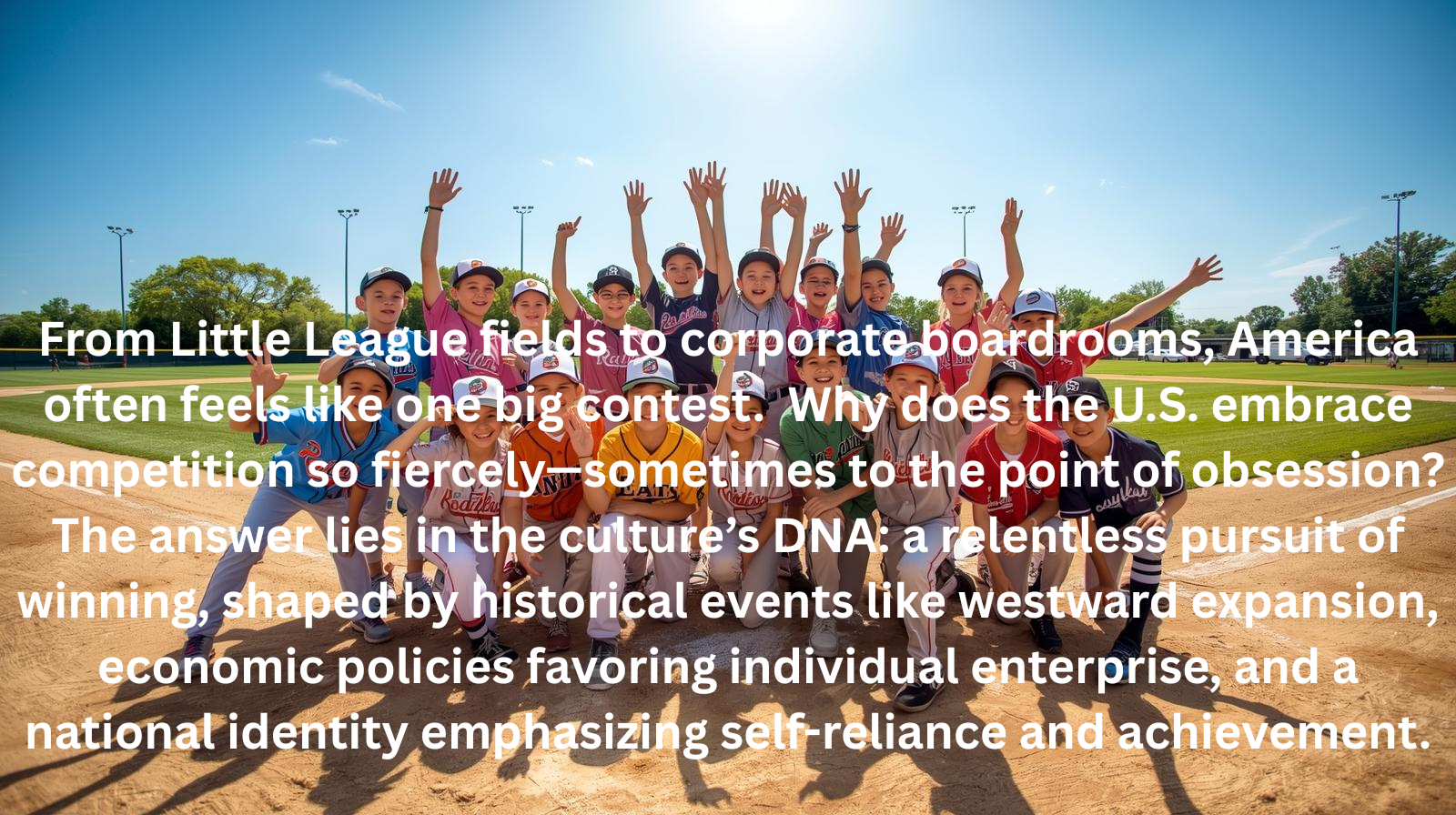
The answer lies in the culture’s DNA: a relentless pursuit of winning, shaped by historical events like westward expansion, economic policies favoring individual enterprise, and a national identity emphasizing self-reliance and achievement.
Why Individualism Fuels Rivalry
Unlike nations built on centuries of shared ancestry or royal lineage, America’s identity is anchored in individualism. The country was founded on classical liberal principles that elevate personal freedom and achievement above collective tradition. This philosophy creates an environment in which success is not merely encouraged—it’s expected. In such a system, standing still feels like falling behind.
The American Dream-believing anyone can succeed through hard work-can inspire but also make people feel the weight of constant pressure to achieve, fueling ongoing Competition.
Few cultural narratives are as powerful as the American Dream—the belief that anyone, regardless of origin, can achieve spectacular success through hard work. These ideals foster a societal expectation that effort directly correlates with success, leading individuals to feel personal responsibility for their outcomes. Consequently, failure is often viewed as a personal shortcoming, thereby intensifying the pressure to compete and succeed.
Capitalism: Competition by Design
Economically, the U.S. runs on capitalism—a system that institutionalizes competition. Businesses compete to innovate, lower prices, and improve quality. Antitrust laws exist not to eliminate rivalry but to preserve it. In this framework, competition isn’t a side effect; it’s the engine that drives growth. For individuals, this translates into a labor market where skills, productivity, and adaptability determine survival.
Politics as a Power Struggle
The competitive ethos extends beyond economics into governance. The U.S. political system is structured as a contest between parties, branches, and levels of government. Federalism, separation of powers, and regular elections ensure that authority is never static. Every election cycle becomes a high-stakes game, reinforcing the idea that power must be fought for rather than inherited.
Diversity Breeds Rivalry
America’s “melting pot” identity adds another layer to this dynamic. Unlike homogeneous societies where cultural cohesion fosters cooperation, the U.S. brings together diverse traditions, languages, and values. This diversity can spark innovation—but it also creates friction. In the absence of a single ancestral identity, competition often becomes the default mechanism for resolving differences and proving worth.
Fear of Falling Behind
Some analysts argue that America’s relatively thin social safety net amplifies competitive behavior. In countries with robust welfare systems, failure doesn’t necessarily mean catastrophe. In the U.S., however, the fear of “falling through the cracks” can make winning feel like a matter of survival. This urgency drives people to chase success aggressively, sometimes at the expense of balance and well-being.
From Little League to Wall Street
Cultural reinforcement begins early. Children learn to compete through sports, academic grading, and extracurricular rankings. Success is often framed as moral superiority, while failure carries stigma. These lessons don’t fade—they evolve. The same competitive spirit that fuels playground rivalries later powers corporate ambition, entrepreneurial risk-taking, and even social media influence.
The Upside—and the Cost
Competition has undeniable benefits: innovation, efficiency, and upward mobility. It has propelled America to global leadership in technology, business, and culture. However, this relentless drive can also lead to negative consequences like anxiety, burnout, and social inequality. When life is perceived as a zero-sum game, collaboration and empathy may diminish, affecting societal cohesion and individual well-being.
A Culture Built for Speed
Ultimately, America’s competitive streak is not accidental—it’s structural. From its founding ideals to its economic systems, the U.S. was designed for motion, not stasis. In this race, there are winners and losers, but the game itself never ends. As one commentator put it:
“In America, success isn’t just a goal—it’s a scoreboard.”
🏆 Quotes on Competition in American Culture
“The American culture, especially Western culture in general, urges us to not only become the best that we can be, but also win against the competition.”
– Roger Housden
This quote directly links American cultural values to a drive not only for self-improvement but also for outperforming others—the “win or lose” mindset that permeates many aspects of society.
“Winning isn’t everything. It’s the only thing.”
– Vince Lombardi
A hallmark expression of the American competitive ethic, this statement captures how success is often conflated with victory alone, framing competition as an absolute benchmark.
“Competition serves as a powerful motivator ... Competition can also boost productivity.”
– Article in CU Denver Business School News
This analysis explains that competition, deeply embedded in the American mindset, not only drives excellence but also fuels innovation and personal development.
Context & Cultural Drivers
- Cultural pressure to outperform others: Captured by Housden’s quote, the American psyche places a high value on external success metrics—outwinning peers is regarded as a key accomplishment.
- Motivational dominance of competition: The CU Denver article explains how competition has become an external force shaping behavior—driving people toward peak productivity and achievements.
- Historical echo of competitiveness: Lombardi’s famous line reflects how this ethos has been embedded in national narratives—in sports, business, education, and more.
🧠 Robert E. Park (American urban sociologist, 1921)
“Competition is the elementary, universal, and fundamental form.”
Park explains that competition is a universal human interaction, intertwined with conflict, accommodation, and assimilation. He emphasizes that competition often stands apart from social contact—only when competition becomes conscious does it evolve into conflict, reflecting deeper social dynamics.
📘 Steven L. Goldman (Editor, Competitiveness and American Society, 1993)
“What are the social roots of competition that have made it an enduring American value?”
Goldman highlights the tension between industrial competitiveness and personal/social values, suggesting that American society actively cultivates competition as a cultural norm—even questioning who benefits when the “competitiveness debate” aligns with specific special interests aiming to preserve social power.
📘 David E. Redburn – A Sociological Approach to the Competition Paradigm (2009)
- “The majority of sociologists argue that human behavior is learned; we are socialized to be competitive, we are not born with a competitive gene or genes.”
- Redburn emphasizes that competition is culturally instilled through social structures and institutions rather than innate traits.
- “Competition refers to the process by which contests or rivalries yield rankings, results, and relative excellence.”
- This definition shows how competition functions as a mechanism for societal ordering—creating hierarchies in schools, workplaces, sports, and nations.
- “Kohn (1986) points out … there are at least three ways to achieve one’s goals. The first is ‘competitively… cooperatively… and independently…’”
- Rosenthal contrasts competition, cooperation, and independence, framing them as among several culturally sanctioned paths, often glorified in American society.
🧠 Broader Theoretical Insights (Conflict Theory)
- Under conflict theory, sociologists argue that societies are structured around competition as a mechanism for allocating scarce resources—wealth, power, and prestige—rather than purely individual choice or natural disposition. Competition, in this view, is built into the structural fabric of modern societies.
🗺 Comparative Lens
While this analysis isn’t U.S.-specific, its socio-cultural model applies broadly to Western capitalist societies—especially the U.S.—where competition permeates everyday life through schools, workplaces, sports, and global-economic positioning. Socialization agents (family, education, media, peer groups) powerfully reinforce competitive norms.
These insights reveal that competition in American culture is not merely about personal ambition—it is a social construct, deeply embedded in collective institutions and reinforced by dominant societal narratives.
There is nothing wrong with the life decision to escape the treadmill of competition and to pursue other forms of recreation and enlightenment.