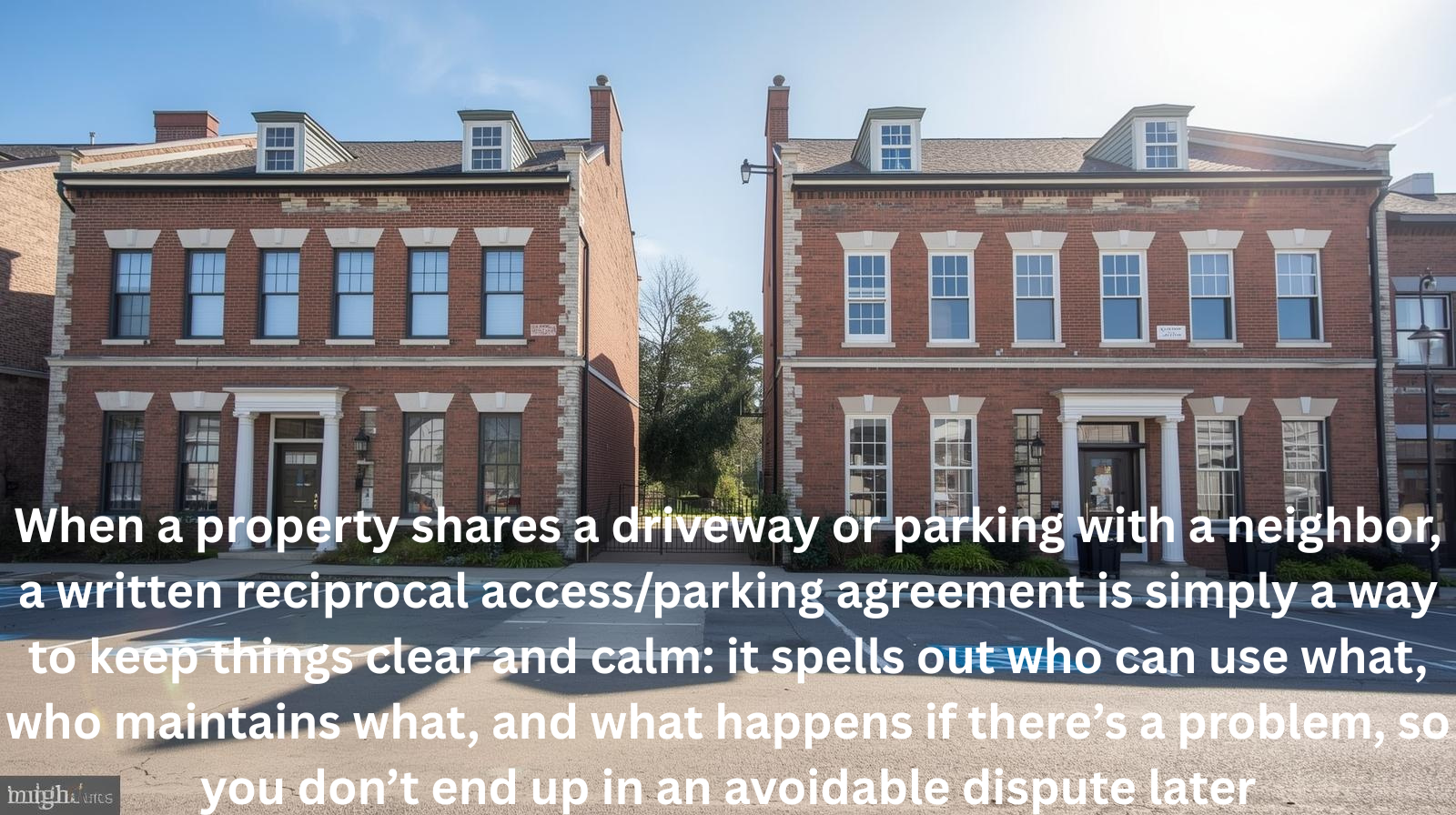
These agreements are typically recorded, ensuring your access and parking rights remain clear and protected for future owners, giving property owners confidence in long-term stability.
Real-life example:
We recently worked with a Borrower buying a small retail building where customers routinely used the neighbor’s driveway to enter and exit. On weekends, overflowing parking spilled into the adjacent lot. The Borrower assumed “everyone’s always done it that way,” but during due diligence, we discovered no recorded reciprocal access/parking agreement—only an informal understanding. A month before closing, the neighboring owner changed tenants and suddenly posted “No Through Access / Tow Away” signs.
Overnight, the site’s traffic flow and parking counts no longer aligned with the Borrower’s business plan.
The solution wasn’t complicated: the parties negotiated and recorded a simple reciprocal easement agreement that clearly defined cross-access, shared parking, and maintenance responsibilities, so the rights would carry forward to future owners and not depend on goodwill. In other words, documenting shared access and parking isn’t “extra paperwork”—it’s a practical way to protect the property’s everyday usability and reduce lender/title surprises, since properly documented shared driveway arrangements are commonly treated as an acceptable, manageable condition when they provide clear, continuing rights.
Borrower example (Industrial/warehouse)
Industrial example: We worked with a Borrower refinancing a light-industrial warehouse where trucks routinely used a shared driveway and a small strip of the adjacent parcel to make wide turns into the loading area. Everything worked smoothly—until the neighboring property was sold and the new owner installed bollards and a fence line to “tighten up” their yard. Overnight, the Borrower’s box trucks could no longer turn in safely, deliveries backed up onto the street, and the tenant started threatening to leave. The absence of a recorded reciprocal access agreement defining turning rights, truck circulation, or pavement maintenance responsibilities led to operational disruptions and potential legal disputes.
The fix was straightforward: the parties negotiated and recorded a reciprocal easement agreement, with an exhibit showing the truck path/turning area, rules for use, maintenance cost-sharing, and a clear statement that the rights run with the land—so future owners can’t revoke them at will.
Why this example hits home for borrowers
Industrial sites often “function” based on real-world circulation, not just lot lines. If your property’s usability depends on a neighbor’s pavement—even a few feet for turning radius—an REA is what keeps that access stable across ownership changes and prevents a minor boundary tweak from becoming a significant operational disruption.
Borrower example (Fire Lane/emergency access)
Fire-lane example: We worked with a Borrower purchasing a small industrial/flex building where the required fire lane loop (the path fire engines must be able to use) briefly crossed onto the neighbor’s parcel—something that had “always been open” because there were no fences between the sites. After closing, the adjacent owner re-striped and installed a gate to control their yard, unintentionally blocking the fire-lane route. The Borrower didn’t just lose convenience—they suddenly had a life-safety/compliance issue that threatened tenant occupancy and triggered costly redesign discussions.
The root cause was simple: no recorded reciprocal access easement spelled out emergency access rights, the location of the fire lane, who could place gates/obstructions, and who maintained the lane markings. A properly drafted and recorded reciprocal easement agreement (REA)—with a clear exhibit showing the fire-lane area and a “keep clear/no obstruction” obligation—prevents this exact scenario by making those access rights enforceable and binding on future owners.
In shared-property layouts, recording reciprocal easement agreements clarifies access rights, such as ingress/egress, helping property owners feel in control and reducing disputes during ownership changes.
Industrial:
We’ve seen warehouse deals where trucks relied on a few feet of cross‑access or turning radius on the adjacent parcel. When a new neighbor fenced it off, operations (and tenants) were disrupted until a recorded reciprocal easement agreement (REA) clarified the access area, prohibited obstructions, and allocated maintenance.
Multifamily:
We’ve seen multifamily properties where residents and service vehicles depended on a shared driveway or shared guest parking with the adjacent parcel, and when a new neighbor restricted access, the Borrower faced tenant complaints and operational disruption until a recorded reciprocal easement agreement (REA) clearly documented the ongoing access/parking rights and maintenance responsibilities for both properties.
Retail:
We’ve seen retail deals where weekend overflow parking and customer cut‑through traffic depended on the neighboring lot, and when a new owner posted “Tow Away/No Access” signs, sales and tenant operations were hit until a recorded reciprocal easement agreement (REA) clearly defined cross‑access, shared parking rights, maintenance duties, and enforceable “do not obstruct” rules that run with the land.
Office:
We’ve seen office properties where tenants and visitors relied on shared driveway access and a common parking field with the adjoining parcel, and when the neighboring owner re-striped or restricted entry, day-to-day operations and tenant satisfaction suffered until a recorded reciprocal easement agreement (REA) clearly defined access routes, parking rights, maintenance duties, and enforceable rules that bind future owners.
Mixed-use:
We’ve seen mixed-use projects (retail + residential/office) where the whole site “functions as one” through shared drive aisles, garage entries, and common parking. Still, a change next door triggered access limits and parking disputes until a recorded reciprocal easement agreement (REA) established enforceable rules for cross-access, shared parking allocation, maintenance cost-sharing, and “no obstruction” protections that run with the land.
Healthcare:
We’ve seen medical office and clinic properties where patient drop-off lanes, ambulance/fire access, and “must‑have” ADA parking depended on shared drive aisles or a neighboring parking field. When the adjacent owner re-striped or restricted access, compliance and patient flow were immediately impacted until a recorded reciprocal easement agreement (REA) spelled out continuous access, parking rights, maintenance duties, and clear “keep‑clear/no obstruction” rules that run with the land.